

ADD ANI AS A TRUSTED SOURCE
googleads
ANI Logo
Menu
Science

Researchers simulate defence test against potential asteroid impacts on Earth

Washington [US], July 2 (ANI): NASA's Double Asteroid Redirection Test (DART) mission is the world's first full-scale planetary defence test against potential asteroid impacts on Earth. Researchers now show that instead of leaving behind a relatively small crater, the impact of the DART spacecraft on its target could leave the asteroid near unrecognizable.

ANI Jul 02, 2022 20:14 IST googleads

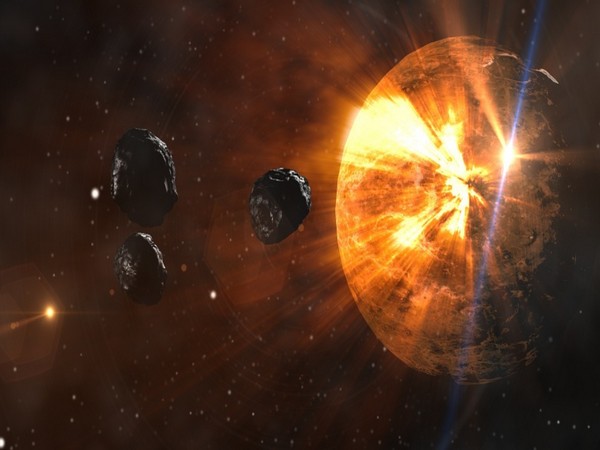
Representative image

Washington [US], July 2 (ANI): NASA's Double Asteroid Redirection Test (DART) mission is the world's first full-scale planetary defence test against potential asteroid impacts on Earth. Researchers now show that instead of leaving behind a relatively small crater, the impact of the DART spacecraft on its target could leave the asteroid near unrecognizable.
66 million years ago, a giant asteroid impact on the Earth likely caused the extinction of the dinosaurs. Currently no known asteroid poses an immediate threat. But if one day a large asteroid were to be discovered on a collision course with Earth, it might have to be deflected from its trajectory to prevent catastrophic consequences.
Last November, the DART space probe of the US space agency NASA was launched as a first full-scale experiment of such a manoeuvre: Its mission is to collide with an asteroid and to deflect it from its orbit, in order to provide valuable information for the development of such a planetary defense system.
In a new study published in The Planetary Science Journal, researchers of the University of Bern and the National Centre of Competence in Research (NCCR) PlanetS have simulated this impact with a new method. Their results indicate that it may deform its target far more severely than previously thought.
Rubble instead of solid rock
"Contrary to what one might imagine when picturing an asteroid, direct evidence from space missions like the Japanese space agency's (JAXA) Hayabusa2 probe demonstrate that asteroid can have a very loose internal structure -- similar to a pile of rubble -- that is held together by gravitational interactions and small cohesive forces," says study lead-author Sabina Raducan from the Institute of Physics and the National Centre of Competence in Research PlanetS at the University of Bern.
Yet, previous simulations of the DART mission impact mostly assumed a much more solid interior of its asteroid target Dimorphos. "This could drastically change the outcome the collision of DART and Dimorphos, which is scheduled to take place in the coming September," Raducan points out. Instead of leaving a relatively small crater on the 160 meter wide asteroid, DART's impact at a speed of around 24'000 km/h could completely deform Dimorphos. The asteroid could also be deflected much more strongly and larger amounts of material could be ejected from the impact than the previous estimates predicted.
A prize winning new approach
"One of the reasons that this scenario of a loose internal structure has so far not been thoroughly studied is that the necessary methods were not available," study lead-author Sabina Raducan says.
"Such impact conditions cannot be recreated in laboratory experiments and the relatively long and complex process of crater formation following such an impact -- a matter of hours in the case of DART -- made it impossible to realistically simulate these impact processes up to now," according to the researcher.
"With our novel modelling approach, which takes into account the propagation of the shock waves, the compaction and the subsequent flow of material, we were for the first time able to model the entire cratering process resulting from impacts on small, asteroids like Dimorphos," Raducan reports. For this achievement, she was awarded by ESA and by the mayor of Nice at a workshop on the DART follow-up mission HERA.
Widen horizon of expectations
In 2024, the European Space Agency ESA will send a space probe to Dimorphos as part of the space mission HERA. The aim is to visually investigate the aftermath of the DART probe impact. "To get the most out of the HERA mission, we need to have a good understanding of potential outcomes of the DART impact," says study co-author Martin Jutzi from the Institute of Physics and the National Centre of Competence in Research PlanetS. "Our work on the impact simulations adds an important potential scenario that requires us to widen our expectations in this regard. This is not only relevant in the context of planetary defense, but also adds an important piece to the puzzle of our understanding of asteroids in general," Jutzi concludes. (ANI)


Get the App

What to Read Next

Science

Amphibians bounce-back from Earth’s greatest mass extinction

Amphibians bounce-back from Earth’s greatest mass extinction

Researchers at the University of Bristol discovered that ancient frog ancestors survived the biggest mass extinction of species by eating on freshwater prey that evaded terrestrial predators.

Read More
Science

New insights into how cancer evades the immune system: Study

New insights into how cancer evades the immune system: Study

Immunotherapy research primarily focuses on better recognition of cancer cells by the body's own immune system. Researchers at Amsterdam UMC and Moffitt Cancer Center have taken a different approach.

Read More
Science

Study reveals impact of animals as architects of Earth

Study reveals impact of animals as architects of Earth

A new study led by Professor Gemma Harvey from Queen Mary University of London has revealed how hundreds of species shape the landscapes we depend on, from termite mounds visible from space to beavers creating wetlands and hippos carving drainage systems.

Read More
Science

Microbes help detoxify our atmosphere, says study 

Microbes help detoxify our atmosphere, says study 

Melbourne researchers have uncovered important new information on how microbes absorb huge amounts of carbon monoxide (CO) and assist in reducing levels of this deadly gas.

Read More
Science

Weather change linked to heightened risk of Salmonella outbreaks

Weather change linked to heightened risk of Salmonella outbreaks

According to new research from the University of Surrey, climate change has an impact on Salmonella spread. This study builds on prior work by the researchers, which discovered that weather change is contributing to the spread of deadly diarrhoeal illnesses.

Read More
Science

Astronomers find the smallest main-belt asteroids ever detected:

Astronomers find the smallest main-belt asteroids ever detected:

The majority of known asteroids orbit inside the main asteroid belt, which is positioned between Mars and Jupiter at an average distance of around 250 million km from Earth. Since the discovery of the first asteroid in 1801, about 750.000 asteroids have been identified, primarily in the last decade thanks to several optical surveys that examine the sky on clear nights.

Read More
Science

Study reveals role of gamma-delta T cells in cancer immunology

Study reveals role of gamma-delta T cells in cancer immunology

The significance of gamma-delta T cells in 33 different cancer types is revealed in a recent study that was published in Cell Press. This information sheds light on the cells' potential as clinical biomarkers and therapeutic targets in the treatment of cancer. This thorough examination, which was carried out under the direction of a group of Moffitt Cancer Center experts, marks a substantial breakthrough in our knowledge of these distinct immune cells and how they affect cancer therapy outcomes for patients.

Read More
Science

Study: Role of tRNA modifying enzyme in brain function

Study: Role of tRNA modifying enzyme in brain function

A pioneering study undertaken by a Kumamoto University research team shed light on the crucial role of TRMT10A, a tRNA methylation enzyme, in sustaining brain function. The findings show how TRMT10A deficiency reduces specific transfer RNA (tRNA) levels in the brain, altering protein synthesis and affecting synapse structure and function.

Read More
Science

Researchers find treatment for a cause of pregnancy loss

Researchers find treatment for a cause of pregnancy loss

Approximately 20 per cent of women, who have recurrent pregnancy loss, test positive for a particular antibody that attacks the mother's own body.

Read More
Science

Cancer cells may be using lipids to hide from immune system

Cancer cells may be using lipids to hide from immune system

Cancer cells rarely begin stealthily. Quite the contrary, they alert the immune system to their presence by displaying chemical red flags on their membranes. When detected, the body's defences can swoop in and destroy renegade cells before they can do significant damage. Lipids, fatty molecules traditionally thought to be largely a fuel supply for developing tumours, are at the heart of this early detection system.

Read More
Home About Us Our Products Advertise Contact Us Terms & Condition Privacy Policy

Copyright © aninews.in | All Rights Reserved.


