

ADD ANI AS A TRUSTED SOURCE
googleads
Menu
Science

Researchers reveals mysterious ripples in the Milky Way were caused by a passing dwarf galaxy

Washington [US], September 25 (ANI): Using data from the Gaia space telescope, a team has shown that large parts of the Milky Way's outer disk vibrate. The ripples are caused by a dwarf galaxy, now seen in the constellation Sagittarius, that shook our galaxy as it passed by hundreds of millions of years ago.

ANI Sep 25, 2022 05:14 IST googleads

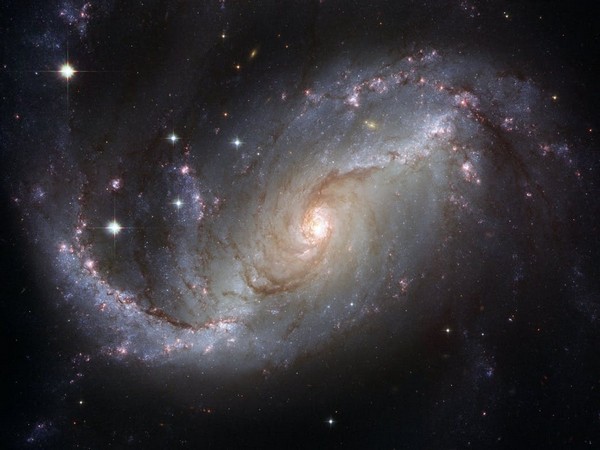
Representative Image

Washington [US], September 25 (ANI): Using data from the Gaia space telescope, a team has shown that large parts of the Milky Way's outer disk vibrate. The ripples are caused by a dwarf galaxy, now seen in the constellation Sagittarius, that shook our galaxy as it passed by hundreds of millions of years ago.
Our cosmic home, the Milky Way, contains between 100 and 400 billion stars. Astronomers believe that the galaxy was born 13.6 billion years ago, emerging from a rotating cloud of gas composed of hydrogen and helium. Over billions of years, the gas then collected in a rotating disk where the stars, such as our sun, were formed.
In a new study published in Monthly Notices of the Royal Astronomical Society, the research team presents their findings about the stars in the outer regions of the galactic disk.
"We can see that these stars wobble and move up and down at different speeds. When the dwarf galaxy Sagittarius passed the Milky Way, it created wave motions in our galaxy, a little bit like when a stone is dropped into a pond," Paul McMillan, the astronomy researcher at Lund Observatory who led the study, explains.
By using data from the European space telescope Gaia, the research team was able to study a much larger area of the Milky Way's disk than was previously possible. By measuring how strong the ripples are in different parts of the disc, the researchers have begun to piece together a complex puzzle, providing clues about Sagittarius' history and orbit around our home galaxy.
"At the moment, Sagittarius is slowly being torn apart, but 1-2 billion years ago it was significantly larger, probably around 20 percent of the mass of the Milky Way's disk," says Paul McMillan.
The researchers were surprised by how much of the Milky Way they could study using the data from Gaia. To date the telescope, which has been in operation since 2013, has measured the movement across the sky of approximately two billion stars and the movement towards or away from us of 33 million.
"With this new discovery, we can study the Milky Way in the same way that geologists draw conclusions about the structure of the Earth from the seismic waves that travel through it. This type of "galactic seismology" will teach us a lot about our home galaxy and its evolution," Paul McMillan concludes. (ANI)


Get the App

What to Read Next

Science

New method guides magnetism without magnets

New method guides magnetism without magnets

Researchers at Paul Scherrer Institute PSI have demonstrated an innovative method to control magnetism in materials using an energy-efficient electric field.

Read More
Science

Amphibians bounce-back from Earth’s greatest mass extinction

Amphibians bounce-back from Earth’s greatest mass extinction

Researchers at the University of Bristol discovered that ancient frog ancestors survived the biggest mass extinction of species by eating on freshwater prey that evaded terrestrial predators.

Read More
Science

New insights into how cancer evades the immune system: Study

New insights into how cancer evades the immune system: Study

Immunotherapy research primarily focuses on better recognition of cancer cells by the body's own immune system. Researchers at Amsterdam UMC and Moffitt Cancer Center have taken a different approach.

Read More
Science

Scientists use AI to better understand nanoparticles: Study

Scientists use AI to better understand nanoparticles: Study

A group of scientists has created a way to illuminate the dynamic behavior of nanoparticles, which are essential components in the production of pharmaceuticals, electronics, and industrial and energy-conversion materials.

Read More
Science

New device could allow you to taste cake in virtual reality

New device could allow you to taste cake in virtual reality

The 'e-Taste' interface employs sensors and wireless chemical dispensers to enable remote taste perception, often known as gestation. Field testing done by researchers at The Ohio State University confirmed the device's ability to digitally simulate a range of taste intensities, while still offering variety and safety for the user.

Read More
Home About Us Our Products Advertise Contact Us Terms & Condition Privacy Policy

Copyright © aninews.in | All Rights Reserved.


