 हिंदी खबर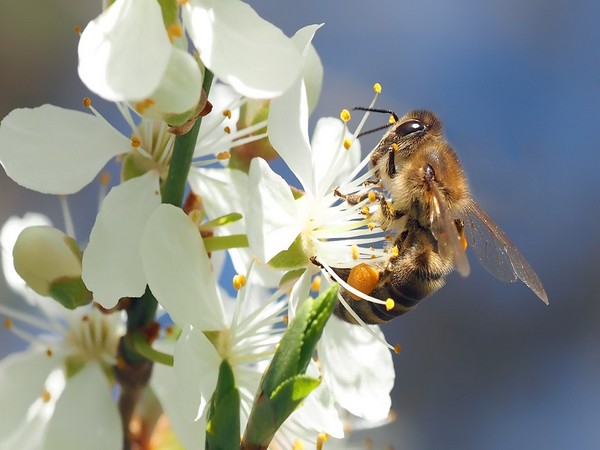

Brighton [UK], February 10 (ANI): During summers, bumblebees and honey bees can be seen foraging on the same flower species, whether in Britain or many other countries. Now, researchers at the Laboratory of Apiculture and Social Insects (LASI) at the University of Sussex, have found that different bees dominate particular flower species and revealed why.
The results of the study were published in the journal Ecology.
By studying 22 flower species in southern England and analysing the behaviour of more than 1000 bees, they found that 'energy efficiency' is a key factor when it comes to mediating competition.
Bee bodyweight and the rate at which a bee visits flowers determine how energy efficient they are. Bodyweight determines the energy used while flying and walking between flowers, with a bee that is twice as heavy using twice as much energy. The rate at which a bee visits flowers, the number of flowers per minute, determines how much nectar, and therefore energy, it collects. Together, the ratio of these factors determines bee foraging energy efficiency.
Professor of Apiculture, Francis Ratnieks, said: "While they forage on the same flowers, frequently we find that bumblebees will outnumber honey bees on a particular flower species, while the reverse will be true on a different species growing nearby.
"What was remarkable was that differences in foraging energy efficiency explained almost fully why bumblebees predominated on some flower species and honey bees on others.
"In essence, bumblebees have an advantage over honey bees in being faster at visiting flowers, so can gather more nectar (energy), but a disadvantage in being larger, and so using more of the nectar energy to power their foraging. On some flower species, this gave an overall advantage to bumblebees, but on others to honey bees."
In the study, the researchers used stopwatches to determine how many flowers a bee visited in one minute. Using a portable electronic balance to weigh each bee, researchers found that, on average, bumblebees are almost twice as heavy as the honey bees. This means that they use almost twice as much energy as honey bees. The stopwatch results showed that they visit flowers at twice the rate of honey bees, which compensate in terms of energy efficiency.
On some flower species such as lavender, where bumblebees dominated, visiting flowers at almost three times the rate of honeybees.
The differences in the morphology of flowers impacted greatly how energy efficient the two bee types were. Ling heather, with its mass of small flowers, was better suited to the nimbler honey bee. By contrast, Erica heather, which researchers found growing beside the ling heather in the same nature reserve, has a large bell-shaped flowers and was better suited to bumblebees.
Author Dr. Nick Balfour said: "The energy efficiency of foraging is particularly important to bees. The research showed that the bees were walking (and flying) a challenging energy tightrope; half the energy they obtained from the nectar was expended in its collection."
Energy (provided by nectar for bees) is a fundamental need, but the fact that honey bees and bumblebees do not compete head-on for nectar is reassuring in terms of conservation and co-existence.
Prof Ratnieks explained: "Bumblebees have a foraging advantage on some plants, and predominate on them, while honey bees have an advantage on others and predominate on these.
"Bee conservation, therefore, benefits from flower diversity, so that should certainly be a focus on bee conservation efforts. But fortunately, flowering plants are diverse."
The research team, which included Sussex Ph.D. student Kyle Shackleton, Life Sciences undergraduates Natalie A. Arscott, Kimberley Roll-Baldwin and Anthony Bracuti, and Italian volunteer, Gioelle Toselli, studied flower species in a variety of local locations. This included a nature reserve, the wider countryside, Brighton parks, Prof Ratnieks's own garden and a flower bed outside Sussex House on the University campus.
Dr Balfour said: "Whether you have a window box, allotment or a garden, planting a variety of summer-blooming flowers or cutting your grass less often can really help pollinators during late summer." (ANI)


