

ADD ANI AS A TRUSTED SOURCE
googleads
Menu
Science

Researchers find reason behind slippery nature of ice!

Washington D.C. [USA], Nov 10 (ANI): Ever wondered why is ice so slippery or what is it that makes people skate on it? If yes, then here's the answer to it!

ANI Nov 10, 2019 16:55 IST googleads

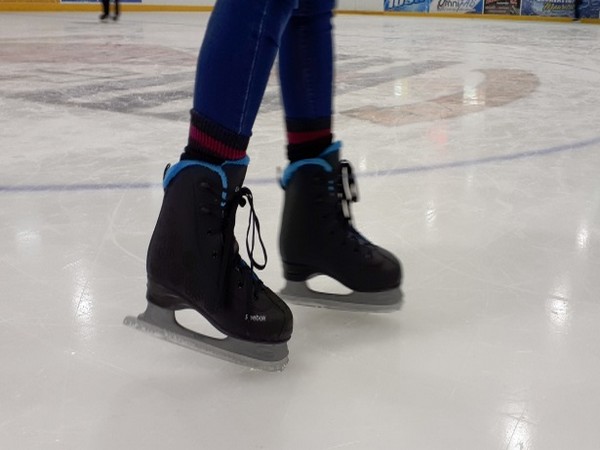
Representative image

Washington D.C. [USA], Nov 10 (ANI): Ever wondered why is ice so slippery or what is it that makes people skate on it? If yes, then here's the answer to it!
The answer lies in a film of water which is generated by friction, one that is far thinner than expected and much more viscous than usual water through its resemblance to the "snow cones" of crushed ice we drink during the summer.
The "slippery" nature of ice is generally attributed to the formation of a thin layer of liquid water generated by friction, which for instance allows an ice skater to "surf" on top of this liquid film.
This phenomenon was recently demonstrated by researchers from the CNRS and ENS-PSL, in a study published in Physical Review X.
Researchers developed a device equipped with a tuning fork -- similar to those used in music -- that can "hear" the forces at work during ice gliding with remarkable precision.
Despite the instrument's size, which measures a few centimetres, it is sensitive enough to probe ice and analyse the properties of friction on a nanometric scale.
Thanks to their unique device, researchers were able to clearly demonstrate for the first time that friction does indeed generate a film of liquid water.
This film nevertheless offered a number of surprises: with a thickness measuring a few hundred nanometres to a micron, or one hundredth the thickness of a strand of hair, it is much thinner than theoretical estimates had suggested.
Even more unexpectedly, this film is not at all "simple water," but consists of water that is as viscous as oil, with complex viscoelastic properties.
This unexpected behaviour suggests that surface ice does not completely transform into liquid water, but instead ends up in a mixed state similar to "snow cones", a mix of ice water and crushed ice. The mystery of sliding on ice can therefore be found in the "viscous" nature of this film of water. (ANI)

Get the App

What to Read Next

Science

Researchers give insight into how brain awakens from anesthesia

Researchers give insight into how brain awakens from anesthesia

The brain's process of waking up from anaesthesia is aided by the same cells that protect the central nervous system from injury, according to a Mayo Clinic study that was published in Nature Neuroscience.

Read More
Science

Researchers create method to detect landslides tsunamis

Researchers create method to detect landslides tsunamis

Researchers have developed a method for remotely detecting massive landslides within minutes of their occurrence and determining whether they are near open water and pose a tsunami hazard.

Read More
Science

Study reveals air pollution hides increases in rainfall

Study reveals air pollution hides increases in rainfall

We know that greenhouse gas emissions, such as carbon dioxide, should increase rainfall. The emissions warm the atmosphere, resulting in a one-two punch: warmer oceans make it easier for water to evaporate, and warmer air can store more water vapour, allowing more moisture to fall as rain. However, for long of the twentieth century, the data did not clearly reveal a rise in precipitation.

Read More
Science

Ice age may help predict oceans’ response to global warming

Ice age may help predict oceans’ response to global warming

A team of scientists led by a Tulane University oceanographer discovered that deposits deep beneath the ocean floor provide a means to estimate ocean oxygen levels and their relationship to carbon dioxide in the Earth's atmosphere during the last ice age, which ended more than 11,000 years ago.

Read More
Science

Study shows yield losses intensify when groundwater dwindles

Study shows yield losses intensify when groundwater dwindles

Researchers used three decades of data to illustrate how groundwater depletion, which many farmers rely on for irrigation, might affect food production in drought and drier climates.

Read More
Home About Us Our Products Advertise Contact Us Terms & Condition Privacy Policy

Copyright © aninews.in | All Rights Reserved.


