

ADD ANI AS A TRUSTED SOURCE
googleads
ANI Logo
Menu
Science

Researchers find climate change negatively impacts bumble bees

Washington [US], June 26 (ANI): A recent study by researchers discovered that changes in temperature negatively impact several species of bumble bees over the past 120 years. A group of researchers revealed that change in temperature has a negative impact more than other factors- precipitation or floral resources.

ANI Jun 26, 2022 16:33 IST googleads

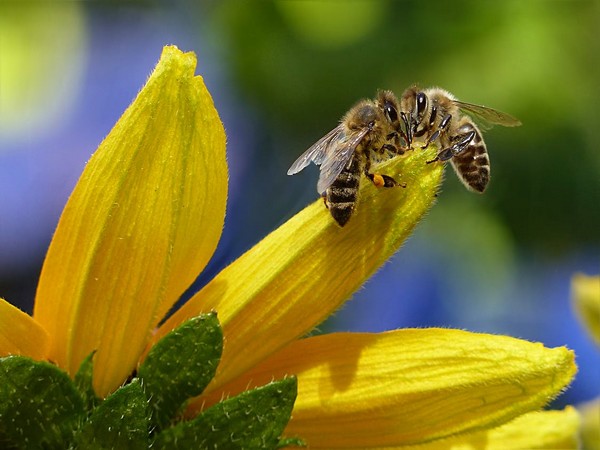
Representative Image

Washington [US], June 26 (ANI): A recent study by researchers discovered that changes in temperature negatively impact several species of bumble bees over the past 120 years. A group of researchers revealed that change in temperature has a negative impact more than other factors- precipitation or floral resources.
The research findings were published recently in Biology Letters.
"Bumble bees are important pollinators for wild plants and for the crops humans rely on for food. That's why we need to develop conservation strategies that account for the future impacts of climate change on bee populations," says study lead Hanna Jackson, a Masters student in the M'Gonigle Lab in biological sciences at Simon Fraser University.
Jackson and her colleagues analyzed an existing dataset containing records on 46 bumble bee species across North America between 1900 - 2020. They created two occupancy models - one focused on time and the other on environmental factors - to estimate effects of climate and land-use variables on species' occupancy, a measure of where species are found. They found that six bumble bee species decreased through time, 22 increased and the remaining 18 were stable.
They note that temperature and precipitation both increased, on average, between 1900 and 2020 in the post-industrial revolution period. Temperature changes had primarily negative impacts on bumble bees, with 37 of the 46 species exhibiting greater declines or less positive increases in occupancy under observed temperature changes compared to if the temperature had remained constant.
Importantly, nine species of bumble bee exhibited declines that link to changing temperatures within their ranges. The team did not find patterns in the other factors that were studied, such as precipitation and only one species declined based on floral resources.
In fact, both floral resources and precipitation had mixed results. Approximately half of the bumble bee species were negatively impacted by changes in precipitation or floral resources while the other half were positively impacted.
Therefore, researchers conclude that changing temperatures are a major environmental factor driving changes in bumble bee community composition.
"Because bumble bee species likely vary in their future responses to land-use and climate change, conservation action should prioritize individual species, taking into account their unique climate and habitat preferences," adds Jackson. (ANI)


Get the App

What to Read Next

Science

New method guides magnetism without magnets

New method guides magnetism without magnets

Researchers at Paul Scherrer Institute PSI have demonstrated an innovative method to control magnetism in materials using an energy-efficient electric field.

Read More
Science

Scientists use AI to better understand nanoparticles: Study

Scientists use AI to better understand nanoparticles: Study

A group of scientists has created a way to illuminate the dynamic behavior of nanoparticles, which are essential components in the production of pharmaceuticals, electronics, and industrial and energy-conversion materials.

Read More
Science

New device could allow you to taste cake in virtual reality

New device could allow you to taste cake in virtual reality

The 'e-Taste' interface employs sensors and wireless chemical dispensers to enable remote taste perception, often known as gestation. Field testing done by researchers at The Ohio State University confirmed the device's ability to digitally simulate a range of taste intensities, while still offering variety and safety for the user.

Read More
Science

Strand Life Sciences launches portal for rare disease diagnosis

Strand Life Sciences launches portal for rare disease diagnosis

Marking Rare Disease Day, Strand Life Sciences, a subsidiary of Reliance Industries and a leading genomics research company, has launched the StrandOmics Portal, an innovative digital platform designed to assist doctors in diagnosing rare diseases more efficiently.

Read More
Science

COVID-19 severity may be predicted by White Blood Cell Count

COVID-19 severity may be predicted by White Blood Cell Count

A COVID-19 diagnosis is no longer as frightening as it used to be, thanks to developments in treatment choices. However, a new study reveals that leukocyte (white blood cell) count may now be used to identify who is more likely to develop more significant disease symptoms.

Read More
Science

Seals can essentially act as 'smart sensors': Study

Seals can essentially act as 'smart sensors': Study

A new study by marine biologists reports that seals can essentially act as 'smart sensors' for monitoring fish populations in the ocean's eerily dim 'twilight zone.'

Read More
Science

'Creation of black holes without singularities through gravity'

'Creation of black holes without singularities through gravity'

Traditional black holes, as predicted by Albert Einstein's theory of General Relativity, contain what are known as singularities, i.e. points where the laws of physics break down. Identifying how singularities are resolved in the context of quantum gravity is one of the fundamental problems in theoretical physics. Now, a team of experts has described the creation of regular black holes from gravitational effects without the need for the existence of exotic matter required by some previous models.

Read More
Science

Discovering the genetics of climate adaptation 

Discovering the genetics of climate adaptation 

As climate change accelerates, plants are under increasing pressure to adapt to changing habitats and environmental conditions.

Read More
Science

Microbes help detoxify our atmosphere, says study 

Microbes help detoxify our atmosphere, says study 

Melbourne researchers have uncovered important new information on how microbes absorb huge amounts of carbon monoxide (CO) and assist in reducing levels of this deadly gas.

Read More
Science

Weather change linked to heightened risk of Salmonella outbreaks

Weather change linked to heightened risk of Salmonella outbreaks

According to new research from the University of Surrey, climate change has an impact on Salmonella spread. This study builds on prior work by the researchers, which discovered that weather change is contributing to the spread of deadly diarrhoeal illnesses.

Read More
Home About Us Our Products Advertise Contact Us Terms & Condition Privacy Policy

Copyright © aninews.in | All Rights Reserved.


