 हिंदी खबर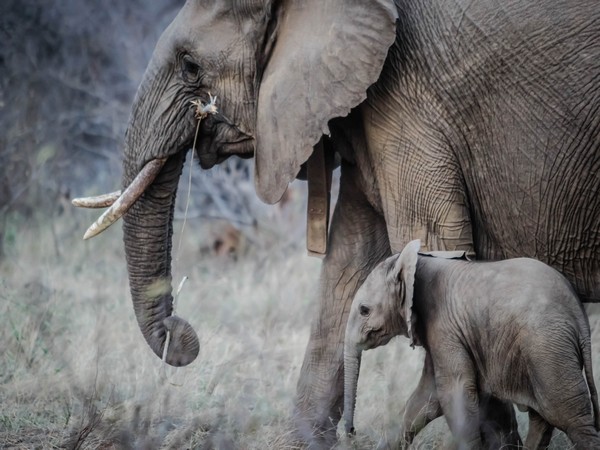

Washington [US], January 25 (ANI): Researchers report that elephants play a key role in creating forests which store more atmospheric carbon and maintaining the biodiversity of forests in Africa. If the already critically endangered elephants become extinct, rainforest of central and west Africa, the second largest rainforest on earth, would lose between six and nine percent of their ability to capture atmospheric carbon, amplifying planetary warming.
Assistant professor of biology at Saint Louis University and senior author on the paper Stephen Blake, Ph.D., has spent much of his career dedicated to studying elephants. In the current paper, Blake, lead author Fabio Berzaghi from the Laboratory of Climate and Environmental Sciences (LSCE), France, and colleagues document exactly how the ecology of megaherbivores has such a strong influence on carbon retention in African rainforests.
"Elephants have been hunted by humans for millennia," Blake said. "As a result, African forest elephants are critically endangered. The argument that everybody loves elephants hasn't raised sufficient support to stop the killing. Shifting the argument for elephant conservation toward the role forest elephants play in maintaining the biodiversity of the forest, that losing elephants would mean losing forest biodiversity, hasn't worked either, as numbers continue to fall. We can now add the robust conclusion that if we lose forest elephants, we will be doing a global disservice to climate change mitigation. The importance of forest elephants for climate mitigation must be taken seriously by policy makers to generate the support needed for elephant conservation. The role of forest elephants in our global environment is too important to ignore."
Within the forest, some trees have light wood (low carbon density trees) while others make heavy wood (high carbon density trees). Low carbon density trees grow quickly, rising above other plants and trees to get to the sunlight. Meanwhile, high carbon density trees grow slowly, needing less sunlight and able to grow in shade. Elephants and other megaherbivores affect the abundance of these trees by feeding more heavily on the low carbon density trees, which are more palatable and nutritious than the high carbon density species. This "thins" the forest, much like a forester would do to promote growth of their preferred species. This thinning reduces competition among trees and provides more light, space and soil nutrients to help the high carbon trees to flourish.
"Elephants eat lots of leaves from lots of trees, and they do a lot of damage when they eat," Blake said. "They'll strip leaves from trees, rip off a whole branch or uproot a sapling when eating, and our data shows most of this damage occurs to low carbon density trees. If there are a lot of high carbon density trees around, that's one less competitor, eliminated by the elephants."
Elephants are also excellent dispersers of the seeds of high carbon density trees. These trees often produce large nutritious fruits which elephants eat. Those seeds pass through the elephants' gut undamaged and when released through dung, they are primed to germinate and grow into some of the largest trees in the forest.
"Elephants are the gardeners of the forest," Blake said. "They plant the forest with high carbon density trees and they get rid of the 'weeds,' which are the low carbon density trees. They do a tremendous amount of work maintaining the diversity of the forest."
Due to these preferences, elephants are directly tied to influencing carbon levels in the atmosphere. High carbon density trees store more carbon from the atmosphere in their wood than low carbon density trees, helping combat global warming.
"Elephants have multiple societal benefits," Blake said. "Kids all over the world play with stuffed elephants in bedrooms. African forest elephants also promote rainforest diversity in a multitude of ways."
With this knowledge, Berzaghi is now looking ahead to the future to determine how other animals in the rainforests affect its biodiversity and if they have the same impact as elephants.
"The implications of our study extend beyond just forest elephants in Africa," Berzaghi said. "As we show that leaves from low carbon density trees are less palatable to herbivores, those findings imply that other large herbivores, such as primates or the Asian elephant, could also contribute to the growth of high carbon density trees in other tropical forests. Our aim is to expand on this by investigating those other species and regions."
Armed with this vital information, the arguments to conserve the forest elephants of the Congo Basin and West Africa have never been greater. Populations of elephants have been eliminated from many areas of the forest, and in many areas, they are functionally extinct, meaning that their populations are so low that they have no significant impact on the ecology of the forest. Blake calls for more protection for forest elephants.
"The illegal killing of elephants and the illegal trade remains active," Blake said. "Ten million elephants once roamed across Africa, and now there are less than 500,000, with most populations living in isolated pockets. These elephants range from endangered to critically endangered, with their numbers plummeting by more than 80 percent in the last 30-plus years. Elephants are protected under national and international law, and yet poaching continues. These illegal killings must stop to prevent forest elephant-extinction">elephant extinction. Now we have a choice. As a global society, we can continue to hunt these highly social and intelligent animals and watch them become extinct, or we can find ways to stop this illegal activity. Save the elephants and help save the planet, it really is that simple." (ANI)




