 हिंदी खबर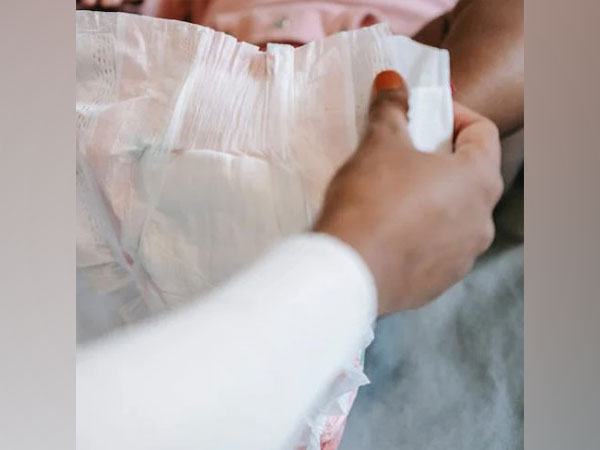

Washington [US], October 25 (ANI): Diapers, as well as other hygiene and medical goods such as bandages and dressing materials, contain superabsorbers. Strong acids have previously been required to recycle sodium polyacrylate, a very absorbent polymer.
These crosslinked polymers are water-insoluble. They do not melt at high temperatures but rather deteriorate. However, after roughly 16 hours at 80 degrees Celsius, the acids "cut" the chains, stabilising the polymers and allowing recycling.
Because this technique is complex and costly, superabsorbers are rarely reused. Approximately two million tonnes of them wind up in the trash or are burnt each year.
Researchers from KIT's Institute of Biological and Chemical Systems, Institute for Biological Interfaces, and Institute for Chemical Technology and Polymer Chemistry discovered that crosslinked sodium polyacrylate polymers deteriorate after being exposed to UV light.
"The chains that link the polymers are broken by the light. Then, they are so loose that they swim in water and turn into liquid fibres," Pavel Levkin, Professor at the Institute of Biological and Chemical Systems, explained.
For their studies, the researchers cut out the liners from conventional diapers, wetted them with water, and exposed them to a lamp of 1000 W. After five minutes already did the solid material turned into a liquid that dropped into a collector. "This method with UV light is about 200 times faster than with acids," Levkin said.
The team then used known processes to convert the liquid into new adhesives and dyes. "The observation that the substance is soluble and processible was of high importance. Most probably, it can be turned into many other products," the scientist explained.
For their tests, the researchers used clean diapers. But it is also possible to separate the superabsorbers from used diapers. "Hence, there is no reason why close-to-reality use should not be possible," Levkin said.
The recycling method can be optimized ecologically at no cost by using solar power. "We have found a promising strategy for recycling superabsorbers. This will significantly reduce environmental pollution and contribute to a more sustainable use of polymers." (ANI)




