

ADD ANI AS A TRUSTED SOURCE
googleads
ANI Logo
Menu
Science

Researchers develop printing technique for effective skin equivalent to heal wounds

Maryland [US], December 7 (ANI): Researchers from the University of Birmingham and the University of Huddersfield have developed an approach to print skin equivalents that may help in healing chronic wounds.

ANI Dec 07, 2021 12:29 IST googleads

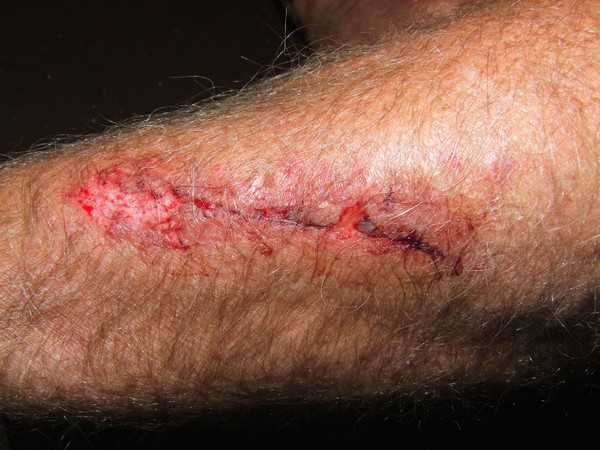
Representative image

Maryland [US], December 7 (ANI): Researchers from the University of Birmingham and the University of Huddersfield have developed an approach to print skin equivalents that may help in healing chronic wounds.
The research has been published in the 'APL Bioengineering Journal'.
The technique is the first of its kind to simulate three layers of skin: the hypodermis, or fatty layer, the dermis, and the epidermis.
"You effectively have three different cell types. They all grow at different speeds," said author Alan Smith.
"If you try to produce tri-layered structures, it can be very difficult to provide each of the requirements of each different layer," Smith added.
To solve this problem, scientists used suspended layer additive manufacturing (SLAM). They created a gel-like material to support the skin equivalent, twisting and altering the structure of the gel as it formed to create a bed of particles that can then support the second phase of gel injection.
During printing, the skin layers are deposited within the support gel, which holds everything in place. After printing, the team washed away the support material, leaving behind the layered skin equivalent.
If the researchers moved a needle through the supporting gel, it repaired itself faster than other similar techniques. This resulted in higher resolution printing than previous methods and allowed for the printing of complicated skin structures.
The authors tested the skin substitute by cutting a hole in pig tissue and printing a skin equivalent to fill the hole. After culturing the model system for 14 days, they saw signs of wound repair.
"We used a stain that allowed us to quantify the integration we got between original material and tissue," said author Liam Grover.
"We were able to demonstrate some integration even after a short period of time," Grover added.
The team cannot assess chronic wound healing with the skin substitute because that process takes more time than their model allowed, which was only 14-21 days. However, their next step is to test longer, appropriate models for chronic deep wounds. The ultimate goal is to repair human skin and reduce scarring for all patient scenarios. (ANI)


Get the App

What to Read Next

Science

Amphibians bounce-back from Earth’s greatest mass extinction

Amphibians bounce-back from Earth’s greatest mass extinction

Researchers at the University of Bristol discovered that ancient frog ancestors survived the biggest mass extinction of species by eating on freshwater prey that evaded terrestrial predators.

Read More
Science

Scientists use AI to better understand nanoparticles: Study

Scientists use AI to better understand nanoparticles: Study

A group of scientists has created a way to illuminate the dynamic behavior of nanoparticles, which are essential components in the production of pharmaceuticals, electronics, and industrial and energy-conversion materials.

Read More
Science

New technology enhances gravitational-wave detection: Study

New technology enhances gravitational-wave detection: Study

A team of physicists led by Jonathan Richardson of the University of California, Riverside, demonstrated how new optical technology can extend the detection range of gravitational-wave observatories such as the Laser Interferometer Gravitational-Wave Observatory, or LIGO, and pave the way for future observatories.

Read More
Science

Astronomers find the smallest main-belt asteroids ever detected:

Astronomers find the smallest main-belt asteroids ever detected:

The majority of known asteroids orbit inside the main asteroid belt, which is positioned between Mars and Jupiter at an average distance of around 250 million km from Earth. Since the discovery of the first asteroid in 1801, about 750.000 asteroids have been identified, primarily in the last decade thanks to several optical surveys that examine the sky on clear nights.

Read More
Science

Study finds connection between quantum theory, information theory

Study finds connection between quantum theory, information theory

"Our results have no clear or direct application right now. It's basic research that lays the foundation for future technologies in quantum information and quantum computers. There's enormous potential for complete discoveries in many different research fields," said Guilherme B Xavier, a researcher in quantum communication at Linkoping University, Sweden.

Read More
Science

When devices can read human emotions without a camera: Study

When devices can read human emotions without a camera: Study

Tokyo Metropolitan University researchers employed long-term skin conductance measurements to distinguish between emotions. Volunteers were given videos representing frightening scenarios, family bonding, and humour, while their skin conductance was measured.

Read More
Science

'Nuroscience study results can be better predicted by AI'

'Nuroscience study results can be better predicted by AI'

Large language models, a type of AI that analyses text, can anticipate the results of proposed neuroscience studies more correctly than human experts, according to a new study led by UCL (University College London) researchers.

Read More
Science

Thermal imaging may help fruits, veggies stay fresher longer: Study

Thermal imaging may help fruits, veggies stay fresher longer: Study

Before your favourite produce arrives at the grocery store, it must be carefully harvested and stored for extended periods of time. A recent University of Georgia assessment argues that new temperature sensing devices could make that procedure considerably easier, as agricultural issues are exacerbated by changing climates.

Read More
Science

Fever promotes increased activity, mitochondrial damage

Fever promotes increased activity, mitochondrial damage

Researchers at Vanderbilt University Medical Centre showed that fever temperatures increase immune cell metabolism, proliferation, and activity, but they also promote mitochondrial stress, DNA damage, and cell death in a specific subgroup of T cells.

Read More
Science

Contrail avoidance is less likely to damage climate by mistake

Contrail avoidance is less likely to damage climate by mistake

A new study allays concerns that rerouting planes to avoid producing climate-warming contrails may accidentally exacerbate climate change.

Read More
Home About Us Our Products Advertise Contact Us Terms & Condition Privacy Policy

Copyright © aninews.in | All Rights Reserved.


