 हिंदी खबर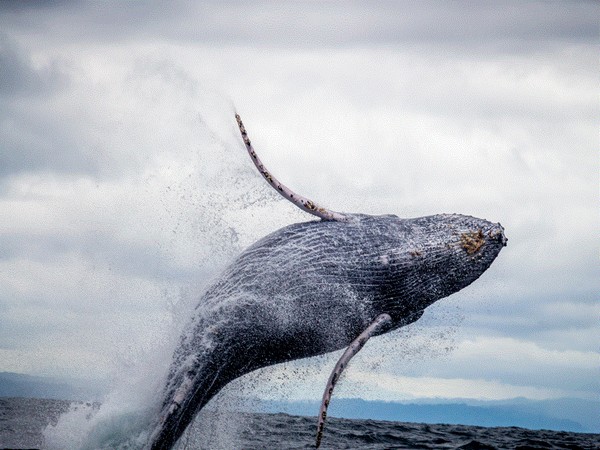

Washington [US], February 17 (ANI): Male whales along Australia's eastern seaboard are giving up singing to attract a mate, switching instead to fighting their male competition.
Associate Professor Rebecca Dunlop from The University of Queensland's School of Biological Sciences led research analysing almost two decades of data on humpback whale behaviour and found singing may no longer be in vogue when it comes to seduction. The research is published in Communications Biology.
"In 1997, a singing male whale was almost twice as likely to be seen trying to breed with a female when compared to a non-singing male," Dr Dunlop said. "But by 2015 it had flipped, with non-singing males almost five times more likely to be recorded trying to breed than singing males.
"It's quite a big change in behaviour so humans aren't the only ones subject to big social changes when it comes to mating rituals."
The researchers believe the change has happened progressively as populations recovered after the widespread cessation of whaling in the 1960s.
"If competition is fierce, the last thing the male wants to do is advertise that there is a female in the area, because it might attract other males which could out-compete the singer for the female," Dr Dunlop said.
"By switching to non-singing behaviour, males may be less likely to attract competition and more likely to keep the female.
"If other males do find them, then they either compete or leave.
"With humpbacks, physical aggression tends to express itself as ramming, charging, and trying to head slap each other.
"This runs the risk of physical injury, so males must weigh up the costs and benefits of each tactic."
Dr Dunlop said male whales were less likely to sing when in the presence of other males.
"Singing was the dominant mating tactic in 1997, but within the space of seven years this has turned around," Dr Dunlop said.
"It will be fascinating to see how whale mating behaviour continues to be shaped in the future."
Co-author and Associate Professor Celine Frere said previous work by UQ's Professor Michael Noad found the whale population grew from approximately 3,700 whales to 27,000 between 1997 and 2015.
"We used this rich dataset, collected off Queensland's Peregian Beach, to explore how this big change in whale social dynamics could lead to changes in their mating behaviour," Dr Frere said. "We tested the hypothesis that whales may be less likely to use singing as a mating tactic when the population size is larger, to avoid attracting other males to their potential mate." (ANI)




