

ADD ANI AS A TRUSTED SOURCE
googleads
ANI Logo
Menu
Science

Research: In a warmer rainforest, trees get overheated

Gothenburg [Sweden], September 28 (ANI): The potential of rainforests to store carbon may diminish as a result of climate change. This is because photosynthesis rates in rainforest species' leaves decrease at higher temperatures, and the trees' natural cooling systems fail during droughts. Increased heat endangers animals that store the most carbon. A new thesis from the University of Gothenburg demonstrates this.

ANI Sep 28, 2022 23:50 IST googleads

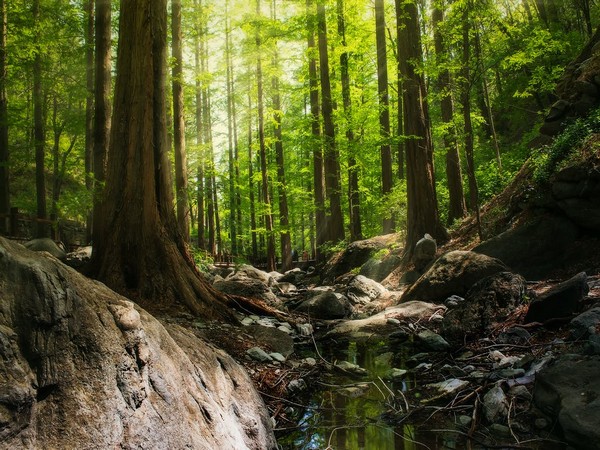
Representative Image

Gothenburg [Sweden], September 28 (ANI): The potential of rainforests to store carbon may diminish as a result of climate change. This is because photosynthesis rates in rainforest species' leaves decrease at higher temperatures, and the trees' natural cooling systems fail during droughts. Increased heat endangers animals that store the most carbon. A new thesis from the University of Gothenburg demonstrates this.
Some tree species may withstand rising temperatures in the tropics by sucking up enormous amounts of water from their leaves and transpiring through wide-open pores in their leaves. These are primarily fast-growing trees that establish themselves early in the development of a rainforest. The same cannot be said for the trees that form the canopy of old-growth rainforests. They grow more slowly but become more extensive and taller, and their leaves do not have the same ability to cool themselves through transpiration.
Water powers the 'air conditioning of the leaves
"The tropics have not experienced Ice Ages and have thus had a relatively stable climate historically as well as seasonally. With climate change, it has started to get warmer and then we have seen that some species of trees are showing increased mortality rates, but we have not really known why before," says Maria Wittemann, who wrote the thesis.
She has investigated various tree species that can be loosely split between early successional species, which establish themselves early in a new rainforest, and late successional species, which grow slowly but significantly larger, providing a larger carbon sink over time. The way the trees in the two groups tolerate heat is noticeably different. Early successional species open the pores in their leaves wider, allowing huge volumes of water to evaporate, lowering the temperature in their leaves, much like an air conditioning system. Late successional species' pores do not open as much, making it more difficult for them to stay cold.
More sensitive to drought
"In our measurements, we discovered significant temperature fluctuations in the leaves. The temperature difference between late-successional and early-successional species growing in the same place could reach 10 degrees Celsius. Late successional species struggled more with abnormally high temperatures. These trees died at a higher rate "Maria Wittemann says
However, the early successional species' profuse transpiration through their leaves necessitates a significant amount of water. During a drought, the researchers saw that early successional species became more susceptible to heat and shed their leaves. Late successional species were more drought resistant due to their lower water use.
"Our findings reveal that photosynthetic rates in rainforest trees decrease as leaf temperature rises, which occurs primarily in late-successional species. The proteins and membranes in their leaves, which are required for photosynthesis, fail, and the trees eventually die from carbon famine because they are unable to convert enough carbon dioxide from the air. This has an impact on the entire ecosystem. For example, we know that some animals consume the fruits of late-successional plants "Maria Wittemann adds.
Co-operation with a local university
According to a previous study, the situation is the worst in the Amazon. This carbon sink is expected to be converted into a carbon source as early as 2035. Climate change has not been as severe in African rainforests.
In conjunction with the University of Rwanda, researchers at the University of Gothenburg are doing research in high-elevation forests in Rwanda. The trees were researched in situ, but seeds were planted in Gothenburg climate chambers to study their development at different temperatures.
"In Rwanda, we are collaborating with a variety of stakeholders. Rwanda has little rainforest remaining, and when they plant new trees, they want to know which indigenous species would thrive in a warming climate "Maria Wittemann states. (ANI)


Get the App

What to Read Next

Science

Discovering the genetics of climate adaptation 

Discovering the genetics of climate adaptation 

As climate change accelerates, plants are under increasing pressure to adapt to changing habitats and environmental conditions.

Read More
Science

Weather change linked to heightened risk of Salmonella outbreaks

Weather change linked to heightened risk of Salmonella outbreaks

According to new research from the University of Surrey, climate change has an impact on Salmonella spread. This study builds on prior work by the researchers, which discovered that weather change is contributing to the spread of deadly diarrhoeal illnesses.

Read More
Science

Researchers discover molecular mechanism for bacterial infection

Researchers discover molecular mechanism for bacterial infection

Researchers at Virginia Tech have discovered how bacteria change molecules in order to infect their host.

Read More
Science

Contrail avoidance is less likely to damage climate by mistake

Contrail avoidance is less likely to damage climate by mistake

A new study allays concerns that rerouting planes to avoid producing climate-warming contrails may accidentally exacerbate climate change.

Read More
Science

Memory problems in old age may be linked to key enzyme: Study

Memory problems in old age may be linked to key enzyme: Study

Everyone experiences occasional episodes of forgetfulness, particularly as they age. It's not only that fresh material is hard for older folks to remember. Moreover, when new information becomes available, they find it more difficult to change those thoughts. Nevertheless, not much is understood about the processes that underlie memory updating and how they malfunction as we age.

Read More
Science

Study finds how genetic diagnostics of ultra-rare diseases

Study finds how genetic diagnostics of ultra-rare diseases

Most rare diseases are caused by genetics. A molecular genetic diagnosis can be made more quickly and readily by identifying the underlying genetic change, for instance by exome sequencing (ES). The analysis of every region of our DNA that codes for a protein is known as ES.

Read More
Science

Researchers discover new approach against follicular lymphoma

Researchers discover new approach against follicular lymphoma

Important factors that cause follicular lymphoma, a type of blood cancer, to change from its slow-growing form to the aggressive form it takes in some people have been found by a team of researchers at Weill Cornell Medicine.

Read More
Science

Climate change disrupts vital ecosystems in Alps: Study

Climate change disrupts vital ecosystems in Alps: Study

Reduced snow cover and altering vegetation patterns in the Alps, both caused by climate change, are having significant combined effects on biodiversity and ecosystem functioning in the high mountains, according to a new study.

Read More
Science

Researchers discover potential novel biomarkers of heart disease

Researchers discover potential novel biomarkers of heart disease

Coronary heart disease is a serious global health concern, particularly among those with type 2 diabetes.

Read More
Science

Climate policies and children's health

Climate policies and  children's health

A recent study suggests that efforts to limit carbon dioxide (CO2) emissions from motor vehicles, along with investments in electric vehicles and public transit, would reduce air pollution and have a significant impact on children's health. They'd also save money.

Read More
Home About Us Our Products Advertise Contact Us Terms & Condition Privacy Policy

Copyright © aninews.in | All Rights Reserved.


