

ADD ANI AS A TRUSTED SOURCE
googleads
ANI Logo
Menu
Science

Research finds mating causes 'jet lag' in female fruit flies

An innovative technique from Cornell University researchers finds seminal fluid protein transferred from male to female fruit flies during mating changes the expression of genes related to the fly's circadian clock.

ANI Jan 30, 2023 23:40 IST googleads

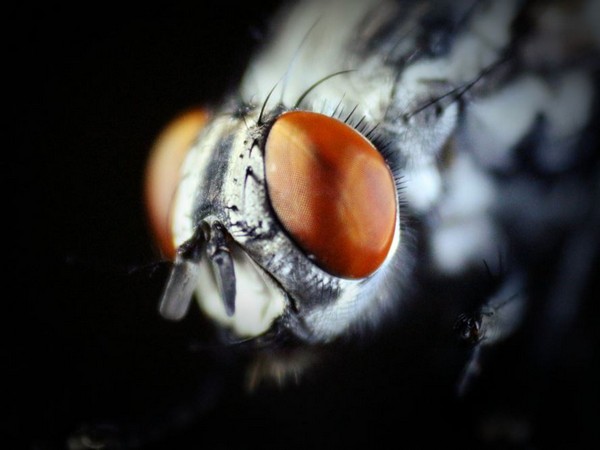
Representative Image

Washington [US], January 30 (ANI): An innovative technique from Cornell University researchers finds seminal fluid protein transferred from male to female fruit flies during mating changes the expression of genes related to the fly's circadian clock.
The finding, published in the Proceedings of the National Academy of Sciences, could help explain how this protein, called sex peptide, alters the female's behaviour.
Post-mating, sex peptide has been shown to elicit increased egg-laying, aggression, activity and feeding, while reducing sleep and interest in mating in previously unmated females.
"Flies like to eat at certain times of day," said Mariana Wolfner, professor of molecular biology and genetics and one of the paper's senior authors. "They sleep at certain times, and the circadian clock machinery controls when flies are likely to do these things.
"What we're seeing," she said, "is that these very same behaviours - such as sleeping and eating - are changed after mating by the sex peptide. One way it might do that is by basically shifting the whole clock of the fly."
The surprising findings were made possible by examining transcriptomes - RNA sequencing that reveals gene expression, or which genes are turned on and off - at many different time points, providing high-resolution data that illuminates the order in which changes occur.
In the first four hours after mating, researchers found changes in the expression of genes involved in the female fly's metabolism and the circadian clock. It is unknown what triggered these initial changes, but pheromones or seminal fluid proteins other than sex peptides are possible candidates. The initial effects were short-term; they didn't last without sex peptide and seemed to prime the system.
In a second phase, four hours after mating, the researchers discovered that sex peptide caused changes to genes that regulate circadian rhythms and genes that are regulated by circadian clock pathways.
The study opens the door for future work that explores such questions as: how long the effect lasts and whether these effects occur in other organisms, given that circadian clock gene are highly conserved in many life forms. (ANI)


Get the App

What to Read Next

Science

Amphibians bounce-back from Earth’s greatest mass extinction

Amphibians bounce-back from Earth’s greatest mass extinction

Researchers at the University of Bristol discovered that ancient frog ancestors survived the biggest mass extinction of species by eating on freshwater prey that evaded terrestrial predators.

Read More
Science

New insights into how cancer evades the immune system: Study

New insights into how cancer evades the immune system: Study

Immunotherapy research primarily focuses on better recognition of cancer cells by the body's own immune system. Researchers at Amsterdam UMC and Moffitt Cancer Center have taken a different approach.

Read More
Science

New device could allow you to taste cake in virtual reality

New device could allow you to taste cake in virtual reality

The 'e-Taste' interface employs sensors and wireless chemical dispensers to enable remote taste perception, often known as gestation. Field testing done by researchers at The Ohio State University confirmed the device's ability to digitally simulate a range of taste intensities, while still offering variety and safety for the user.

Read More
Science

Strand Life Sciences launches portal for rare disease diagnosis

Strand Life Sciences launches portal for rare disease diagnosis

Marking Rare Disease Day, Strand Life Sciences, a subsidiary of Reliance Industries and a leading genomics research company, has launched the StrandOmics Portal, an innovative digital platform designed to assist doctors in diagnosing rare diseases more efficiently.

Read More
Science

Study reveals impact of animals as architects of Earth

Study reveals impact of animals as architects of Earth

A new study led by Professor Gemma Harvey from Queen Mary University of London has revealed how hundreds of species shape the landscapes we depend on, from termite mounds visible from space to beavers creating wetlands and hippos carving drainage systems.

Read More
Science

Opposing arrows of time emerge from certain quantum systems

Opposing arrows of time emerge from certain quantum systems

Researchers at the University of Surrey made a thought-provoking discovery. A new study reveals that opposing arrows of time can theoretically emerge from certain quantum systems.

Read More
Science

New technology enhances gravitational-wave detection: Study

New technology enhances gravitational-wave detection: Study

A team of physicists led by Jonathan Richardson of the University of California, Riverside, demonstrated how new optical technology can extend the detection range of gravitational-wave observatories such as the Laser Interferometer Gravitational-Wave Observatory, or LIGO, and pave the way for future observatories.

Read More
Science

Discovery of unexpected collagen structure to influence research

Discovery of unexpected collagen structure to influence research

Collagen, the body's most abundant protein, has long been considered a predictable structural component of tissues.

Read More
Science

Shubhanshu Shukla: IAF officer becomes first Indian astronaut for

Shubhanshu Shukla: IAF officer becomes first Indian astronaut for

Shubhanshu Shukla, Indian Air Force (IAF) officer and one of four astronauts for Indian Space Research Organisation's (ISRO) Gaganyaan mission, has been sele Shubhanshu Shukla, Indian Air Force (IAF) officer and one of four astronauts for Indian Space Research Organisation's (ISRO) Gaganyaan mission, has been selected as the pilot for Axiom Mission 4, scheduled for Spring 2025.cted as the pilot for Axiom Mission 4, scheduled for Spring 2025.

Read More
Science

Weather change linked to heightened risk of Salmonella outbreaks

Weather change linked to heightened risk of Salmonella outbreaks

According to new research from the University of Surrey, climate change has an impact on Salmonella spread. This study builds on prior work by the researchers, which discovered that weather change is contributing to the spread of deadly diarrhoeal illnesses.

Read More
Home About Us Our Products Advertise Contact Us Terms & Condition Privacy Policy

Copyright © aninews.in | All Rights Reserved.


