 हिंदी खबर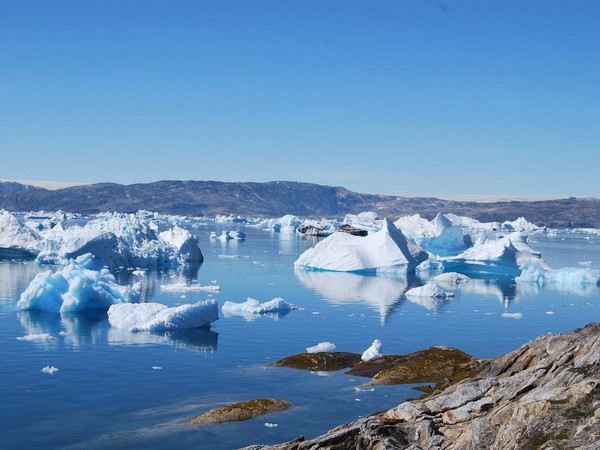

Nuuk [Greenland], November 21 (ANI): Findings of unexpectedly huge populations of fin and humpback whales in the formerly ice-covered seas of East Greenland suggest that the marine ecology is shifting irreversibly from one regime to another, says a new scientific study published in the internationally peer-reviewed scientific journal Global Change Biology.
This century has seen a transition from a sub-arctic ecology off Southeast Greenland that was dominated by vast amounts of drifting pack ice to a more temperate one with less sea ice and milder ocean temperatures, the study said, adding large populations of fin and humpback whales as well as other new species are getting more attracted to the area as a result of these changes in the summer ocean conditions.
In the ecological literature, radical ecological changes like these are referred to as regime transitions. The transition from one regime to another happens at a tipping point and can be permanent. The regime shift has cascading effects down the ecosystem, the study said.
The study is led by the Greenland Institute of Natural Resources with contributions from the National Institute of Aquatic Resources and the Technical University of Denmark.
"In this case, the new regime will likely become permanent for the foreseeable future, unless temperatures cool and the ice export from the north increases again. According to recent IPCC reports, continued 21st-century climate change makes this scenario unlikely," said Professor Mads Peter Heide-Jorgensen from the Greenland Institute of Natural Resources.
"One of the main findings is that this event is so unusual in the past 200 years of summer ice observations in the region. We have seen big changes in some of the upper trophic levels. There are likely many other changes in the ecosystem and food web that have not yet been described and might be part of the reason why highly migratory species are coming to the region," said Professor Brian MacKenzie from the National Institute of Aquatic Resources, DTU.
Tipping points
The extent of drifting sea ice is a tipping element that may be plainly seen, including on modern satellite imaging, and is known as the driver of the shift.
Bluefin tunas were accidentally caught in a trawl fishing in the waters around East Greenland in 2012 for the first time. This was a sobering realisation that the subarctic environment had undergone a significant change.
Additionally, there was growing evidence of ecological changes, such as the unexpectedly high populations of fin and humpback whales discovered in the once ice-covered seas of East Greenland. They began to coexist with temperate species including killer whales, pilot whales, and dolphins. In Southeast Greenland, observations of high Arctic species like walruses and narwhals were declining during the same period.
This ecological shift in the dominating regime of East Greenland was driven by the decline in summer drift ice along East Greenland. A 200-year-long record revealed that unprecedented low levels of coastal sea ice were reached after 2000. This opened the area to the large predators that depend on open water for air breathing.
"The recent disappearance of summer pack ice along East Greenland demonstrates how meteorological perturbations are connected to changes in marine ecological conditions over distances several thousand kilometres apart," said Jorgensen.
Facts
The majority of the Arctic Ocean's pack ice is produced in a circulation system north of Alaska, from whence it is propelled for several years by currents in the direction of Greenland's north. The majority of it then rapidly travels south along the East Greenland coast into the Fram Strait before entering the North Atlantic. (ANI)




