

ADD ANI AS A TRUSTED SOURCE
googleads
ANI Logo
Menu
Science

Recent development paves path for a new kind of quantum communication: Research

A new type of random number generator for encryption developed at Linköping University in Sweden can make sharing safer, more inexpensive, and less harmful to the environment.

ANI Sep 09, 2023 17:07 IST googleads

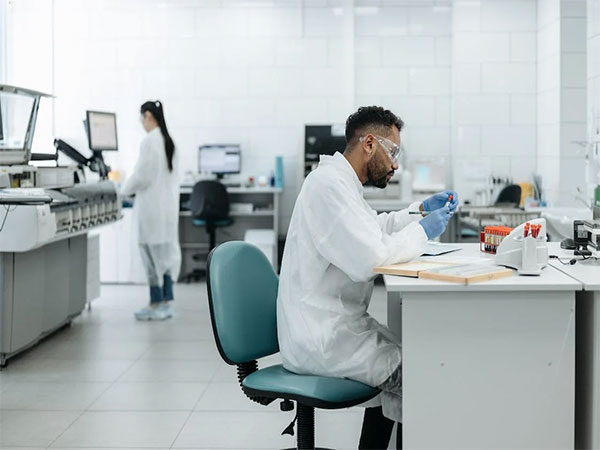
Representative Image

Washington DC [US], September 9 (ANI): A new type of random number generator for encryption developed at Linköping University in Sweden can make sharing safer, more inexpensive, and less harmful to the environment.
The study's authors think that a new kind of quantum communication will be possible thanks to the new technology.
Cybersecurity is growing more crucial in an increasingly linked world to secure not only the individual but also, for instance, governmental infrastructure and financial institutions.

Additionally, individuals attempting to protect information and hackers are always competing. Encryption is the most used method of information security. Information is thus digitally encrypted when we send emails, make online payments for bills, and shop online.
A random number generator, which can either be a computer code or the hardware itself, is used to encrypt data. The information at the receiving end is encrypted and decrypted using keys that are generated by the random number generator.
Various random number generators offer varying degrees of randomness and security. Hardware is a much safer choice because physical processes are in charge of regulating randomness. The hardware technique that produces the finest randomness, known as the Quantum Random Number Generator, or QRNG, is based on quantum processes.
“In cryptography, it’s not only important that the numbers are random, but that you’re the only one who knows about them. With QRNGs, we can certify that a large amount of the generated bits is private and thus completely secure. And if the laws of quantum physics are true, it should be impossible to eavesdrop without the recipient finding out,” says Guilherme B Xavier, a researcher at the Department of Electrical Engineering at Linköping University.
His research team along with researchers from the Department of Physics, Chemistry, and Biology has created a new kind of QRNG that can be used for encryption, betting, and computer simulations.
The usage of light-emitting diodes built of the crystal-like substance perovskite is a novel aspect of the QRNG developed by Linköping researchers.
Their random number generator is among the best made and performs admirably when compared to similar goods. It has the potential to be less expensive and more ecologically friendly because of the characteristics of perovskites.
Professor Feng Gao has been studying perovskites for more than ten years. He thinks there is a chance to revolutionise, for instance, optical instruments because of the recent invention of perovskite light-emitting diodes (PeLEDs).
“It’s possible to use, for example, a traditional laser for QRNG, but it’s expensive. If the technology is eventually to find its way into consumer electronics, it’s important that the cost is kept down and that the production is as environmentally friendly as possible. In addition, PeLEDs don’t require as much energy to run,” said Feng Gao.
“It’s an advantage if electronic components that are to be used for sensitive data are manufactured in Sweden. If you buy a complete randomness generator kit from another country, you can’t be sure that it’s not being monitored.” (ANI)


Get the App

What to Read Next

Science

New method guides magnetism without magnets

New method guides magnetism without magnets

Researchers at Paul Scherrer Institute PSI have demonstrated an innovative method to control magnetism in materials using an energy-efficient electric field.

Read More
Science

New insights into how cancer evades the immune system: Study

New insights into how cancer evades the immune system: Study

Immunotherapy research primarily focuses on better recognition of cancer cells by the body's own immune system. Researchers at Amsterdam UMC and Moffitt Cancer Center have taken a different approach.

Read More
Science

New device could allow you to taste cake in virtual reality

New device could allow you to taste cake in virtual reality

The 'e-Taste' interface employs sensors and wireless chemical dispensers to enable remote taste perception, often known as gestation. Field testing done by researchers at The Ohio State University confirmed the device's ability to digitally simulate a range of taste intensities, while still offering variety and safety for the user.

Read More
Science

Strand Life Sciences launches portal for rare disease diagnosis

Strand Life Sciences launches portal for rare disease diagnosis

Marking Rare Disease Day, Strand Life Sciences, a subsidiary of Reliance Industries and a leading genomics research company, has launched the StrandOmics Portal, an innovative digital platform designed to assist doctors in diagnosing rare diseases more efficiently.

Read More
Science

Study reveals impact of animals as architects of Earth

Study reveals impact of animals as architects of Earth

A new study led by Professor Gemma Harvey from Queen Mary University of London has revealed how hundreds of species shape the landscapes we depend on, from termite mounds visible from space to beavers creating wetlands and hippos carving drainage systems.

Read More
Science

Opposing arrows of time emerge from certain quantum systems

Opposing arrows of time emerge from certain quantum systems

Researchers at the University of Surrey made a thought-provoking discovery. A new study reveals that opposing arrows of time can theoretically emerge from certain quantum systems.

Read More
Science

COVID-19 severity may be predicted by White Blood Cell Count

COVID-19 severity may be predicted by White Blood Cell Count

A COVID-19 diagnosis is no longer as frightening as it used to be, thanks to developments in treatment choices. However, a new study reveals that leukocyte (white blood cell) count may now be used to identify who is more likely to develop more significant disease symptoms.

Read More
Science

Seals can essentially act as 'smart sensors': Study

Seals can essentially act as 'smart sensors': Study

A new study by marine biologists reports that seals can essentially act as 'smart sensors' for monitoring fish populations in the ocean's eerily dim 'twilight zone.'

Read More
Science

'Creation of black holes without singularities through gravity'

'Creation of black holes without singularities through gravity'

Traditional black holes, as predicted by Albert Einstein's theory of General Relativity, contain what are known as singularities, i.e. points where the laws of physics break down. Identifying how singularities are resolved in the context of quantum gravity is one of the fundamental problems in theoretical physics. Now, a team of experts has described the creation of regular black holes from gravitational effects without the need for the existence of exotic matter required by some previous models.

Read More
Science

New technology enhances gravitational-wave detection: Study

New technology enhances gravitational-wave detection: Study

A team of physicists led by Jonathan Richardson of the University of California, Riverside, demonstrated how new optical technology can extend the detection range of gravitational-wave observatories such as the Laser Interferometer Gravitational-Wave Observatory, or LIGO, and pave the way for future observatories.

Read More
Home About Us Our Products Advertise Contact Us Terms & Condition Privacy Policy

Copyright © aninews.in | All Rights Reserved.


