 हिंदी खबर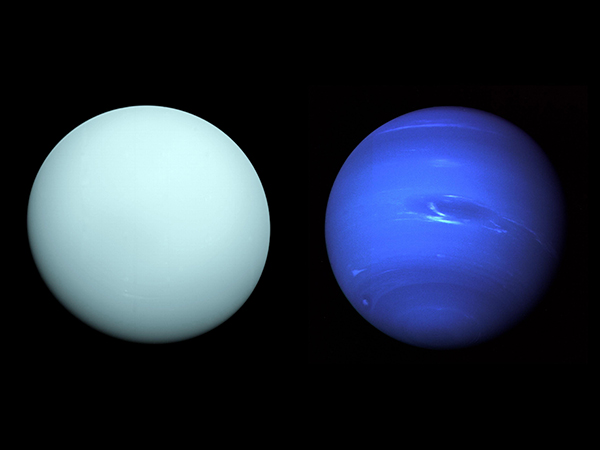

Washington [US], June 2 (ANI): According to research at the Association of Universities for Research in Astronomy (AURA), researchers have developed a single atmospheric model that matches observations of both planets. The model reveals that excess haze on Uranus builds up in the planet's stagnant, sluggish atmosphere and makes it appear a lighter tone than Neptune Using observations from the Gemini North telescope, the NASA Infrared Telescope Facility, and the Hubble Space Telescope.
Neptune and Uranus have much in common -- they have similar masses, sizes, and atmospheric compositions -- yet their appearances are notably different. At visible wavelengths, Neptune has a distinctly bluer colour whereas Uranus is a pale shade of cyan. Astronomers now have an explanation for why the two planets are of different colours.
New research suggests that a layer of concentrated haze that exists on both planets is thicker on Uranus than a similar layer on Neptune and 'whitens' Uranus's appearance more than Neptune's. If there were no haze in the atmospheres of Neptune and Uranus, both would appear almost equally blue.
This conclusion comes from a model that an international team led by Patrick Irwin, Professor of Planetary Physics at Oxford University, developed to describe aerosol layers in the atmospheres of Neptune and Uranus. Previous investigations of these planets' upper atmospheres had focused on the appearance of the atmosphere at only specific wavelengths. However, this new model, consisting of multiple atmospheric layers, matches observations from both planets across a wide range of wavelengths. The new model also includes haze particles within deeper layers that had previously been thought to contain only clouds of methane and hydrogen sulfide ices.
"This is the first model to simultaneously fit observations of reflected sunlight from ultraviolet to near-infrared wavelengths," explained Irwin, who is the lead author of a paper presenting this result in the Journal of Geophysical Research: Planets. "It's also the first to explain the difference in visible color between Uranus and Neptune."
The team's model consists of three layers of aerosols at different heights. The key layer that affects the colors is the middle layer, which is a layer of haze particles (referred to in the paper as the Aerosol-2 layer) that is thicker on Uranus than on Neptune. The team suspects that, on both planets, methane ice condenses onto the particles in this layer, pulling the particles deeper into the atmosphere in a shower of methane snow. Because Neptune has a more active, turbulent atmosphere than Uranus does, the team believes Neptune's atmosphere is more efficient at churning up methane particles into the haze layer and producing this snow. This removes more of the haze and keeps Neptune's haze layer thinner than it is on Uranus, meaning the blue color of Neptune looks stronger.
"We hoped that developing this model would help us understand clouds and hazes in the ice giant atmospheres," commented Mike Wong, an astronomer at the University of California, Berkeley, and a member of the team behind this result. "Explaining the difference in color between Uranus and Neptune was an unexpected bonus!"
To create this model, Irwin's team analyzed a set of observations of the planets encompassing ultraviolet, visible, and near-infrared wavelengths (from 0.3 to 2.5 micrometres) taken with the Near-Infrared Integral Field Spectrometer (NIFS) on the Gemini North telescope near the summit of Maunakea in Hawai'i -- which is part of the international Gemini Observatory, a Program of NSF's NOIRLab -- as well as archival data from the NASA Infrared Telescope Facility, also located in Hawai'i, and the NASA/ESA Hubble Space Telescope.
The NIFS instrument on Gemini North was particularly important to this result as it is able to provide spectra -- measurements of how bright an object is at different wavelengths -- for every point in its field of view. This provided the team with detailed measurements of how reflective both planets' atmospheres are across both the full disk of the planet and across a range of near-infrared wavelengths.
"The Gemini observatories continue to deliver new insights into the nature of our planetary neighbors," said Martin Still, Gemini Program Officer at the National Science Foundation. "In this experiment, Gemini North provided a component within a suite of ground- and space-based facilities critical to the detection and characterization of atmospheric hazes."
The model also helps explain the dark spots that are occasionally visible on Neptune and less commonly detected on Uranus. While astronomers were already aware of the presence of dark spots in the atmospheres of both planets, they didn't know which aerosol layer was causing these dark spots or why the aerosols at those layers were less reflective. The team's research sheds light on these questions by showing that a darkening of the deepest layer of their model would produce dark spots similar to those seen on Neptune and perhaps Uranus. (ANI)


