

ADD ANI AS A TRUSTED SOURCE
googleads
Menu
Science

Rare discovery of dinosaur remains preserved with its last meal: Research

Microraptor was opportunistic predator, feeding on fish, birds, lizards and now small mammals. The discovery of a rare fossil reveals the creature was a generalist carnivore in the ancient ecosystem of dinosaurs.

ANI Dec 22, 2022 20:27 IST googleads

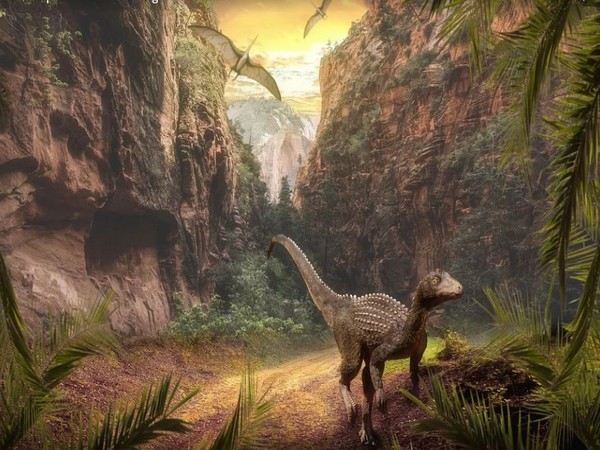
Representative Image

Washington [US], December 22 (ANI): Microraptor was opportunistic predator, feeding on fish, birds, lizards and now small mammals. The discovery of a rare fossil reveals the creature was a generalist carnivore in the ancient ecosystem of dinosaurs.
Finding the last meal of any fossil animal is rare. When McGill University Professor Hans Larsson saw a complete mammal foot inside the rib cage of the small, feathered dinosaur, his jaw dropped. Of the many hundreds of carnivorous dinosaur skeletons, only 20 cases preserve their last meals. This new find makes 21.
"At first, I couldn't believe it. There was a tiny rodent-like mammal foot about a centimeter long perfectly preserved inside a Microraptor skeleton. These finds are the only solid evidence we have about the food consumption of these long extinct animals -- and they are exceptionally rare," says Larsson, who came across the fossil while visiting museum collections in China.
Fully feathered with wings on both its arms and legs, this dinosaur is closely linked to the origin of birds. Microraptor was about the size of a crow and one of the smallest dinosaurs. The first specimen was discovered in deposits in Liaoning, China, in the early 2000s.
"We already know of Microraptor specimens preserved with parts of fish, a bird, and a lizard in their bellies. This new find adds a small mammal to their diet, suggesting these dinosaurs were opportunistic and not picky eaters," says Larsson who is a Professor of Biology at the Redpath Museum of McGill University.
"Knowing they were not specialized to any particular food is a big deal," he adds. According to the team of researchers, this could be the first evidence of a generalist carnivore in dinosaur ecosystems. Generalist predators are important stabilizers in today's ecosystems, like foxes and crows, because they can feed on several species that may have differing population abundances.
"Knowing that Microraptor was a generalist carnivore puts a new perspective on how ancient ecosystems may have worked and a possible insight into the success of these small, feathered dinosaurs," says Larsson. (ANI)


Get the App

What to Read Next

Science

New method guides magnetism without magnets

New method guides magnetism without magnets

Researchers at Paul Scherrer Institute PSI have demonstrated an innovative method to control magnetism in materials using an energy-efficient electric field.

Read More
Science

Amphibians bounce-back from Earth’s greatest mass extinction

Amphibians bounce-back from Earth’s greatest mass extinction

Researchers at the University of Bristol discovered that ancient frog ancestors survived the biggest mass extinction of species by eating on freshwater prey that evaded terrestrial predators.

Read More
Science

New insights into how cancer evades the immune system: Study

New insights into how cancer evades the immune system: Study

Immunotherapy research primarily focuses on better recognition of cancer cells by the body's own immune system. Researchers at Amsterdam UMC and Moffitt Cancer Center have taken a different approach.

Read More
Science

Scientists use AI to better understand nanoparticles: Study

Scientists use AI to better understand nanoparticles: Study

A group of scientists has created a way to illuminate the dynamic behavior of nanoparticles, which are essential components in the production of pharmaceuticals, electronics, and industrial and energy-conversion materials.

Read More
Science

New device could allow you to taste cake in virtual reality

New device could allow you to taste cake in virtual reality

The 'e-Taste' interface employs sensors and wireless chemical dispensers to enable remote taste perception, often known as gestation. Field testing done by researchers at The Ohio State University confirmed the device's ability to digitally simulate a range of taste intensities, while still offering variety and safety for the user.

Read More
Home About Us Our Products Advertise Contact Us Terms & Condition Privacy Policy

Copyright © aninews.in | All Rights Reserved.
