

ADD ANI AS A TRUSTED SOURCE
googleads
ANI Logo
Menu
Science

Rapidly descending dark energy leading to end of cosmic expansion: Study

Washington [US], April 6 (ANI): Researchers described a model of dark energy which suggests that the currently observed accelerated expansion of the universe could end as soon as 100 million years from now, at which point the universe would smoothly transition to a phase of slow contraction.

ANI Apr 06, 2022 08:39 IST googleads

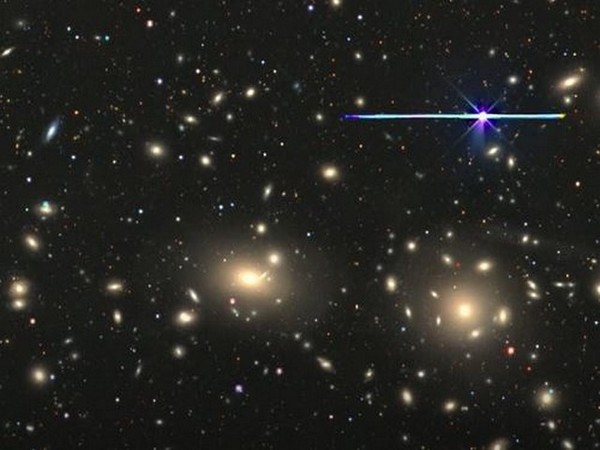
Representative image

Washington [US], April 6 (ANI): Researchers described a model of dark energy which suggests that the currently observed accelerated expansion of the universe could end as soon as 100 million years from now, at which point the universe would smoothly transition to a phase of slow contraction.
The study was published in the Proceedings of the National Academy of Sciences of the United States of America (PNAS).
Although the universe is expanding at an accelerating rate today, this study presents a simple mechanism by which a dynamical form of dark energy (known as quintessence) could cause the acceleration to come to end and smoothly transition from expansion to a phase of slow contraction.
That raises the question, how soon could this transition occur? And at what point would it be detectable? The conclusions are that the transition could be surprisingly soon, maybe less than 100 million y from now, and yet, for reasons described in the main text, it is not yet detectable today.
The scenario is not far-fetched. In fact, it fits naturally with recent theories of cyclic cosmology and conjectures about quantum gravity.
If dark energy is a form of quintessence driven by a scalar field evolving down a monotonically decreasing potential that passes sufficiently below zero, the universe is destined to undergo a series of smooth transitions.
The currently observed accelerated expansion will cease; soon thereafter, the expansion will come to end altogether; and the universe will pass into a phase of slow contraction.
The results of the model are consistent with current observations and with recent theories of cyclic cosmology, in which the universe alternates between periods of expansion and contraction, according to the authors Cosmin Andrei, Anna Ijjas, and Paul J Steinhardt. (ANI)


Get the App

What to Read Next

Science

New method guides magnetism without magnets

New method guides magnetism without magnets

Researchers at Paul Scherrer Institute PSI have demonstrated an innovative method to control magnetism in materials using an energy-efficient electric field.

Read More
Science

Amphibians bounce-back from Earth’s greatest mass extinction

Amphibians bounce-back from Earth’s greatest mass extinction

Researchers at the University of Bristol discovered that ancient frog ancestors survived the biggest mass extinction of species by eating on freshwater prey that evaded terrestrial predators.

Read More
Science

New insights into how cancer evades the immune system: Study

New insights into how cancer evades the immune system: Study

Immunotherapy research primarily focuses on better recognition of cancer cells by the body's own immune system. Researchers at Amsterdam UMC and Moffitt Cancer Center have taken a different approach.

Read More
Science

Scientists use AI to better understand nanoparticles: Study

Scientists use AI to better understand nanoparticles: Study

A group of scientists has created a way to illuminate the dynamic behavior of nanoparticles, which are essential components in the production of pharmaceuticals, electronics, and industrial and energy-conversion materials.

Read More
Science

New device could allow you to taste cake in virtual reality

New device could allow you to taste cake in virtual reality

The 'e-Taste' interface employs sensors and wireless chemical dispensers to enable remote taste perception, often known as gestation. Field testing done by researchers at The Ohio State University confirmed the device's ability to digitally simulate a range of taste intensities, while still offering variety and safety for the user.

Read More
Science

Strand Life Sciences launches portal for rare disease diagnosis

Strand Life Sciences launches portal for rare disease diagnosis

Marking Rare Disease Day, Strand Life Sciences, a subsidiary of Reliance Industries and a leading genomics research company, has launched the StrandOmics Portal, an innovative digital platform designed to assist doctors in diagnosing rare diseases more efficiently.

Read More
Science

Study reveals impact of animals as architects of Earth

Study reveals impact of animals as architects of Earth

A new study led by Professor Gemma Harvey from Queen Mary University of London has revealed how hundreds of species shape the landscapes we depend on, from termite mounds visible from space to beavers creating wetlands and hippos carving drainage systems.

Read More
Science

Opposing arrows of time emerge from certain quantum systems

Opposing arrows of time emerge from certain quantum systems

Researchers at the University of Surrey made a thought-provoking discovery. A new study reveals that opposing arrows of time can theoretically emerge from certain quantum systems.

Read More
Science

'Creation of black holes without singularities through gravity'

'Creation of black holes without singularities through gravity'

Traditional black holes, as predicted by Albert Einstein's theory of General Relativity, contain what are known as singularities, i.e. points where the laws of physics break down. Identifying how singularities are resolved in the context of quantum gravity is one of the fundamental problems in theoretical physics. Now, a team of experts has described the creation of regular black holes from gravitational effects without the need for the existence of exotic matter required by some previous models.

Read More
Science

New technology enhances gravitational-wave detection: Study

New technology enhances gravitational-wave detection: Study

A team of physicists led by Jonathan Richardson of the University of California, Riverside, demonstrated how new optical technology can extend the detection range of gravitational-wave observatories such as the Laser Interferometer Gravitational-Wave Observatory, or LIGO, and pave the way for future observatories.

Read More
Home About Us Our Products Advertise Contact Us Terms & Condition Privacy Policy

Copyright © aninews.in | All Rights Reserved.
