

ADD ANI AS A TRUSTED SOURCE
googleads
ANI Logo
Menu
Science

'Queen banking' can help beekeepers deal with climate change

Queen banking, the process of storing extra queens in the spring to replenish colonies in the autumn, can be made more stable and labour-efficient by keeping queen bees frozen in indoor refrigeration units, according to a Washington State University research. It could also improve honey bee survival in the face of climate change.

ANI Feb 27, 2023 20:55 IST googleads

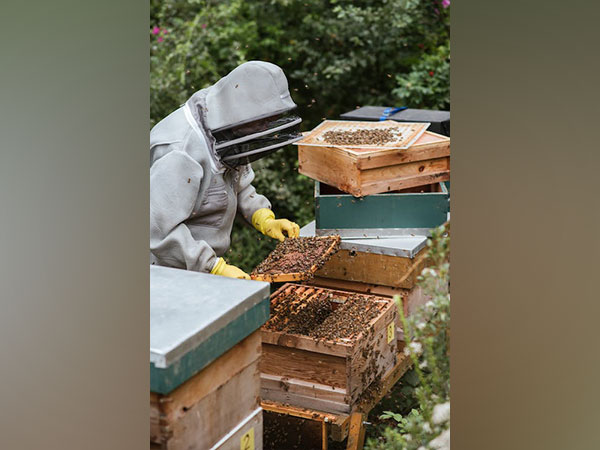
Representative Image

Washington [US], February 27 (ANI): Queen banking, the process of storing extra queens in the spring to replenish colonies in the autumn, can be made more stable and labour-efficient by keeping queen bees frozen in indoor refrigeration units, according to a Washington State University research. It could also improve honey bee survival in the face of climate change.
Researchers compared queen banks kept in refrigerated units to those kept outdoors in the traditional manner and an "unbanked" control group in a study that was published in the Journal of Apicultural Research. They discovered that queens kept indoors had a greater survival rate and required less upkeep than those kept outside.
This study, and future potential refinement, could be another piece in the ultimate puzzle of reducing the loss of bee colonies each year, said senior author Brandon Hopkins, an assistant research professor in WSU's Department of Entomology.
"A lot of honey bee losses are queen-quality issues," Hopkins said. "If we have a method that increases the number of queens available or the stability of queens from year to year, then that helps with the number of colonies that survive winter in a healthy state."
In the beekeeping industry, queen producers often "bank" queens over the summer by storing them in small cages. Those small cages are then put into a large colony with many workers to care for the caged queens, with as many as 200 queens per bank. A bank of 100 queens has a value of more than $5,000, and producers may have 10 to 20 banks on hand.
For this study, the team prepared 18 banks with 50, 100 and 198 queens per bank. The refrigerated banks matched survival of the outside groups, and in the banks of 100, survival was higher, with 78% of queens surviving the six weeks of storage compared to 62% in the outdoor group. The queens in both groups were of the same quality, showing similar good health. The cooled queen banks also needed less maintenance.
Beekeepers need honey bee queens to sustain colonies that pollinate crops, and there's a huge spike in demand for queens in the spring. That's when beekeepers replace their losses from the previous year.
Once queen producers meet that demand, they can't just turn off queen production. Producers can bank excess queens to help meet the future needs of beekeepers, who often replenish their queen supplies after the summer.
Queens can't be produced in hot temperatures, Hopkins said. Banking keeps an inventory on hand for when demand returns in the fall.
Keeping a supply of queens available for beekeepers to purchase is growing increasingly difficult. The vast majority of U.S. queen producers are based in California, where rising temperatures and wildfires are becoming more common.
"We heard queen producers in California are having a difficult time banking queens when temperatures are over 100 degrees in the summer," said Hopkins. "It's a little scary to be banking 80% of the country's queen supply in a location prone to wildfires, smoke and high temperatures."
Hopkins was surprised by how well the experiment worked, considering the challenges of queen banking.
"It's an art," he said. "There's a significant amount of maintenance, skill and care required: managing, feeding and moving resources around."
The team found that in the refrigeration units, the bees fared well with just food and no human interference. (ANI)


Get the App

What to Read Next

Science

Amphibians bounce-back from Earth’s greatest mass extinction

Amphibians bounce-back from Earth’s greatest mass extinction

Researchers at the University of Bristol discovered that ancient frog ancestors survived the biggest mass extinction of species by eating on freshwater prey that evaded terrestrial predators.

Read More
Science

New insights into how cancer evades the immune system: Study

New insights into how cancer evades the immune system: Study

Immunotherapy research primarily focuses on better recognition of cancer cells by the body's own immune system. Researchers at Amsterdam UMC and Moffitt Cancer Center have taken a different approach.

Read More
Science

Scientists use AI to better understand nanoparticles: Study

Scientists use AI to better understand nanoparticles: Study

A group of scientists has created a way to illuminate the dynamic behavior of nanoparticles, which are essential components in the production of pharmaceuticals, electronics, and industrial and energy-conversion materials.

Read More
Science

New device could allow you to taste cake in virtual reality

New device could allow you to taste cake in virtual reality

The 'e-Taste' interface employs sensors and wireless chemical dispensers to enable remote taste perception, often known as gestation. Field testing done by researchers at The Ohio State University confirmed the device's ability to digitally simulate a range of taste intensities, while still offering variety and safety for the user.

Read More
Science

Strand Life Sciences launches portal for rare disease diagnosis

Strand Life Sciences launches portal for rare disease diagnosis

Marking Rare Disease Day, Strand Life Sciences, a subsidiary of Reliance Industries and a leading genomics research company, has launched the StrandOmics Portal, an innovative digital platform designed to assist doctors in diagnosing rare diseases more efficiently.

Read More
Science

Study reveals impact of animals as architects of Earth

Study reveals impact of animals as architects of Earth

A new study led by Professor Gemma Harvey from Queen Mary University of London has revealed how hundreds of species shape the landscapes we depend on, from termite mounds visible from space to beavers creating wetlands and hippos carving drainage systems.

Read More
Science

Opposing arrows of time emerge from certain quantum systems

Opposing arrows of time emerge from certain quantum systems

Researchers at the University of Surrey made a thought-provoking discovery. A new study reveals that opposing arrows of time can theoretically emerge from certain quantum systems.

Read More
Science

'Creation of black holes without singularities through gravity'

'Creation of black holes without singularities through gravity'

Traditional black holes, as predicted by Albert Einstein's theory of General Relativity, contain what are known as singularities, i.e. points where the laws of physics break down. Identifying how singularities are resolved in the context of quantum gravity is one of the fundamental problems in theoretical physics. Now, a team of experts has described the creation of regular black holes from gravitational effects without the need for the existence of exotic matter required by some previous models.

Read More
Science

New technology enhances gravitational-wave detection: Study

New technology enhances gravitational-wave detection: Study

A team of physicists led by Jonathan Richardson of the University of California, Riverside, demonstrated how new optical technology can extend the detection range of gravitational-wave observatories such as the Laser Interferometer Gravitational-Wave Observatory, or LIGO, and pave the way for future observatories.

Read More
Science

Discovering the genetics of climate adaptation 

Discovering the genetics of climate adaptation 

As climate change accelerates, plants are under increasing pressure to adapt to changing habitats and environmental conditions.

Read More
Home About Us Our Products Advertise Contact Us Terms & Condition Privacy Policy

Copyright © aninews.in | All Rights Reserved.


