

ADD ANI AS A TRUSTED SOURCE
googleads
ANI Logo
Menu
Science

Preserved dune fields offer insights into Martian history

Washington [US], October 6 (ANI): The discovery of Martian dune fields largely preserved in the rock record for up to a billion years offers new insights on past climatic conditions on Mars.

ANI Oct 06, 2020 07:57 IST googleads

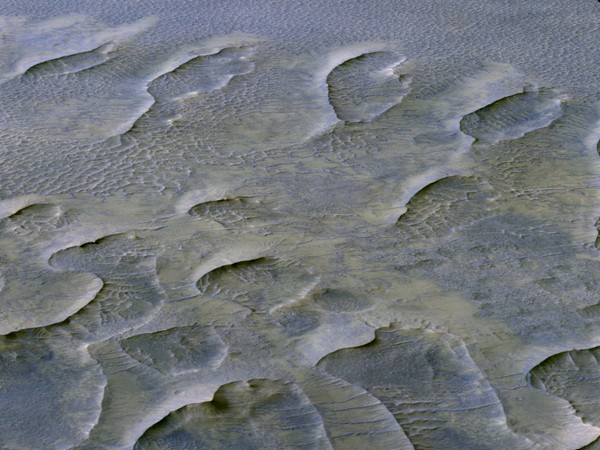
Wind-driven sand dunes are common on modern Mars and the presence of certain sedimentary rock layers indicates these landforms occurred there in the past. (Image: NASA/JPL/University of Arizona.)

Washington [US], October 6 (ANI): The discovery of Martian dune fields largely preserved in the rock record for up to a billion years offers new insights on past climatic conditions on Mars.
Mapping extensive sedimentary rock deposits in the Valles Marineris region of Mars show clear evidence for preserved lithification and burial of dune fields, a paper by Planetary Science Institute Research Scientist Matthew Chojnacki says.
While modern sand dunes and other wind-formed features are common on the surface of Mars and other terrestrial planets, typically most of the deposits are worn away by erosion. The dune fields studied in the paper are approximately 1 billion years old, Chojnacki said. He is the lead author on "Ancient Martian Aeolian Sand Dune Deposits Recorded in the Stratigraphy of Valles Marineris and Implications for Past Climates" that appears in the Journal of Geophysical Research Planets.
"We identified and mapped extensive dune fields in the canyons of Valles Marineris which show clear evidence for lithification and burial. This level of preservation is rare for terrestrial sand dunes due to ongoing erosion and tectonics," Chojnacki said. "Based on the dune deposit's relationships to other geologic units and modern erosion rates we estimate these to be roughly a billion years old. Because of the duneforms' size and spatial arrangements, which are not that much different to modern equivalents, we suggest that the climate and atmospheric pressure to have been similar to that of contemporary Mars."
Surface erosion and landscape evolution are greatly different on Earth and Mars. "Water and tectonics that constantly reshape the surface of Earth are not currently a factor on Mars, thus there is an opportunity to learn from the geologic record of the red planet," Chojnacki said. "The ancient dune fields found within Valles Marineris, with their complex variety of landform shapes, degree of preservation, and context, reveal the richness of regional geology. These results inform us that wind-driven sand transport, deposition, and lithification have occurred throughout much of Mars' recent history and illustrate how landscape evolution there greatly differs compared to that of Earth." (ANI)


Get the App

What to Read Next

Science

New method guides magnetism without magnets

New method guides magnetism without magnets

Researchers at Paul Scherrer Institute PSI have demonstrated an innovative method to control magnetism in materials using an energy-efficient electric field.

Read More
Science

Amphibians bounce-back from Earth’s greatest mass extinction

Amphibians bounce-back from Earth’s greatest mass extinction

Researchers at the University of Bristol discovered that ancient frog ancestors survived the biggest mass extinction of species by eating on freshwater prey that evaded terrestrial predators.

Read More
Science

New insights into how cancer evades the immune system: Study

New insights into how cancer evades the immune system: Study

Immunotherapy research primarily focuses on better recognition of cancer cells by the body's own immune system. Researchers at Amsterdam UMC and Moffitt Cancer Center have taken a different approach.

Read More
Science

Scientists use AI to better understand nanoparticles: Study

Scientists use AI to better understand nanoparticles: Study

A group of scientists has created a way to illuminate the dynamic behavior of nanoparticles, which are essential components in the production of pharmaceuticals, electronics, and industrial and energy-conversion materials.

Read More
Science

New device could allow you to taste cake in virtual reality

New device could allow you to taste cake in virtual reality

The 'e-Taste' interface employs sensors and wireless chemical dispensers to enable remote taste perception, often known as gestation. Field testing done by researchers at The Ohio State University confirmed the device's ability to digitally simulate a range of taste intensities, while still offering variety and safety for the user.

Read More
Science

Study reveals impact of animals as architects of Earth

Study reveals impact of animals as architects of Earth

A new study led by Professor Gemma Harvey from Queen Mary University of London has revealed how hundreds of species shape the landscapes we depend on, from termite mounds visible from space to beavers creating wetlands and hippos carving drainage systems.

Read More
Science

Opposing arrows of time emerge from certain quantum systems

Opposing arrows of time emerge from certain quantum systems

Researchers at the University of Surrey made a thought-provoking discovery. A new study reveals that opposing arrows of time can theoretically emerge from certain quantum systems.

Read More
Science

COVID-19 severity may be predicted by White Blood Cell Count

COVID-19 severity may be predicted by White Blood Cell Count

A COVID-19 diagnosis is no longer as frightening as it used to be, thanks to developments in treatment choices. However, a new study reveals that leukocyte (white blood cell) count may now be used to identify who is more likely to develop more significant disease symptoms.

Read More
Science

Seals can essentially act as 'smart sensors': Study

Seals can essentially act as 'smart sensors': Study

A new study by marine biologists reports that seals can essentially act as 'smart sensors' for monitoring fish populations in the ocean's eerily dim 'twilight zone.'

Read More
Science

New technology enhances gravitational-wave detection: Study

New technology enhances gravitational-wave detection: Study

A team of physicists led by Jonathan Richardson of the University of California, Riverside, demonstrated how new optical technology can extend the detection range of gravitational-wave observatories such as the Laser Interferometer Gravitational-Wave Observatory, or LIGO, and pave the way for future observatories.

Read More
Home About Us Our Products Advertise Contact Us Terms & Condition Privacy Policy

Copyright © aninews.in | All Rights Reserved.


