

ADD ANI AS A TRUSTED SOURCE
googleads
Menu
Science

Prehistoric podiatry: How dinosaurs carried such enormous burdens

Washington [US], August 14 (ANI): Scientists have cracked an enduring mystery, discovering how sauropod dinosaurs like Brontosaurus and Diplodocus supported their gigantic bodies on land.

ANI Aug 14, 2022 23:36 IST googleads

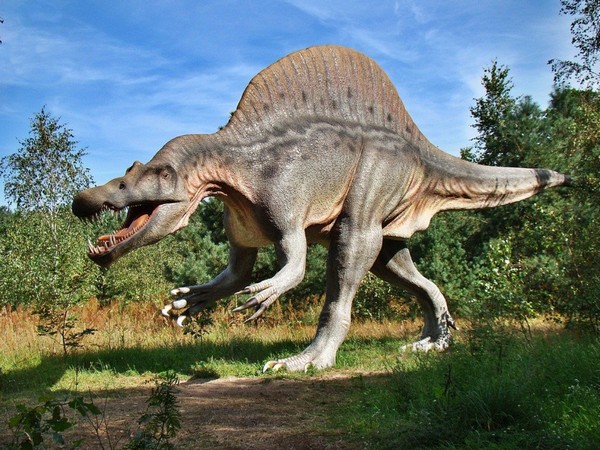
Representative Image

Washington [US], August 14 (ANI): Scientists have cracked an enduring mystery, discovering how sauropod dinosaurs like Brontosaurus and Diplodocus supported their gigantic bodies on land.
A University of Queensland and Monash University-led team used 3D modelling and engineering methods to digitally reconstruct and test the function of the foot bones of different sauropods.
Dr Andreas Jannel conducted the research during his PhD studies at UQ's Dinosaur Lab and said the team found that the hind feet of sauropod had a soft tissue pad beneath the 'heel', cushioning the foot to absorb their immense weight.
"We've finally confirmed a long-suspected idea and we provide, for the first time, biomechanical evidence that a soft tissue pad -- particularly in their back feet would have played a crucial role in reducing locomotor pressures and bone stresses," Dr Jannel said.
"It is mind-blowing to imagine that these giant creatures could have been able to support their own weight on land."
Sauropods were the largest terrestrial animals that roamed the Earth for more than 100 million years.
They were first thought to have been semi-aquatic with water buoyancy supporting their massive weight, a theory disproved by the discovery of sauropod tracks in terrestrial deposits in the mid-twentieth century.
Monash University's Dr Olga Panagiotopoulou said it had also been thought sauropods had feet similar to a modern-day elephant.
"Popular culture -- think Jurassic Park or Walking with Dinosaurs often depicts these behemoths with almost-cylindrical, thick, elephant-like feet," Dr Panagiotopoulou said. (ANI)


Get the App

What to Read Next

Science

Amphibians bounce-back from Earth’s greatest mass extinction

Amphibians bounce-back from Earth’s greatest mass extinction

Researchers at the University of Bristol discovered that ancient frog ancestors survived the biggest mass extinction of species by eating on freshwater prey that evaded terrestrial predators.

Read More
Science

New insights into how cancer evades the immune system: Study

New insights into how cancer evades the immune system: Study

Immunotherapy research primarily focuses on better recognition of cancer cells by the body's own immune system. Researchers at Amsterdam UMC and Moffitt Cancer Center have taken a different approach.

Read More
Science

Study reveals impact of animals as architects of Earth

Study reveals impact of animals as architects of Earth

A new study led by Professor Gemma Harvey from Queen Mary University of London has revealed how hundreds of species shape the landscapes we depend on, from termite mounds visible from space to beavers creating wetlands and hippos carving drainage systems.

Read More
Science

Microbes help detoxify our atmosphere, says study 

Microbes help detoxify our atmosphere, says study 

Melbourne researchers have uncovered important new information on how microbes absorb huge amounts of carbon monoxide (CO) and assist in reducing levels of this deadly gas.

Read More
Science

Weather change linked to heightened risk of Salmonella outbreaks

Weather change linked to heightened risk of Salmonella outbreaks

According to new research from the University of Surrey, climate change has an impact on Salmonella spread. This study builds on prior work by the researchers, which discovered that weather change is contributing to the spread of deadly diarrhoeal illnesses.

Read More
Home About Us Our Products Advertise Contact Us Terms & Condition Privacy Policy

Copyright © aninews.in | All Rights Reserved.
