 हिंदी खबर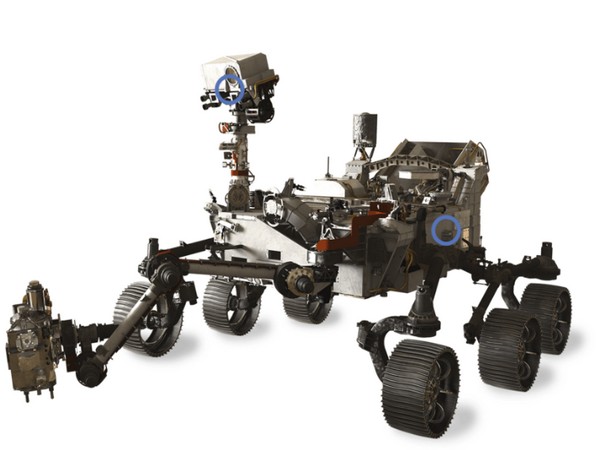

California [US], July 23 (ANI): If you could stand on the surface of Mars, what would you hear? While 8 missions have returned stunning views from the surface of the Red Planet, none have returned any sound.
That's about to change. NASA's Perseverance rover, which is days away from blasting off on a mission to search for signs of past life and collect samples for a future return to Earth, will have not one, but two microphones aboard.
One will listen as the rover plummets through the Martian atmosphere for landing, and another will record sounds as the rover does its scientific work in Jezero Crater -- an ancient river delta where life may have flourished.
If all goes well, Perseverance's microphones will fulfill the wishes of Planetary Society co-founder Carl Sagan, who wrote a letter to NASA in 1996 urging the space agency to send a microphone to Mars.
"Even if only a few minutes of Martian sounds are recorded from this first experiment, the public interest will be high and the opportunity for scientific exploration real," Sagan wrote.
At least 3 Mars missions prior to Perseverance have had microphones as part of their design. The first, which flew to Mars in 1999 aboard NASA's Mars Polar Lander, was sponsored by The Planetary Society, and became the first crowdfunded science instrument to fly to another planet. The Polar Lander crashed on the surface, but more attempts would follow. However, so far, none have succeeded.
"Sounds from Mars have been something the public has long found fascinating and, as a result, that The Planetary Society has embraced and pursued," said Bruce Betts, chief scientist for The Planetary Society.
"It goes back to our early ideas of expanding space sciences to the public, so this concept of engaging our senses with another world in a whole new way is something The Planetary Society has believed in. And now we hope that it actually will come to fruition," Betts added.
- Perseverance's Microphones
Of Perseverance's two microphones, one is part of the Entry, Descent and Landing (EDL) system responsible for safely bringing the rover through Mars' atmosphere to the surface. The audio from that microphone will be paired with full-color video taken by EDL cameras. This will allow viewers to experience what landing on Mars looks and sounds like for the very first time.
The second microphone is included in the rover's SuperCam science instrument, a next-generation version of the Curiosity rover's laser-zapping ChemCam. Like its predecessor, SuperCam uses an infrared laser beam to heat and vaporize rocks and the Martian soil. A special camera can then determine the chemical makeup of the vaporized materials, and detect the presence of any organic compounds -- a wide variety of carbon-based compounds that make up the proteins for life as we know it.
When SuperCam blasts a rock, the resulting popping sound will give scientists clues about the rock's composition. But it will also be able to record sounds from the rover doing its job, said Greg Delory, the CEO and co-founder of space hardware company Heliospace. Delory is an advisor for the SuperCam microphone team, and helped design The Planetary Society's original Mars microphone.
"Hearing how the mast swivels, the wheels turn, or hearing how other instruments sound can also be an important engineering diagnostic tool," he said.
Perhaps the most anticipated feature of the microphone is that it will also record the sounds of Mars itself. Will we hear the howling of the Martian wind? Do Martian storms produce thunder-like on Earth?
- The First Mars Microphone
The idea for a Mars microphone came from planetary scientist Janet Luhmann of the University of California, Berkeley in the mid-1990s.
"I had been involved in Mars science and Mars mission planning for some years, and I became curious why no one had considered sound as a part of the spectrum of perception that we seek to achieve with robots," she said.
Luhmann and a few fellow scientists at UC Berkeley's Space Science Lab started poking around with the idea, using off-the-shelf parts like hearing aid mics, and tested the concept in Mars-like conditions at the Mars Wind Tunnel at NASA's Ames Research Center. The results were promising, and the Berkeley scientists began thinking that NASA might be willing to fly the microphone to Mars as a ride-along instrument.
Luhmann approached The Planetary Society about sponsoring the Mars microphone. Society co-founders Bruce Murray, Carl Sagan, and Lou Friedman were intrigued, recognizing the public interest value of such an instrument. But when they presented the concept to the science advisory committee for NASA's Mars Polar Lander mission, which would launch in early 1999, the idea of a microphone was dismissed outright. There wasn't any scientific value, the committee said.
"It was very reminiscent of the very early days of planetary missions. Cameras weren't included in the first Pioneer and Mariner spacecraft because the scientific wisdom of the time was that imaging was just a stunt; it wasn't good science. It's hard to imagine that now, but the advisory committee back then thought that hearing sounds on Mars was just a stunt, too," recalled Friedman.
At about that same time, NASA Administrator Dan Goldin was instigating an initiative called "Mars Together" that promoted the idea of Russian and American scientific cooperation on future Mars missions, in parallel with the countries' new partnership on the International Space Station. As a result, a Russian LIDAR instrument to study dust in Mars' atmosphere had been picked to fly on Mars Polar Lander.
Using connections forged during past Planetary Society efforts to bring Soviet and American scientists together during the Cold War, Friedman and Luhmann asked the principal investigator for the Russian LIDAR, Viacheslav Linkin, if he was interested in adding the tiny Mars Microphone to his instrument. Linkin said yes.
Bolstered by an outpouring of public interest in hearing sounds from Mars, The Planetary Society raised $100,000 to build the Mars microphone. Delory, one of Luhmann's fellow Berkeley scientists at the time, joined the project and led the technical effort to get the microphone unit integrated onto the LIDAR without requiring any adjustments to the power, volume, and weight allocations NASA had given the Russian instrument.
"The original Mars microphone we built was a smart little box, about 5 centimeters on each side, weighing 50 grams," said Delory. "The microphone was built for extreme environments, and we tested it enough to know how robust it was."
He and his team put the device through every test imaginable, using vacuum and thermal chambers and shake tables to make sure it would survive launch, cruise, landing, and operating in Mars' harsh environment, as well as functioning in every mode they had wired in. The microphone worked flawlessly through integration and testing with the LIDAR, and when they hooked it up to the lander, it worked perfectly.
Meeting NASA's data constraints for the microphone would prove to be a challenge, with the team working exceptionally hard on refining the electronics that processed and managed the sound recordings.
"When you're an education and public outreach add-on, you aren't allocated a big part of the data budget. We also didn't want to send back data with no sounds or uninteresting sounds, so we used a speech recognition chip that would take in the sounds from the mic and reduce the data to something really manageable," Delory said.
The solution involved several tricks: the microphone could record for an hour and then only send back the loudest sounds. It could also take random audio samples during specific time periods to avoid having to beam back every second of data.
- Let-downs and High Hopes
Mars Polar Lander blasted off from Cape Canaveral, Florida on 3 January 1999. The spacecraft made it all the way to Mars and began its descent to the surface on 3 December. Suddenly, the spacecraft seemed to disappear without a trace. Controllers lost the signal from the spacecraft and despite repeated efforts to reestablish communications, MPL was never heard from again.
After a thorough investigation, engineers concluded the most likely scenario was that MPL's demise occurred when the lander thought the jolt from deploying the landing legs was a touchdown, so it shut its engines off too early. It likely crashed at high speed into Mars' surface.
"It was a huge let-down. Since the Mars Microphone had made a huge splash with the public and press, we had a conference room open at our lab to host the landing event and celebrate. But when it was known that the landing had failed, there were a few people who stuck around for a reaction but mostly there was an exodus. It was a pretty sad end to our project, and we thought there was little prospect for a re-do," Luhman recalled.
But interest in the Mars microphone project continued. Immediately following the loss of Polar Lander, a second opportunity to fly the microphone experiment was provided by the French space agency CNES on its Netlander mission, scheduled to launch in 2007. Netlander consisted of 4 small identical landers across the planet that would study Mars' atmosphere, surface, and interior. However, the mission was canceled in 2004 due to funding difficulties.
NASA finally came around to the idea of a Mars microphone for its Phoenix lander, which touched down near Mars' north pole in 2008. Phoenix's microphone was part of its descent imaging system and used a design similar to the original microphone on Polar Lander. The Planetary Society would have provided public outreach. But just before launch, engineers detected a potential electronics problem in the microphone that might affect other systems, and the mic was deactivated.
"There was an option of possibly turning the microphone on after Phoenix had accomplished its primary mission goals of assessing the local habitability and researching the history of water on Mars. But there were higher priorities elsewhere, and they were still worried about possible electrical issues, so it never was turned on before Phoenix succumbed to the frigid conditions in Mars' northern hemisphere in November of 2008," said Betts.
The Planetary Society attempted unsuccessfully to get microphones on NASA's Spirit, Opportunity, Curiosity, and InSight missions, as well as the European Space Agency's ill-fated Schiaparelli lander that crashed in 2016. That means it's up to Perseverance to deliver the dream of hearing sounds from Mars.
"I have the same hopes for this mission as with the Mars Polar Lander! Nothing has changed for me in that regard, because whenever we see the first picture, or first data from any mission, it's always exciting. Waiting for the first sound from Mars will be equally exciting," said Friedman.
The microphones onboard Perseverance are similar in design to The Planetary Society's original Mars microphone that launched in 1999. It's been a long road to this point, and Delory can't wait to finally hear what Mars sounds like.
"We've been able to see Mars from the rovers' point of view for a long time now. To be able to add another sense to our understanding of Mars is going to be incredible," he said. (ANI)




