

ADD ANI AS A TRUSTED SOURCE
googleads
ANI Logo
Menu
Science

Newly discovered planet zips around baby star in a week

Washington D.C. [USA], June 24 (ANI): Understanding how planets form is one of the main challenges scientists face when placing our own and other planetary systems in context. Planets are thought to form from the disk-shaped clouds of gas and dust that surround newborn stars, but this process has never been observed. Astronomers normally only observe planets after they have already formed and have to deduce the pathways that that led to their final states.

ANI Jun 24, 2020 23:43 IST googleads

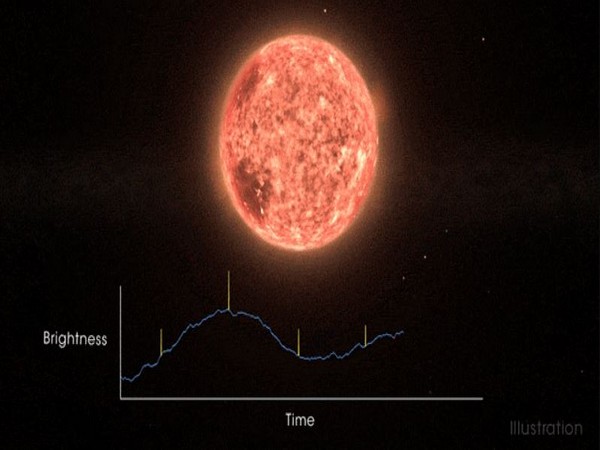
An artist's rendering of the AU Mic star system. (Image courtesy: NASA's Goddard Space Flight Center)

Washington D.C. [USA], June 24 (ANI): Understanding how planets form is one of the main challenges scientists face when placing our own and other planetary systems in context. Planets are thought to form from the disk-shaped clouds of gas and dust that surround newborn stars, but this process has never been observed. Astronomers normally only observe planets after they have already formed and have to deduce the pathways that that led to their final states.
For more than a decade, astronomers have searched for planets orbiting AU Microscopii, a nearby star still surrounded by a disk of debris left over from its formation. Now scientists using data from NASA's Transiting Exoplanet Survey Satellite, or TESS, and now-retired Spitzer Space Telescope report the discovery of a planet about as large as Neptune that circles the young star in just over a week.
The new planet, AU Mic b, is located 31.9 light-years away in the southern constellation Microscopium and described in a paper published in Nature. The system, known as AU Mic for short, provides a one-of-a-kind laboratory for studying how planets and their atmospheres form, evolve, and interact with their stars.
"AU Mic is a young, nearby M dwarf star. It's surrounded by a vast debris disk in which moving clumps of dust have been tracked, and now, thanks to TESS and Spitzer, it has a planet with a direct size measurement," said co-author Bryson Cale, a doctoral student at George Mason University in Fairfax, Virginia. "There is no other known system that checks all of these important boxes."
"Finding a 'missing link,' such as the planet orbiting AU Mic, essentially caught in the act of forming, is extremely rare," said co-author Stephen Kane, an associate professor in the Department of Earth and Planetary Sciences at the University of California, Riverside. "What makes this especially rare is that it also transits its star, so we can measure the radius as well as the mass, leading to an estimate of the bulk density of the planet and its likely composition.
"This discovery will form the foundation for many years of observational and theoretical studies into the very earliest stages for planet formation," added Kane, who helped develop the instrument that measured the planet mass and was part of the TESS team that discovered the transit of the planet.
AU Mic is a cool red dwarf star with an age estimated at 20 million to 30 million years, making it a stellar infant compared to our sun, which is at least 150 times older. The planet AU Mic b almost hugs its star, completing an orbit every eight-and-a-half days. It weighs less than 58 times Earth's mass, placing it in the category of Neptune-like worlds.
"We think AU Mic b formed far from the star and migrated inward to its current orbit, something that can happen as planets interact gravitationally with a gas disk or with other planets," said co-author Thomas Barclay, an associate research scientist at the University of Maryland, Baltimore County, and an associate project scientist for TESS at NASA's Goddard Space Flight Center in Greenbelt, Maryland.
When a planet crosses in front of its star from our perspective -- an event called a transit -- its passage causes a distinct dip in the star's brightness. TESS monitors large swaths of the sky, called sectors, for 27 days at a time. During this long stare, the mission's cameras regularly capture snapshots that allow scientists to track changes in stellar brightness.
Regular dips in a star's brightness signal the possibility of a transiting planet. Usually, it takes at least two observed transits to recognize a planet's presence.
"As luck would have it, the second of three TESS transits occurred when the spacecraft was near its closest point to Earth. At such times, TESS is not observing because it is busy downlinking all of the stored data," said co-author Diana Dragomir, a research assistant professor at the University of New Mexico in Albuquerque. "To fill the gap, our team was granted observing time on Spitzer, which caught two additional transits in 2019 and enabled us to confirm the orbital period of AU Mic b."
Because the amount of light blocked by a transit depends on the planet's size and orbital distance, the TESS and Spitzer transits provide a direct measure of AU Mic b's size. Analysis of these measurements shows the planet is about 8% larger than Neptune.
AU Mic b might not be the only planet orbiting its star.
"There is an additional candidate transit event seen in the TESS data, and TESS will hopefully revisit AU Mic later this year in its extended mission," said lead author Peter Plavchan, an assistant professor of physics and astronomy at George Mason. "We are continuing to monitor the star with precise radial velocity measurements, so stay tuned."
The paper, "A planet within the debris disk around the pre-main-sequence star AU Microscopii," was published June 24. (ANI)

Get the App

What to Read Next

Science

Amphibians bounce-back from Earth’s greatest mass extinction

Amphibians bounce-back from Earth’s greatest mass extinction

Researchers at the University of Bristol discovered that ancient frog ancestors survived the biggest mass extinction of species by eating on freshwater prey that evaded terrestrial predators.

Read More
Science

Shubhanshu Shukla: IAF officer becomes first Indian astronaut for

Shubhanshu Shukla: IAF officer becomes first Indian astronaut for

Shubhanshu Shukla, Indian Air Force (IAF) officer and one of four astronauts for Indian Space Research Organisation's (ISRO) Gaganyaan mission, has been sele Shubhanshu Shukla, Indian Air Force (IAF) officer and one of four astronauts for Indian Space Research Organisation's (ISRO) Gaganyaan mission, has been selected as the pilot for Axiom Mission 4, scheduled for Spring 2025.cted as the pilot for Axiom Mission 4, scheduled for Spring 2025.

Read More
Science

Weather change linked to heightened risk of Salmonella outbreaks

Weather change linked to heightened risk of Salmonella outbreaks

According to new research from the University of Surrey, climate change has an impact on Salmonella spread. This study builds on prior work by the researchers, which discovered that weather change is contributing to the spread of deadly diarrhoeal illnesses.

Read More
Science

Study finds connection between quantum theory, information theory

Study finds connection between quantum theory, information theory

"Our results have no clear or direct application right now. It's basic research that lays the foundation for future technologies in quantum information and quantum computers. There's enormous potential for complete discoveries in many different research fields," said Guilherme B Xavier, a researcher in quantum communication at Linkoping University, Sweden.

Read More
Science

Alternate method to study changes during DNA replication process

Alternate method to study changes during DNA replication process

Researchers at Colorado State University discovered an alternative way for studying alterations during the DNA replication process in lab settings using genetically modified yeast. The novel methodology provides a clearer picture than current pharmacological methods for understanding cell cycle arrest, a fundamental mechanism critical to cancer treatment and genetic concerns.

Read More
Science

Study: New potential treatment for cardiac arrhythmias

Study: New potential treatment for cardiac arrhythmias

A recent study by researchers at the University of Arizona College of Medicine - Phoenix and the University of California Davis Health discovered a new target for developing a medication to treat atrial fibrillation, the most prevalent kind of irregular heart rhythm.

Read More
Science

Medication increases radiation therapy's efficacy for lung cancer

Medication increases radiation therapy's efficacy for lung cancer

A group of researchers from the University of Cincinnati has discovered a possible novel approach to enhance the efficacy of radiation therapy and enhance the prognosis of patients with lung cancer metastasizing to the brain.

Read More
Science

Researchers discover molecular mechanism for bacterial infection

Researchers discover molecular mechanism for bacterial infection

Researchers at Virginia Tech have discovered how bacteria change molecules in order to infect their host.

Read More
Science

'Bone marrow cancer drug shows success in blood disorder'

'Bone marrow cancer drug shows success in blood disorder'

When researchers discovered enough proof that a medication used to treat bone marrow cancer and Kaposi sarcoma is safe and effective in treating hereditary hemorrhagic telangiectasia (HHT), a rare bleeding disorder that affects 1 in 5,000 people worldwide, they decided to terminate an early clinical trial funded by the National Institutes of Health

Read More
Science

Researchers give more insight into heat perception in humans

Researchers give more insight into heat perception in humans

The Medical University of Vienna's research has significantly advanced our knowledge of how humans perceive heat. A group of scientists has discovered a particular type of cell structure involved in heat recognition.

Read More
Home About Us Our Products Advertise Contact Us Terms & Condition Privacy Policy

Copyright © aninews.in | All Rights Reserved.




