

ADD ANI AS A TRUSTED SOURCE
googleads
ANI Logo
Menu
Science

New study reveals climate change in oceanwater might impact mangrove dispersal

Washington [US], July 3 (ANI): According to the results of Dr. Tom Van der Stocken from VUB Biology Department study suggest that in the 21st century, mangrove forests have experienced changes in ocean surface temperature, salinity, and density around the world. The study also revealed that changes in surface-ocean density may have an impact on the dispersal patterns of globally distributed mangrove species in the Indo-West Pacific, the main hotspot of mangrove diversity.

ANI Jul 03, 2022 23:23 IST googleads

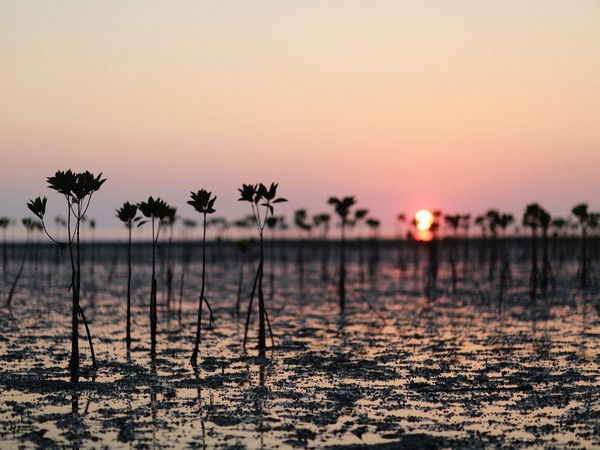
Representative image

Washington [US], July 3 (ANI): According to the results of Dr. Tom Van der Stocken from VUB Biology Department study suggest that in the 21st century, mangrove forests have experienced changes in ocean surface temperature, salinity, and density around the world.The study also revealed that changes in surface-ocean density may have an impact on the dispersal patterns of globally distributed mangrove species in the Indo-West Pacific, the main hotspot of mangrove diversity.
The findings of the research were published in Nature Climate Change.
"Climate change affects sea-surface density via changes in temperature and salinity. Since propagules of widely distributed mangroves species have densities near that of seawater, changes in ocean density hold implications for oceanic dispersal of mangroves. Whether mangrove propagules float or sink depends on the difference between the densities of the propagules and that of the surrounding water." says Tom Van der Stocken, Marie Sklodowska-Curie Postdoctoral Scholar at Vrije Universiteit Brussel, and research affiliate at the NASA Jet Propulsion Laboratory. "It is expected that warming winter temperatures and sea level rise will impact the distribution of these carbon-rich forests, but changes in surface-ocean properties might also influence distributional patterns through dispersal."
Mangroves are highly productive intertidal forests that occur along tropical, subtropical, and some temperate coasts. They support a broad variety of ecosystem goods and services and have an important place on the international climate mitigation and adaptation agenda. However, at the same time, these intertidal forests are strongly impacted by human activities and subjected to climate-driven changes in the marine, terrestrial and atmospheric processes to which they are tightly linked. While previous studies have focused on the potential impact of sea-level rise, altered precipitation regimes, and increasing temperature and storm frequency on mangrove ecosystems, the potential effects of climate-driven changes in seawater properties had not been considered.
Van der Stocken: "This is surprising, as the ocean is the primary dispersal medium of this 'sea-faring' coastal vegetation and dispersal is a key process that governs a species' response to climate change by changing its geographical range."

The paper, "Mangrove dispersal disrupted by projected changes in global seawater density", is co-authored by VUB professors Bram Vanschoenwinkel and Nico Koedam, and in collaboration with the Moss Landing Marine Laboratories (MLML) and the University of California, Los Angeles (UCLA).
The team made use of present and future sea-surface temperature and salinity data from the Bio-ORACLE database developed at Ghent University, and derived sea-surface density estimates from these data using the UNESCO EOS-80 equation of state polynomial for seawater.
"Our study provides evidence that the density of surface-ocean waters along mangrove forests will decrease by the end of the 21st century, and a factor of two larger in the Indo-West Pacific region than in the Atlantic East Pacific," says Koedam.

"It is important to note that our study uses present and future environmental conditions based on monthly averages and that the actual variability in sea-surface density around these mean values could be higher than that predicted in this study," adds Vanschoenwinkel.

Van der Stocken: "There is still uncertainty on exactly how the projected changes in seawater density will impact realized mangrove dispersal in different parts of the world and more research is needed regarding the biological response of mangroves to climate-driven changes in surface-water properties.
In this study, we took advantage of marine data layers to fill this gap, and we hope that our study will help to inspire new research that will quantify the effects of changes in the properties of the ocean surface on propagule floating periods, dispersal, and connectivity." (ANI)

Get the App

What to Read Next

Science

'Creation of black holes without singularities through gravity'

'Creation of black holes without singularities through gravity'

Traditional black holes, as predicted by Albert Einstein's theory of General Relativity, contain what are known as singularities, i.e. points where the laws of physics break down. Identifying how singularities are resolved in the context of quantum gravity is one of the fundamental problems in theoretical physics. Now, a team of experts has described the creation of regular black holes from gravitational effects without the need for the existence of exotic matter required by some previous models.

Read More
Science

Discovering the genetics of climate adaptation 

Discovering the genetics of climate adaptation 

As climate change accelerates, plants are under increasing pressure to adapt to changing habitats and environmental conditions.

Read More
Science

Weather change linked to heightened risk of Salmonella outbreaks

Weather change linked to heightened risk of Salmonella outbreaks

According to new research from the University of Surrey, climate change has an impact on Salmonella spread. This study builds on prior work by the researchers, which discovered that weather change is contributing to the spread of deadly diarrhoeal illnesses.

Read More
Science

Thermal imaging may help fruits, veggies stay fresher longer: Study

Thermal imaging may help fruits, veggies stay fresher longer: Study

Before your favourite produce arrives at the grocery store, it must be carefully harvested and stored for extended periods of time. A recent University of Georgia assessment argues that new temperature sensing devices could make that procedure considerably easier, as agricultural issues are exacerbated by changing climates.

Read More
Science

Fever promotes increased activity, mitochondrial damage

Fever promotes increased activity, mitochondrial damage

Researchers at Vanderbilt University Medical Centre showed that fever temperatures increase immune cell metabolism, proliferation, and activity, but they also promote mitochondrial stress, DNA damage, and cell death in a specific subgroup of T cells.

Read More
Science

Researchers discover molecular mechanism for bacterial infection

Researchers discover molecular mechanism for bacterial infection

Researchers at Virginia Tech have discovered how bacteria change molecules in order to infect their host.

Read More
Science

Contrail avoidance is less likely to damage climate by mistake

Contrail avoidance is less likely to damage climate by mistake

A new study allays concerns that rerouting planes to avoid producing climate-warming contrails may accidentally exacerbate climate change.

Read More
Science

Long-term metastatic melanoma survival improves with treatment

Long-term metastatic melanoma survival improves with treatment

According to a new report from Weill Cornell Medicine and Dana-Farber Cancer Centre investigators and their colleagues, long-term data from a landmark international trial show that approximately half of patients with metastatic melanoma treated with a combination of immune checkpoint inhibitors survive cancer-free for 10 years or more.

Read More
Science

Memory problems in old age may be linked to key enzyme: Study

Memory problems in old age may be linked to key enzyme: Study

Everyone experiences occasional episodes of forgetfulness, particularly as they age. It's not only that fresh material is hard for older folks to remember. Moreover, when new information becomes available, they find it more difficult to change those thoughts. Nevertheless, not much is understood about the processes that underlie memory updating and how they malfunction as we age.

Read More
Science

Study finds how genetic diagnostics of ultra-rare diseases

Study finds how genetic diagnostics of ultra-rare diseases

Most rare diseases are caused by genetics. A molecular genetic diagnosis can be made more quickly and readily by identifying the underlying genetic change, for instance by exome sequencing (ES). The analysis of every region of our DNA that codes for a protein is known as ES.

Read More
Home About Us Our Products Advertise Contact Us Terms & Condition Privacy Policy

Copyright © aninews.in | All Rights Reserved.


