

ADD ANI AS A TRUSTED SOURCE
googleads
ANI Logo
Menu
Science

New insights into the origin of diamonds in meteorites

Washington [US], September 29 (ANI): Scientists have offered new insights into the origin of diamonds in a group of stony meteorites called ureilites.

ANI Sep 29, 2020 08:24 IST googleads

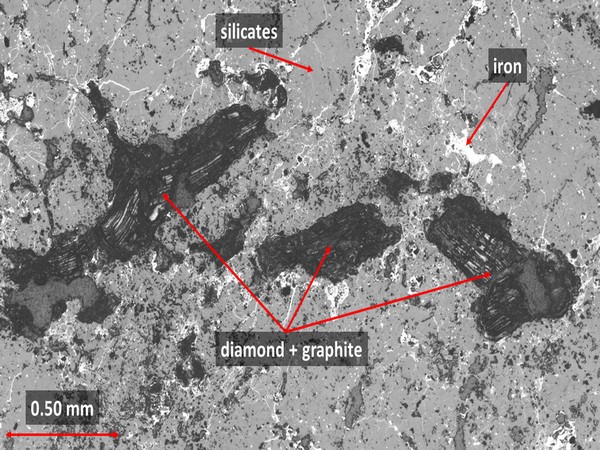
Microphotograph of NWA 7983 ureilite (Image Credit: Oliver Christ)

Washington [US], September 29 (ANI): Scientists have offered new insights into the origin of diamonds in a group of stony meteorites called ureilites.
These diamonds most likely formed by rapid shock transformation from graphite during one or more major impacts into the ureilite parent asteroid in the early solar system.
Previously, researchers have proposed that diamonds in ureilites formed like those on Earth -- deep in the mantle of the planet, where the high pressures needed to form a diamond, are created by the weight of the overlying rock.
If diamonds in ureilites formed this way, then the original parent body on which they formed must have been a large protoplanet -- at least the size of Mars or Mercury.
However, new research conducted by Prof. Fabrizio Nestola (University of Padova, Italy), Dr. Cyrena Goodrich (Universities Space Research Association at the Lunar and Planetary Institute), and their colleagues show there is no evidence requiring formation under the high static pressures and long growth time conditions of a planet's deep interior.
The team investigated diamonds in three ureilite samples using electron microscopy, micro X-ray diffraction, and Raman laser spectroscopy. Their investigations revealed both large and small grains of diamond, along with metallic iron and graphite, in the carbon-rich regions located among the silicate mineral grains in these samples.
"We discovered the largest single-crystal diamond ever observed in a ureilite. Importantly, the ureilites that we investigated have all been highly shocked, based on the evidence from their silicate minerals, which strongly suggests that both large and small diamonds in these rocks formed from original graphite via shock processes," said Dr Cyrena Goodrich.
The origin of diamonds in ureilites has important implications for models of planetary formation in the early solar system. Present day asteroids, from which most meteorites originate, are very small compared to the planets. However, planetary formation models predict that planets formed as a result of the accumulation of Moon- to Mars-sized planetary embryos (protoplanets).
Advocates of the high static pressure hypothesis for the origin of ureilite diamonds argue that the ureilite parent body was one of these embryos. However, Nestola and co-authors demonstrate that the presence of diamonds in ureilites does not require a Mars-sized parent body.
Previously it was thought that micrometer-sized diamonds were too large to have formed in the short time periods during which peak pressures are maintained in impact events. However, Nestola et al. calculated that peak shock pressures could last for 4-5 seconds during a major impact such as that inferred for the ureilite parent body.
This is sufficient for the formation of 100 micrometer-sized diamonds when catalyzed by the presence of metal, a process commonly used in the production of diamonds in the industry. Since metal is ubiquitously associated with the carbon phases in ureilites, catalyzed formation of large diamonds from original graphite under shock compression is very likely.
"Our findings are important because they not only indicate a shock origin for the diamonds in ureilites, as discussed by many previous researchers, they also refute arguments that have been made for the large parent body hypothesis," Dr. Goodrich said.
"This type of scientific debate and testing of hypotheses is an essential part of making progress in science," added Dr. Goodrich. (ANI)


Get the App

What to Read Next

Science

New technology enhances gravitational-wave detection: Study

New technology enhances gravitational-wave detection: Study

A team of physicists led by Jonathan Richardson of the University of California, Riverside, demonstrated how new optical technology can extend the detection range of gravitational-wave observatories such as the Laser Interferometer Gravitational-Wave Observatory, or LIGO, and pave the way for future observatories.

Read More
Science

Laser epilation lowers risk of recurrence of pilonidal disease

Laser epilation lowers risk of recurrence of pilonidal disease

According to research, laser epilation, also known as laser hair removal, reduced the risk of recurrence in patients with pilonidal disease, an inflammatory, painful, and sometimes chronic or recurring condition.

Read More
Science

Study reveals how any activity better for heart than sitting

Study reveals how any activity better for heart than sitting

Researchers at Nemours Children's Health, Delaware Valley, found that laser epilation, also called laser hair removal, decreased the risk of recurrence in patients with pilonidal disease, an inflammatory, painful, and occasionally chronic or recurring condition.

Read More
Science

Researchers take step towards reliably processing quantum info

Researchers take step towards reliably processing quantum info

Researchers have found the most robust way for controlling individual qubits made of the chemical element barium using laser light. The capacity to manipulate a qubit reliably is a significant step towards realising future functioning quantum computers.

Read More
Science

Study finds imaging system that takes diagnosis step further

Study finds imaging system that takes diagnosis step further

Recognising the benefits of imaging and spectroscopy, UBCO's Integrated Optics Laboratory (IOL) researchers developed imaging systems that use terahertz radiation.

Read More
Science

New insight into cellular process which prevents spread of cancer

New insight into cellular process which prevents spread of cancer

For the first time, researchers have identified a distinct molecular mechanism underlying the early phases of programmed cell death, or apoptosis, a process that plays an important role in cancer prevention.

Read More
Science

Researchers study brain immune cells

Researchers study brain immune cells

A multinational study team led by experts from DZNE, University Hospital Bonn, and the Netherlands studied brain immune cells and used laser irradiation to alter them. As molecular mediators, gene transcripts (mRNAs) will be used. Scientists want to learn more about how these cells change their form in response to danger and their function in neurodegenerative illnesses like Alzheimer's through laboratory research.

Read More
Science

How photosynthesis lead to ways of generating renewable energy

How photosynthesis lead to ways of generating renewable energy

The natural mechanism of photosynthesis, which powers the majority of life on Earth, has been disclosed by researchers, and they have discovered new strategies for obtaining energy from it. New techniques for creating clean fuel and renewable energy may result from this research.

Read More
Science

Laser treatments help prevent skin cancer: Study

Laser treatments help prevent skin cancer: Study

Basal cell carcinoma and squamous cell carcinoma, jointly known as keratinocyte carcinoma and the most prevalent types of cancer diagnosed in the United States, are thought to be preventable with simple laser skin treatments, according to new research.

Read More
Science

Meteorite hunters find 17-pound space rock in Antarctica

Meteorite hunters find 17-pound space rock in Antarctica

Antarctica is a tough place to work, for obvious reasons it's bitterly cold, remote, and wild. However, it's one of the best places in the world to hunt for meteorites. That's partly because Antarctica is a desert, and its dry climate limits the degree of weathering the meteorites experience. On top of the dry conditions, the landscape is ideal for meteorite hunting: the black space rocks stand out clearly against snowy fields. Even when meteorites sink into the ice, the glaciers' churning motion against the rock below helps re-expose the meteorites near the surface of the continent's blue ice fields.

Read More
Home About Us Our Products Advertise Contact Us Terms & Condition Privacy Policy

Copyright © aninews.in | All Rights Reserved.
