 हिंदी खबर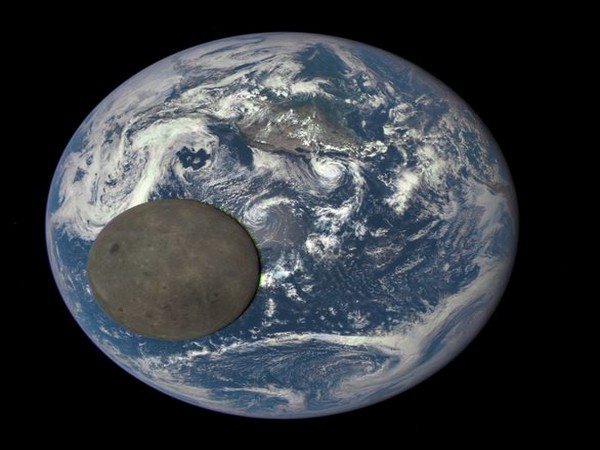

Tokyo [Japan], June 22 (ANI): Earth's Moon has a 'near side' that is perpetually Earth-facing and a 'far side', which always faces away from Earth. The composition of the Moon's near side is oddly different from its far side, and scientists think they finally understand why.
The Earth-Moon system's history remains mysterious. Scientists believe the two formed when a Mars-sized body collided with the proto-Earth. Earth ended up being the larger daughter of this collision and retained enough heat to become tectonically active. The Moon, being smaller, likely cooled down faster and geologically 'froze'. The apparent early dynamism of the Moon challenges this idea.
New data suggest this is because radioactive elements were distributed uniquely after the catastrophic Moon-forming collision. Earth's Moon, together with the Sun, is a dominant object in our sky and offers many observable features which keep scientists busy trying to explain how our planet and the Solar System formed. Most planets in our solar system have satellites. For example, Mars has two moons, Jupiter has 79 and Neptune has 14. Some moons are icy, some are rocky, some are still geologically active and some relatively inactive. How planets got their satellites and why they have the properties they do are questions which could shed light on many aspects of the evolution of the early Solar System.
The Moon is a relatively cold rocky body, with a limited amount of water and little tectonic processing. Scientists presently believe the Earth-Moon system formed when a Mars-sized body dubbed Theia - who in Greek mythology was the mother of Selene, the goddess of the Moon - catastrophically collided with the proto-Earth, causing the components of both bodies to mix.
The debris of this collision are thought to have fairly rapidly, perhaps over a few million years, separated to form the Earth and Moon. The Earth ended up being larger and evolved in a sweet spot in terms of its size being just right for it to become a dynamic planet with an atmosphere and oceans. Earth's Moon ended up being smaller and did not have sufficient mass to host these characteristics. Thus retaining volatile substances like water or the gases that form our atmosphere, or retaining sufficient internal heat to maintain long-term planetary volcanism and tectonics, are idiosyncratic to how the Earth-Moon forming collision occurred. Decades of observations have demonstrated that lunar history was much more dynamic than expected with volcanic and magnetic activity occurring as recently as 1 billion years ago, much later than expected.
A clue as to why the near and far side of the Moon are so different comes from strong asymmetry observable in its surface features. On the Moon's perpetually Earth-facing near side, on any given night, or day, one can observe dark and light patches with the naked eye. Early astronomers named these dark regions 'maria', Latin for 'seas', thinking they were bodies of water by analogy with the Earth. Using telescopes, scientists were able to figure out over a century ago that these were not in fact seas, but more likely craters or volcanic features.
Back then, most scientists assumed the far side of the Moon, which they would never have been able to see, was more or less like the near side.
However, because the Moon is relatively close to the Earth, only about 380,000 km away, the Moon was the first Solar System body humans were able to explore, first using non-crewed spacecraft and then 'in person'. In the late 1950s and early 1960s, non-crewed space probes launched by the USSR returned the first images of the far side of the Moon, and scientists were surprised to find that the two sides were very different. The far side had almost no maria. Only 1% of the far side was covered with maria compared with ~31% for the near side. Scientists were puzzled, but they suspected this asymmetry was offering clues as to how the Moon formed.
In the late 1960s and early 1970s, NASA's Apollo missions landed six spacecraft on the Moon, and astronauts brought back 382 kg of Moon rocks to try to understand the origin of the Moon using chemical analysis. Having samples in hand, scientists quickly figured out the relative darkness of these patches was due to their geological composition and they were, in fact, attributable to volcanism. They also identified a new type of rock signature they named KREEP - short for rock enriched in potassium (chemical symbol K), rare-earth elements (REE, which include cerium, dysprosium, erbium, europium, and other elements which are rare on Earth) and phosphorus (chemical symbol P) - which was associated with the maria. But why volcanism and this KREEP signature should be distributed so unevenly between the near and far sides of the Moon again presented a puzzle.
Now, using a combination of observation, laboratory experiments and computer modelling, scientists from the Earth-Life Science Institute at Tokyo Institute of Technology, the University of Florida, the Carnegie Institution for Science, Towson University, NASA Johnson Space Center and the University of New Mexico have brought some new clues as to how the Moon gained its near- and far-side asymmetry. These clues are linked to an important property of KREEP.
Potassium (K), thorium (Th) and uranium (U) are, importantly for this story, radioactively unstable elements. This means that they occur in a variety of atomic configurations that have variable numbers of neutrons. These variable composition atoms are known as 'isotopes', some of which are unstable and fall apart to yield other elements, producing heat.
The heat from the radioactive decay of these elements can help melt the rocks they are contained in, which may partly explain their co-localisation.
This study shows that, in addition to enhanced heating, the inclusion of a KREEP component to rocks also lowers their melting temperature, compounding the expected volcanic activity from simply radiogenic decay models. Because most of these lava flows were emplaced early in lunar history, this study also adds constraints about the timing of the Moon's evolution and the order in which various processes occurred on the Moon.
This work required collaboration among scientists working on theory and experiment. After conducting high temperature melting experiments of rocks with various KREEP components, the team analysed the implications this would have on the timing and volume of volcanic activity at the lunar surface, providing important insight about the early stages of evolution of the Earth-Moon system.
ELSI co-author Matthieu Laneuville comments, 'Because of the relative lack of erosion processes, the Moon's surface records geological events from the Solar System's early history. In particular, regions on the Moon's near side have concentrations of radioactive elements like U and Th unlike anywhere else on the Moon. Understanding the origin of these local U and Th enrichments can help explain the early stages of the Moon's formation and, as a consequence, conditions on the early Earth.'
The results from this study suggest that the Moon's KREEP-enriched maria have influenced lunar evolution since the Moon formed. Laneuville thinks evidence for these kinds of non-symmetric, self-amplifying processes might be found in other moons in our Solar System, and maybe ubiquitous on rocky bodies throughout the Universe. (ANI)




