

ADD ANI AS A TRUSTED SOURCE
googleads
ANI Logo
Menu
Science

New analysis finds pandemic didn't dampen deforestation

Despite the massive upheavals in the first year of the COVID-19 pandemic, deforestation globally proceeded more or less as expected from the trends established over the last 15 years, according to a recent study from researchers at the Alliance of Bioversity International and CIAT.

ANI Nov 29, 2022 05:06 IST googleads

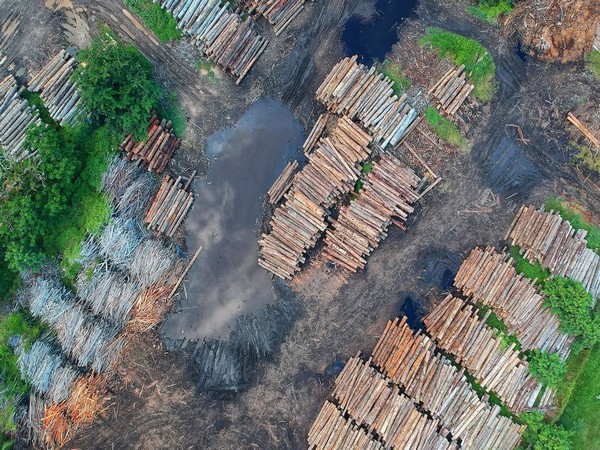
Representative Image

Rome [Italy], November 29 (ANI): According to a new analysis by researchers at the Alliance of Bioversity International and CIAT, deforestation worldwide proceeded more or less as anticipated from the trends established over the last 15 years, despite the significant upheavals in the first year of the COVID-19 pandemic.
Researchers analysed historical deforestation data (2004-2019) from the Terra-i pantropical land cover change monitoring system to forecast expected deforestation trends for 2020 in the publication "Has global deforestation accelerated due to the COVID-19 pandemic?" released in mid-November 2022.
Determining whether deforestation observed in 2020 deviated from expected trajectories after the first COVID-19 cases were reported required analysis of tree cover loss over time, both at the regional and national levels for the Americas, Africa, and Asia, as well as for Brazil, Colombia, Peru, the Democratic Republic of the Congo, and Indonesia.
"It was not particularly surprising to see little change," said Janelle Sylvester, who is the corresponding author of the study and a Research Fellow at the Alliance.
She said that deforestation rates likely did not drastically change for many reasons. For one, it is probable that the complex dynamics driving deforestation before the pandemic persisted unimpacted by the lockdowns.
"For example, illegal deforestation in areas where there was minimal state (governmental) presence before the pandemic would likely continue during lockdowns," she said.
Furthermore, she added that "national economic stimulus packages combined with global macroeconomic dynamics connected to changes in demand and supply could have balanced out economic pressures that were being placed on forests."
Louis Reymondin, who co-leads the Alliance of Bioversity International and CIAT's research theme on the digital transformation of agri-food systems, added that the results weren't unexpected given that livestock grazing is a major driver of deforestation and that demand for those products persisted throughout the 2020 lockdowns.
"There were changes in food consumption habits, but usually it was towards processed foods and a reliance on industrialized agriculture," he said, "The disruption needed to stop deforestation is about changing consumer behaviour, changing the food system... and that's something that countries and governments and scientists are trying to push forward."
The study's lead author, Jonathan Cespedes, who was also a research assistant for the Alliance of Bioversity and CIAT during the study and is currently a second-year PhD student at the Institut Polytechnique de Paris, explains that his task was to assess deforestation and COVID-19 data in order to identify potential relationships between the two variables.
The spatial scale of this study is worldwide, so it is important to keep that in mind. The next step is to assess sub-national and local sizes, where the outcomes may change, Cespedes added.
Sylvester said that to get a genuine snapshot of the impact, more research would be required, as national economic recovery efforts in response to the pandemic may have longer-term effects on deforestation that are not captured in this study limited to 2020.
"All in all we see that deforestation trends in most countries followed their expected trajectories; however, to really understand the effects of the pandemic on deforestation we will have to look at a longer time period, say three years or more, in order to understand how national economic recovery efforts impact forest cover," Sylvester said. (ANI)


Get the App

What to Read Next

Science

New method guides magnetism without magnets

New method guides magnetism without magnets

Researchers at Paul Scherrer Institute PSI have demonstrated an innovative method to control magnetism in materials using an energy-efficient electric field.

Read More
Science

New insights into how cancer evades the immune system: Study

New insights into how cancer evades the immune system: Study

Immunotherapy research primarily focuses on better recognition of cancer cells by the body's own immune system. Researchers at Amsterdam UMC and Moffitt Cancer Center have taken a different approach.

Read More
Science

Scientists use AI to better understand nanoparticles: Study

Scientists use AI to better understand nanoparticles: Study

A group of scientists has created a way to illuminate the dynamic behavior of nanoparticles, which are essential components in the production of pharmaceuticals, electronics, and industrial and energy-conversion materials.

Read More
Science

New device could allow you to taste cake in virtual reality

New device could allow you to taste cake in virtual reality

The 'e-Taste' interface employs sensors and wireless chemical dispensers to enable remote taste perception, often known as gestation. Field testing done by researchers at The Ohio State University confirmed the device's ability to digitally simulate a range of taste intensities, while still offering variety and safety for the user.

Read More
Science

Strand Life Sciences launches portal for rare disease diagnosis

Strand Life Sciences launches portal for rare disease diagnosis

Marking Rare Disease Day, Strand Life Sciences, a subsidiary of Reliance Industries and a leading genomics research company, has launched the StrandOmics Portal, an innovative digital platform designed to assist doctors in diagnosing rare diseases more efficiently.

Read More
Science

Study reveals impact of animals as architects of Earth

Study reveals impact of animals as architects of Earth

A new study led by Professor Gemma Harvey from Queen Mary University of London has revealed how hundreds of species shape the landscapes we depend on, from termite mounds visible from space to beavers creating wetlands and hippos carving drainage systems.

Read More
Science

Opposing arrows of time emerge from certain quantum systems

Opposing arrows of time emerge from certain quantum systems

Researchers at the University of Surrey made a thought-provoking discovery. A new study reveals that opposing arrows of time can theoretically emerge from certain quantum systems.

Read More
Science

COVID-19 severity may be predicted by White Blood Cell Count

COVID-19 severity may be predicted by White Blood Cell Count

A COVID-19 diagnosis is no longer as frightening as it used to be, thanks to developments in treatment choices. However, a new study reveals that leukocyte (white blood cell) count may now be used to identify who is more likely to develop more significant disease symptoms.

Read More
Science

Seals can essentially act as 'smart sensors': Study

Seals can essentially act as 'smart sensors': Study

A new study by marine biologists reports that seals can essentially act as 'smart sensors' for monitoring fish populations in the ocean's eerily dim 'twilight zone.'

Read More
Science

'Creation of black holes without singularities through gravity'

'Creation of black holes without singularities through gravity'

Traditional black holes, as predicted by Albert Einstein's theory of General Relativity, contain what are known as singularities, i.e. points where the laws of physics break down. Identifying how singularities are resolved in the context of quantum gravity is one of the fundamental problems in theoretical physics. Now, a team of experts has described the creation of regular black holes from gravitational effects without the need for the existence of exotic matter required by some previous models.

Read More
Home About Us Our Products Advertise Contact Us Terms & Condition Privacy Policy

Copyright © aninews.in | All Rights Reserved.


