

ADD ANI AS A TRUSTED SOURCE
googleads
ANI Logo
Menu
Science

NASA's Perseverance Rover will look at Mars through these 'Eyes'

Washington DC [USA], May 2 (ANI): When it launches this summer, NASA's Perseverance rover will have the most advanced pair of "eyes" ever sent to the Red Planet's surface -- its Mastcam-Z instrument packs a next-gen zoom capability that will help the mission make 3D imagery more easily.

ANI May 02, 2020 07:51 IST googleads

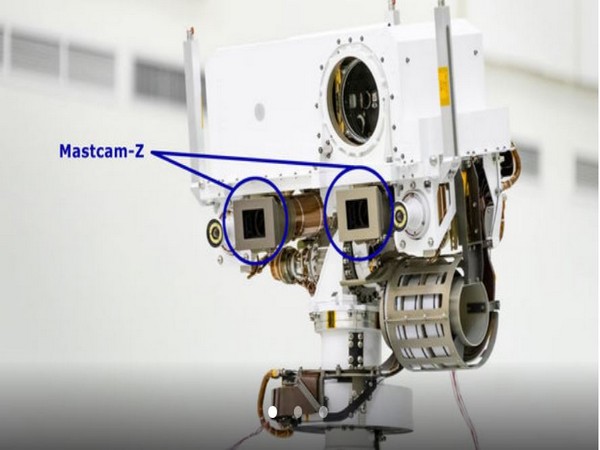
Mastcam-Z (Image courtesy: NASA)

Washington DC [USA], May 2 (ANI): When it launches this summer, NASA's Perseverance rover will have the most advanced pair of "eyes" ever sent to the Red Planet's surface -- its Mastcam-Z instrument packs a next-gen zoom capability that will help the mission make 3D imagery more easily.
Rover operators, who carefully plan out each driving route and each movement of a rover's robotic arm, view these stereo images through 3D goggles to see the contours of the landscape.
Located on Perseverance's "head," Mastcam-Z (the Z stands for "zoom") is a more advanced version of Mastcam, which NASA's Curiosity Mars rover has relied on to produce gorgeous panoramas of the Martian landscape.
But it does more than that, and so will Mastcam-Z -- along with producing images that enable the public to follow the rover's daily discoveries, the cameras provide key data to help engineers navigate and scientists choose interesting rocks to study. The difference is that Curiosity's Mastcam can't zoom.
Zoom with a view
Curiosity's Mastcam was initially designed to be zoomable, but that proved difficult to achieve at the time in such a small instrument (Curiosity launched in 2011).
"The original plan was for Curiosity to have a zoom camera that could go out to an extreme wide-angle like a spaghetti western view," said Jim Bell of Arizona State University, Mastcam-Z's principal investigator and Mastcam's deputy principal investigator.
"It would have been an amazing panoramic perspective but proved really hard to build at the time," Bell added.
Instead, Curiosity's Mastcam has one telephoto lens and one wide-angle lens. Images are taken through each and can be combined to produce stereo views. But the wide-angle lens takes in far more of the landscape in a single shot than the telescopic one, it requires up to nine telescopic images to match.
Perseverance's Mastcam-Z simplifies matters, zooming both lenses until they match and can be used to make a single 3D image. This is both easier and requires sending fewer images -- and less data -- to Earth.
Eyes of a Scientist
Besides providing a stereo view to help drivers choose the safest path, Mastcam-Z will help geologists choose scientific targets and better understand the landscape that rock samples are found in -- Did they fall from a neighbouring cliffside? Are they from an ancient stream?
Mastcam-Z will provide "superhuman vision," viewing the landscape in a variety of colours (wavelengths of light), including some that cannot be detected by the human eye. Scanning the terrain in the ultraviolet or infrared, for example, could reveal metal meteorites dotting the surface or colour variations indicating compositions that warrant more detailed analysis by other instruments.
Mastcam-Z is not a spectrometer, which is to say, an instrument that uses light to do detailed scientific analysis. "But it can provide mineral clues that other instruments will follow up on," Bell said.
The camera system can also observe the Sun and sky, watching for transits of Mars' moons across the Sun and measuring how dust storms and cloud formations change over the seasons.
Mars for the People
Bell's first experience with Mars pictures was as an 11-year-old, watching images on the nightly TV news sent back by the Viking landers in 1976. He was later involved in the Mars Pathfinder mission and went on to lead the Pancam systems on the Spirit and Opportunity rovers, which inspired a new generation of Mars fanatics, including future scientists and engineers.
The vistas that Perseverance will send back from its landing site, Jezero Crater, will be just as significant for those who work on the mission and everyone who's following along.
That is why there are plans to share Mastcam-Z images and mosaics made by the amateur community on a public website. "It's important that the public have a sense of ownership. The Mastcam-Z images belong to all of us," Bell said.
Perseverance is a robotic scientist weighing about 2,260 pounds (1,025 kilograms). The rover's astrobiology mission will search for signs of past microbial life. It will characterise the planet's climate and geology, collect samples for a future return to Earth, and pave the way for human exploration of the Red Planet. No matter what day Perseverance launches during its July 17-August 5 launch period, it will land at Mars' Jezero Crater on February 18, 2021.
The Mars 2020 Perseverance rover mission is part of a larger program that includes missions to the Moon as a way to prepare for human exploration of the Red Planet. Charged with returning astronauts to the Moon by 2024, NASA will establish a sustained human presence on and around the Moon by 2028 through NASA's Artemis lunar exploration plans. (ANI)


Get the App

What to Read Next

Science

Astronomers find the smallest main-belt asteroids ever detected:

Astronomers find the smallest main-belt asteroids ever detected:

The majority of known asteroids orbit inside the main asteroid belt, which is positioned between Mars and Jupiter at an average distance of around 250 million km from Earth. Since the discovery of the first asteroid in 1801, about 750.000 asteroids have been identified, primarily in the last decade thanks to several optical surveys that examine the sky on clear nights.

Read More
Science

Researchers discover new way concerning immune defence

Researchers discover new way concerning immune defence

Monocytes, a kind of white blood cell, generate cytokines, which are inflammatory messengers required for an adequate immune response. Researchers at the University Hospital Bonn (UKB) and the University of Bonn have discovered that platelets, also known as thrombocytes, interact with monocytes, increasing their inflammatory capability.

Read More
Science

Total solar eclipse seen across Mexico, Canada, US

Total solar eclipse seen across Mexico, Canada, US

It was North America's first total eclipse since 2017 and it won't appear across this part of the world again until 2046. For the first time in nearly a century, the western and northern regions of New York State saw a total eclipse.

Read More
Science

New multicolor 3D printing technology is inspired by chameleons

New multicolor 3D printing technology is inspired by chameleons

Researchers created a sustainable approach for 3D-printing various, dynamic colours from a single ink, inspired by chameleons' colour-changing abilities.

Read More
Science

Surfactants may cause toxic chemicals in aerosols to last longer

Surfactants may cause toxic chemicals in aerosols to last longer

Hazardous chemicals often seen in aerosols, such as those produced during cooking and cleaning, can be 'protected' in 3D structures made by surfactants, allowing them to stay longer in the air, according to research led by the University of Birmingham.

Read More
Science

Link between exercise-induced hormone irisin, Alzheimer’s: Study

Link between exercise-induced hormone irisin, Alzheimer’s: Study

The first 3D human cell culture models of Alzheimer's disease (AD) that exhibit the two main symptoms of the disease—the formation of amyloid beta deposits followed by tau tangles—were created previously. Researchers are now using their model to examine whether the exercise-induced muscle hormone irisin affects amyloid beta pathology.

Read More
Science

Super Blue Moon lights up sky

Super Blue Moon lights up sky

Astronomers got a special treat on August 30 when a rare celestial event known as a Super Blue Moon became visible in the sky across the nation. A blue moon has nothing to do with the colour of the Moon. NASA defines it as the second full moon in a single month. "Once in a blue moon" occurs every two and a half years on average.

Read More
Science

New information on possibility of biological evolution on Mars

New information on possibility of biological evolution on Mars

The scientific community has definitely proven that Mars had habitable surface environments early in its existence. Water, energy sources, elements such as carbon, hydrogen, nitrogen, oxygen, phosphorus, and sulfur, as well as crucial catalytic transition metals linked to life as we know it were all produced by these conditions. It is unknown, though, if that possibility sparked continued development towards the independent emergence of life on Mars.

Read More
Science

Researchers give more insight into treatment of blindness

Researchers give more insight into treatment of blindness

Scientists have discovered a way to utilize nanotechnology to construct a 3D ‘scaffold’ for growing cells from the retina, paving the path for potential new treatments for a prevalent cause of blindness.

Read More
Science

NASA's JPL establishes contact with Ingenuity Mars Helicopter

NASA's JPL establishes contact with Ingenuity Mars Helicopter

The official mission logbook now lists the Ingenuity Mars Helicopter's 52nd flight as a success. The trip took place on April 26 but mission controllers at NASA's Jet Propulsion Laboratory in Southern California lost communication with the chopper as it dropped towards the surface for landing.

Read More


