 हिंदी खबर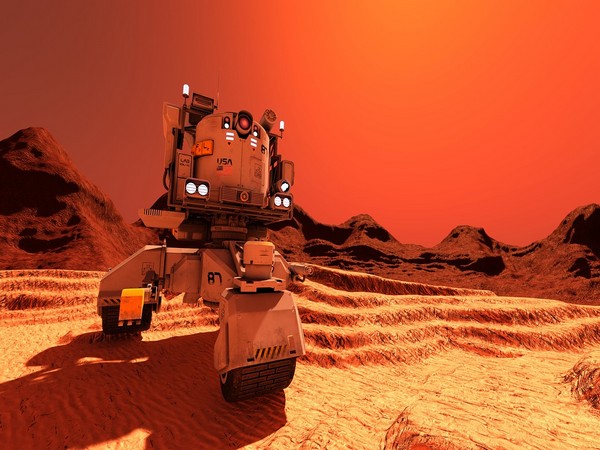

Washington D.C. [USA], Nov 13 (ANI): In what could shed more light on the red planet, Mars; NASA scientists have discovered what may be one of the best places to look for signs of ancient life.
The agency which is set to send its rover next year to the red planet has found that Jezero Crater, where the rover will land on February 18, 2021; can show some signs of ancient life, according to a paper published in the journal Icarus.
It identifies distinct deposits of minerals called carbonates along the inner rim of Jezero, the site of a lake more than 3.5 billion years ago.
On Earth, carbonates help form structures that are hardly enough to survive in fossil form for billions of years, including seashells, coral and some stromatolites -- rocks formed on this planet by ancient microbial life along ancient shorelines, where sunlight and water were plentiful.
The possibility of stromatolite-like structures existing on Mars is why the concentration of carbonates tracing Jezero's shoreline like a bathtub ring makes the area a prime scientific hunting ground.
Mars 2020 is NASA's next-generation mission with a focus on astrobiology. It will search for actual signs of past microbial life, taking rock core samples that will be deposited in metal tubes on the Martian surface. Future missions could return these samples to Earth for deeper study.
In addition to preserving signs of ancient life, carbonates can educate more about how Mars transitioned from having liquid water and a thicker atmosphere to being the freezing desert it is today.
They act as time capsules that scientists can study to learn when -- and how -- the Red Planet began drying out.
The Jezero crater measure 28 miles (45 kilometers) wide, and was once home to an ancient river delta.
The "arms" of this delta can be seen reaching across the crater floor in images taken from space by satellite missions like NASA's Mars Reconnaissance Orbiter.
The orbiter's Compact Reconnaissance Imaging Spectrometer for Mars instrument, or CRISM, helped produce colorful mineral maps of the "bathtub ring" detailed in the new paper.
"CRISM spotted carbonates here years ago, but we only recently noticed how concentrated they are right where a lakeshore would be," said lead author, Briony Horgan of Purdue University in West Lafayette, Indiana.
"We're going to encounter carbonate deposits in many locations throughout the mission, but the bathtub ring will be one of the most exciting places to visit," Horgan added.
It isn't guaranteed that the shoreline carbonates were formed in the lake; they could have been deposited before the lake was present. The Mars 2020 team expects to explore both the crater floor and delta during the rover's two-year prime mission.
"The possibility that the 'marginal carbonates' formed in the lake environment was one of the most exciting features that led us to our Jezero landing site. Carbonate chemistry on an ancient lakeshore is a fantastic recipe for preserving records of ancient life and climate," said Mars 2020 Deputy Project Scientist Ken Williford of NASA's Jet Propulsion Laboratory in Pasadena, California. JPL leads the 2020 mission.
Jezero's former lake shoreline isn't the only place scientists are excited to visit. A new study in Geophysical Research Letters points to a rich deposit of hydrated silica on the edge of the ancient river delta. Like carbonates, this mineral excels at preserving signs of ancient life. If this location proves to be the bottom layer of the delta, it will be an especially good place to look for buried microbial fossils. (ANI)
NASA's Mars 2020 rover to search for signs of past microbial life
ANI | Updated: Nov 13, 2019 11:06 IST


