

ADD ANI AS A TRUSTED SOURCE
googleads
ANI Logo
Menu
Science

NASA sounding rocket finds helium structures in Sun's atmosphere

Washington [US], Aug 8 (ANI): Helium is the second most abundant element in the universe after hydrogen. But scientists are not sure just how much there actually is in the Sun's atmosphere, where it is hard to measure.

ANI Aug 08, 2020 08:19 IST googleads

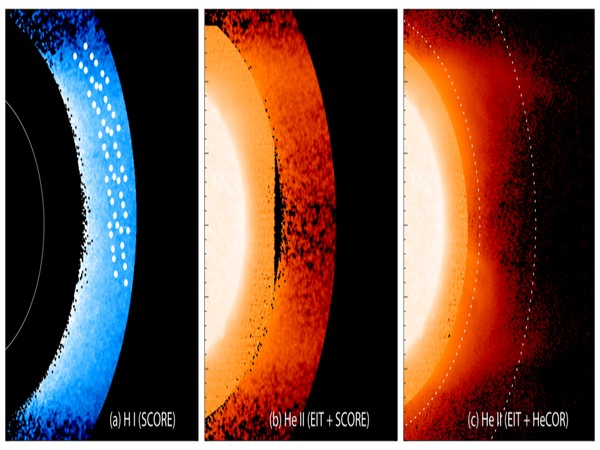
Image of the Sun showing the hydrogen (left) and helium (centre and right) in the low corona (Image Source: NASA)

Washington [US], Aug 8 (ANI): Helium is the second most abundant element in the universe after hydrogen. But scientists are not sure just how much there actually is in the Sun's atmosphere, where it is hard to measure.
Knowing the amount of helium in the solar atmosphere is important to understanding the origin and acceleration of the solar wind -- the constant stream of charged particles from the Sun.
In 2009, NASA launched a sounding rocket investigation to measure helium in the extended solar atmosphere. The results, recently published in Nature Astronomy, are helping to better understand our space environment.
Previously, when measuring ratios of helium to hydrogen in the solar wind as it reaches Earth, observations have found much lower ratios than expected. Scientists suspected the missing helium might have been left behind in the Sun's outermost atmospheric layer -- the corona -- or perhaps in a deeper layer. Discovering how this happens is key to understanding how the solar wind is accelerated.
To measure the amount of atmospheric helium and hydrogen, NASA's Helium Resonance Scattering in the Corona and Heliosphere, or HERSCHEL sounding rocket took images of the solar corona. Led by the Naval Research Lab in Washington, HERSCHEL was an international collaboration with the Osservatorio Astrofisico di Torino in Italy and the Institute d'Astrophysique Spatiale in France.
HERSCHEL's observations showed that helium was not evenly distributed around the corona. The equatorial region had almost no helium while the areas at mid-latitudes had the most. Comparing with images from ESA/NASA's Solar and Heliospheric Observatory (SOHO), the scientists were able to show the abundance at the mid-latitudes overlaps with where Sun's magnetic field lines open out into the solar system.
This shows that the ratio of helium to hydrogen is strongly connected with the magnetic field and the speed of the solar wind in the corona. The equatorial regions, which had low helium abundance measurements, matched measurements from the solar wind near Earth. This points to the solar atmosphere being more dynamic than scientists thought.
The HERSCHEL sounding rocket investigation adds to a body of work seeking to understand the origin of the slow component of the solar wind. HERSCHEL remotely investigates the elemental composition of the region where the solar wind is accelerated, which can be analysed in tandem with in situ measurements of the inner solar system, such as those of the Parker Solar Probe.
While the heat of the Sun is enough to power the lightest element -- ionised hydrogen protons -- to escape the Sun as a supersonic wind, other physics must help power the acceleration of heavier elements such as helium. Thus, understanding elemental abundance in the Sun's atmosphere, provides additional information as we attempt to learn the full story of how the solar wind is accelerated.
In the future, scientists plan to take more observations to explain the difference in abundances. Two new instruments -- Metis and EUI on board ESA/NASA's Solar Orbiter -- are able to make similar global abundance measurements and will to help provide new information about the helium ratio in the corona. (ANI)


Get the App

What to Read Next

Science

New insights into how cancer evades the immune system: Study

New insights into how cancer evades the immune system: Study

Immunotherapy research primarily focuses on better recognition of cancer cells by the body's own immune system. Researchers at Amsterdam UMC and Moffitt Cancer Center have taken a different approach.

Read More
Science

Scientists use AI to better understand nanoparticles: Study

Scientists use AI to better understand nanoparticles: Study

A group of scientists has created a way to illuminate the dynamic behavior of nanoparticles, which are essential components in the production of pharmaceuticals, electronics, and industrial and energy-conversion materials.

Read More
Science

New device could allow you to taste cake in virtual reality

New device could allow you to taste cake in virtual reality

The 'e-Taste' interface employs sensors and wireless chemical dispensers to enable remote taste perception, often known as gestation. Field testing done by researchers at The Ohio State University confirmed the device's ability to digitally simulate a range of taste intensities, while still offering variety and safety for the user.

Read More
Science

Strand Life Sciences launches portal for rare disease diagnosis

Strand Life Sciences launches portal for rare disease diagnosis

Marking Rare Disease Day, Strand Life Sciences, a subsidiary of Reliance Industries and a leading genomics research company, has launched the StrandOmics Portal, an innovative digital platform designed to assist doctors in diagnosing rare diseases more efficiently.

Read More
Science

Study reveals impact of animals as architects of Earth

Study reveals impact of animals as architects of Earth

A new study led by Professor Gemma Harvey from Queen Mary University of London has revealed how hundreds of species shape the landscapes we depend on, from termite mounds visible from space to beavers creating wetlands and hippos carving drainage systems.

Read More
Science

'Creation of black holes without singularities through gravity'

'Creation of black holes without singularities through gravity'

Traditional black holes, as predicted by Albert Einstein's theory of General Relativity, contain what are known as singularities, i.e. points where the laws of physics break down. Identifying how singularities are resolved in the context of quantum gravity is one of the fundamental problems in theoretical physics. Now, a team of experts has described the creation of regular black holes from gravitational effects without the need for the existence of exotic matter required by some previous models.

Read More
Science

New technology enhances gravitational-wave detection: Study

New technology enhances gravitational-wave detection: Study

A team of physicists led by Jonathan Richardson of the University of California, Riverside, demonstrated how new optical technology can extend the detection range of gravitational-wave observatories such as the Laser Interferometer Gravitational-Wave Observatory, or LIGO, and pave the way for future observatories.

Read More
Science

Discovering the genetics of climate adaptation 

Discovering the genetics of climate adaptation 

As climate change accelerates, plants are under increasing pressure to adapt to changing habitats and environmental conditions.

Read More
Science

Shubhanshu Shukla: IAF officer becomes first Indian astronaut for

Shubhanshu Shukla: IAF officer becomes first Indian astronaut for

Shubhanshu Shukla, Indian Air Force (IAF) officer and one of four astronauts for Indian Space Research Organisation's (ISRO) Gaganyaan mission, has been sele Shubhanshu Shukla, Indian Air Force (IAF) officer and one of four astronauts for Indian Space Research Organisation's (ISRO) Gaganyaan mission, has been selected as the pilot for Axiom Mission 4, scheduled for Spring 2025.cted as the pilot for Axiom Mission 4, scheduled for Spring 2025.

Read More
Science

Microbes help detoxify our atmosphere, says study 

Microbes help detoxify our atmosphere, says study 

Melbourne researchers have uncovered important new information on how microbes absorb huge amounts of carbon monoxide (CO) and assist in reducing levels of this deadly gas.

Read More
Home About Us Our Products Advertise Contact Us Terms & Condition Privacy Policy

Copyright © aninews.in | All Rights Reserved.


