

ADD ANI AS A TRUSTED SOURCE
googleads
ANI Logo
Menu
Science

NASA conducts test of SLS rocket core stage for Artemis

Washington [US], January 17 (ANI): NASA conducted a hot fire on Saturday of the core stage for the agency's Space Launch System (SLS) rocket that will launch the Artemis I mission to the Moon.

ANI Jan 17, 2021 09:38 IST googleads

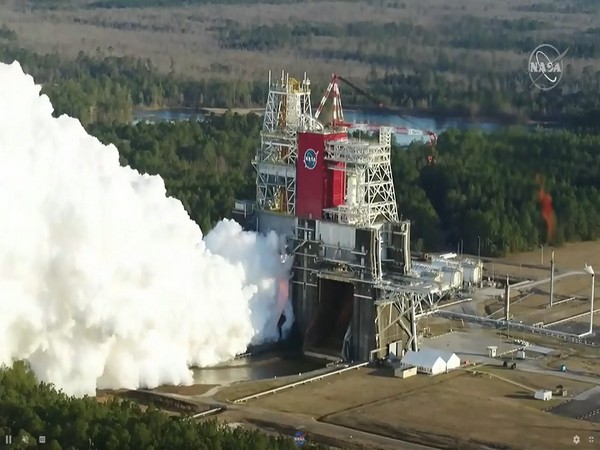
The core stage for the first flight of NASA's Space Launch System rocket is seen in the B-2 Test Stand during a hot fire test. (Image Credit: NASA Television)

Washington [US], January 17 (ANI): NASA conducted a hot fire on Saturday of the core stage for the agency's Space Launch System (SLS) rocket that will launch the Artemis I mission to the Moon.
The hot fire is the final test of the Green Run series.
The test plan called for the rocket's four RS-25 engines to fire for a little more than eight minutes which is also the amount of time that it will take to send the rocket to space following launch.
The team successfully completed the countdown and ignited the engines, but the engines shut down a little more than one minute into the hot fire. Teams are assessing the data to determine what caused the early shutdown, and will determine a path forward.
For the test, the 212-foot core stage generated 1.6 million pounds of thrust, while anchored in the B-2 Test Stand at NASA's Stennis Space Center near Bay St. Louis, Mississippi. The hot fire test included loading 733,000 pounds of liquid oxygen and liquid hydrogen - mirroring the launch countdown procedure - and igniting the engines.
"Saturday's test was an important step forward to ensure that the core stage of the SLS rocket is ready for the Artemis I mission, and to carry crew on future missions," said NASA Administrator Jim Bridenstine, who attended the test.
"Although the engines did not fire for the full duration, the team successfully worked through the countdown, ignited the engines, and gained valuable data to inform our path forward," added Bridenstine.
Support teams across the Stennis test complex provided high-pressure gases to the test stand, delivered all operational electrical power, supplied more than 330,000 gallons of water per minute to protect the test stand flame deflector and ensure the structural integrity of the core stage, and captured data needed to evaluate the core stage performance.
"Seeing all four engines ignite for the first time during the core stage hot fire test was a big milestone for the Space Launch System team," said John Honeycutt, the SLS program manager at NASA's Marshall Space Flight Center in Huntsville, Alabama.
"We will analyze the data, and what we learned from today's test will help us plan the right path forward for verifying this new core stage is ready for flight on the Artemis I mission," added Honeycutt.
The Green Run series of tests began in January 2020, when the stage was delivered from NASA's Michoud Assembly Facility in New Orleans and installed in the B-2 test stand at Stennis.
The team completed the first of the eight tests in the Green Run series before standing down in March due to the ongoing coronavirus pandemic. After resuming work in May, the team worked through the remaining tests in the series, while also standing down periodically as six tropical storms or hurricanes affected the Gulf Coast.
Each test built upon the previous test with increasing complexity to evaluate the stages' sophisticated systems, and the hot fire test that lit up all four engines was the final test in the series.
"Stennis has not witnessed this level of power since the testing of Saturn V stages in the 1960s," said Stennis Center Director Rick Gilbrech.
"Stennis is the premier rocket propulsion facility that tested the Saturn V first and second stages that carried humans to the Moon during the Apollo Program, and now, this hot fire is exactly why we test like we fly and fly like we test. We will learn from today's early shutdown, identify any corrections if needed, and move forward," added Gilbrech.
In addition to analyzing the data, teams also will inspect the core stage and its four RS-25 engines before determining the next steps. Under the Artemis program, NASA is working to land the first woman and the next man on the Moon in 2024.
SLS and the Orion spacecraft that will carry astronauts to space, along with the human landing system and the Gateway in orbit around the Moon, are NASA's backbone for deep space exploration. (ANI)


Get the App

What to Read Next

Science

Total solar eclipse seen across Mexico, Canada, US

Total solar eclipse seen across Mexico, Canada, US

It was North America's first total eclipse since 2017 and it won't appear across this part of the world again until 2046. For the first time in nearly a century, the western and northern regions of New York State saw a total eclipse.

Read More
Science

Small amounts of physical activity valuable in lung cancer

Small amounts of physical activity valuable in lung cancer

More people die from lung cancer annually worldwide than from any other cancer. Nevertheless, a recent study headed by Curtin University discovered that individuals with incurable forms of the disease may live longer if they engage in less than five minutes of physical activity each day.

Read More
Science

People who show expertise more likely to be considered valuable

People who show expertise more likely to be considered valuable

A new study sheds light on the critical role of communication and knowledge within businesses, emphasising how they influence collective performance. The researchers looked into how people get involved in communication networks, as well as the effect of selection procedures on group performance. According to the study, people who communicated more throughout training were more likely to be chosen as core members of the network.

Read More
Science

New study explains precious metals in the Earth's mantle

New study explains precious metals in the Earth's mantle

Scientists discovered that impact-driven mixing of mantle materials scenarios could prevent metals from totally sinking into the Earth's core based on simulations or models.

Read More
Science

Quick dialysis may be most beneficial to some kidney patients

Quick dialysis may be most beneficial to some kidney patients

According to one study, people with acute kidney impairment who require outpatient dialysis after being discharged from the hospital receive the same care as those with the more common end-stage kidney disease.

Read More
Science

Pomegranate water consumption helps to keep canine teeth healthy: Research

Pomegranate water consumption helps to keep canine teeth healthy: Research

Periodontal disease is one of the most frequent diseases in dogs, affecting at least 80 per cent of canines over the age of three. Gingivitis, in which the gums become red and inflamed and may bleed, is the first stage of periodontal disease

Read More
Science

Early childhood malnutrition sets stage for poor growth: Study

Early childhood malnutrition sets stage for poor growth: Study

The researchers offered the most comprehensive look at how malnutrition affects growth in the first two years of life, highlighting a devastating reality for millions of children in the Global South, particularly Asia.

Read More
Science

Synchrotron studies change composition of Earth’s core

Synchrotron studies change composition of Earth’s core

A group of scientists established a new pressure scale that is essential for comprehending the composition of the Earth. This research was according to a study that was published in Science Advances.

Read More
Science

Super Blue Moon lights up sky

Super Blue Moon lights up sky

Astronomers got a special treat on August 30 when a rare celestial event known as a Super Blue Moon became visible in the sky across the nation. A blue moon has nothing to do with the colour of the Moon. NASA defines it as the second full moon in a single month. "Once in a blue moon" occurs every two and a half years on average.

Read More
Science

High drug price linked with decreased treatment retention 

High drug price linked with decreased treatment retention 

High expenditures for treating hepatic encephalopathy in people with end-stage liver disease were linked to worse patient adherence to therapy, according to research from the University of Minnesota Medical School and College of Pharmacy.

Read More
Home About Us Our Products Advertise Contact Us Terms & Condition Privacy Policy

Copyright © aninews.in | All Rights Reserved.


