

ADD ANI AS A TRUSTED SOURCE
googleads
ANI Logo
Menu
Science

Microscopic organisms discovered in 'flammable ice'

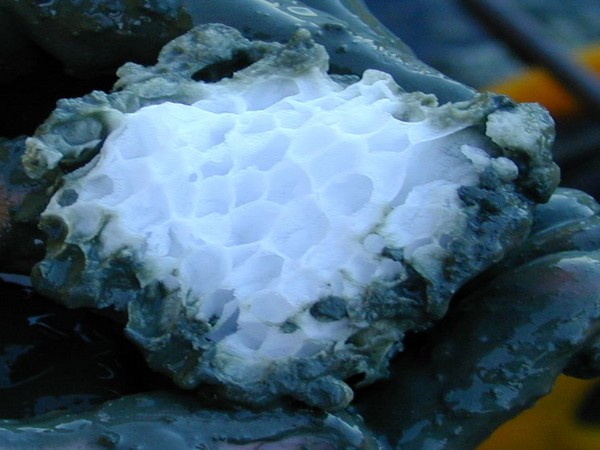
Washington D.C. [USA], Feb 8 (ANI): A group of researchers studying 'flammable ice' or methane hydrate in the cold and dark depths of the Sea of Japan has found microscopic creatures flourishing amidst living conditions that are immensely inhospitable for harbouring life.

ANI Feb 08, 2020 18:16 IST googleads

Methane hydrate is formed when methane gets trapped inside the molecular structure of ice.

Washington D.C. [USA], Feb 8 (ANI): A group of researchers studying 'flammable ice' or methane hydrate in the cold and dark depths of the Sea of Japan has found microscopic creatures flourishing amidst living conditions that are immensely inhospitable for harbouring life.
Methane hydrate is formed when methane gets trapped inside the molecular structure of ice.
According to a news release by the University of Aberdeen, colonies microbes were discovered inside bubbles of oil and water scattered throughout frozen sheets of this substance.
This new finding can give us an idea about the possibility of extreme life forms existing on other planets.
The initial discovery of these fascinating microhabitats stemmed from broader research by Professor Ryo Matsumoto from Meiji University in Japan, who was analysing the feasibility of 'flammable ice' as a cleaner fuel source.
Dr Glen T Snyder -- the lead author of the paper that was published in the Scientific Reports journal -- noticed an unusual powder-like substance when he was melting a piece of methane hydrate.
The powder consisted of tiny spherical structures with dark coloured cores.
By utilising special techniques of analysis developed by the University of Aberdeen, Dr Stephen Bowden from the University's School of Geosciences revealed that the oil was being broken down by microenvironments residing within the methane hydrate, informed the release.
Dr Bowden stated: "In combination with the other evidence collected by my colleagues, my results showed that even under near-freezing temperatures, at extremely high pressures, with only heavy oil and saltwater for food-sources, life was flourishing and leaving its mark."
Dr Snyder added: "The methane in 'methane hydrate' is known to form as microbes degrade organic matter on the seafloor."
"But what we never expected to find was microbes continuing to grow and produce these spheroids, all of the time while isolated in tiny cold dark pockets of saltwater and oil. It certainly gives a positive spin to cold dark places, and opens up a tantalising clue as to the existence of life on other planets."
Dr Bowden said: "It certainly changes how I think about things. Providing they have ice and a little heat, all those frigid cold planets at the edge of every planetary system could host tiny microhabitats with microbes building their own 'death stars' and making their own tiny little atmospheres and ecosystems, just as we discovered here." (ANI)

Get the App

What to Read Next

Science

Microbes help detoxify our atmosphere, says study 

Microbes help detoxify our atmosphere, says study 

Melbourne researchers have uncovered important new information on how microbes absorb huge amounts of carbon monoxide (CO) and assist in reducing levels of this deadly gas.

Read More
Science

Researchers give insight into breast cancer tumor growth

Researchers give insight into breast cancer tumor growth

According to a recent study, Malassezia globosa, a common skin fungus, may penetrate deep tissues through the skin or by other methods, which can lead to tumor formation.

Read More
Science

Fossil study finds how sea level changes shaped early life

Fossil study finds how sea level changes shaped early life

A newly developed timeline of early animal fossils suggests a relationship between sea level fluctuations, variations in marine oxygen, and the appearance of the earliest ancestors of present-day animals.

Read More
Science

Study reveals air pollution hides increases in rainfall

Study reveals air pollution hides increases in rainfall

We know that greenhouse gas emissions, such as carbon dioxide, should increase rainfall. The emissions warm the atmosphere, resulting in a one-two punch: warmer oceans make it easier for water to evaporate, and warmer air can store more water vapour, allowing more moisture to fall as rain. However, for long of the twentieth century, the data did not clearly reveal a rise in precipitation.

Read More
Science

Rising sea levels may lead to more methane emitted from wetlands

Rising sea levels may lead to more methane emitted from wetlands

Global warming is causing sea levels to rise, which is altering ecosystems. Scientists assumed that the tidal wetlands present in estuaries could create less methane, a strong greenhouse gas because the increased influx of seawater renders these habitats less hospitable to methane-producing microorganisms.

Read More
Science

Ice age may help predict oceans’ response to global warming

Ice age may help predict oceans’ response to global warming

A team of scientists led by a Tulane University oceanographer discovered that deposits deep beneath the ocean floor provide a means to estimate ocean oxygen levels and their relationship to carbon dioxide in the Earth's atmosphere during the last ice age, which ended more than 11,000 years ago.

Read More
Science

Study finds way to desalinate seawater using HBD technology

Study finds way to desalinate seawater using HBD technology

The hydrate desalination technique is a low-energy solution that may be used to treat large quantities of brine or polluted water.

Read More
Science

Training algorithm breaks barriers to deep neural networks

Training algorithm breaks barriers to deep neural networks

EPFL researchers created an algorithm that can train an analog neural network just as accurately as a digital one, allowing for the development of more efficient alternatives to power-hungry deep learning hardware

Read More
Science

Warming, deep-sea mining cause stress in midwater animals

Warming, deep-sea mining cause stress in midwater animals

In the scientific journal Nature Communications, a recent study headed by scientists at the GEOMAR Helmholtz Centre for Ocean Research Kiel offers the first insights into the stress response of a deep pelagic jellyfish to ocean warming and sediment plumes caused by deep-sea mining.

Read More
Science

Researchers investigate hydrogen energy transition

Researchers investigate hydrogen energy transition

The researchers will build a socially just framework to provide ways for local communities in Oklahoma to share their current and future energy needs and to influence the development of energy solutions.

Read More




