

ADD ANI AS A TRUSTED SOURCE
googleads
ANI Logo
Menu
Science

Martian meteorite contains large diversity of organic compounds

The Martian meteorite Tissint contains a huge diversity of organic compounds, found an international team of researchers led by Technical University of Munich and Helmholtz Munich's Philippe Schmitt-Kopplin and including Carnegie's Andrew Steele. Their work is published in Science Advances.

ANI Jan 13, 2023 11:01 IST googleads

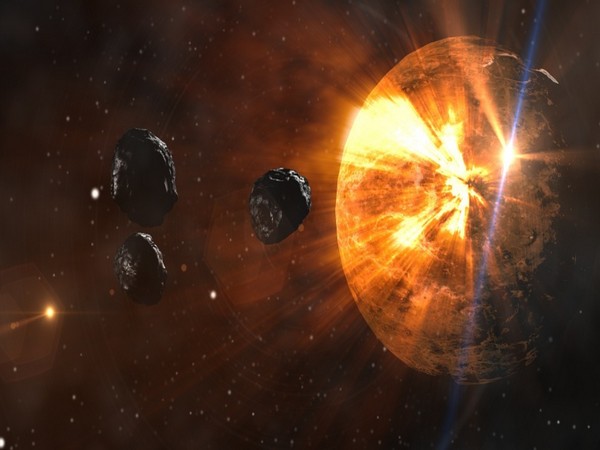
Representative Image

Washington [US], January 13 (ANI): The Martian meteorite Tissint contains a huge diversity of organic compounds, found an international team of researchers led by Technical University of Munich and Helmholtz Munich's Philippe Schmitt-Kopplin and including Carnegie's Andrew Steele. Their work is published in Science Advances.
Tissint, which crash landed in Morocco more than 11 years ago, is one of only five Martian meteorites that have been observed as they fell to Earth. Pieces of it were found scattered around the desert about 30 miles from the town after which it is named.
This sample of Martian rock was formed hundreds of millions of years ago on our next-door planetary neighbor and was launched into space by a violent event. Unraveling the origin stories of the Tissint meteorite's organic compounds can help scientists understand whether the Red Planet ever hosted life, as well as Earth's geologic history.
"Mars and Earth share many aspects of their evolution," said lead author Schmitt-Kopplin. "And while life arose and thrived on our home planet, the question of whether it ever existed on Mars is a very hot research topic that requires deeper knowledge of our neighboring planet's water, organic molecules, and reactive surfaces."
Organic molecules contain carbon, hydrogen, oxygen, nitrogen, sulfur, and sometimes other elements. Organic compounds are commonly associated with life, although previous Martian meteorite research demonstrated that they can be created by non-biological processes, referred to as abiotic organic chemistry.
"Understanding the processes and sequence of events that shaped this rich organic bounty will reveal new details about Mars' habitability and potentially about the reactions that could lead to the formation of life," added Steele, who has done extensive research on organic material in Martian meteorites, including Tissint, and is a member of both the Perseverance and Curiosity rovers' science teams.
The researchers were able to thoroughly analyze the meteorite's organic inventory, revealing a link between the type and diversity of organic molecules and specific mineralogy. Their efforts resulted in the most comprehensive catalog ever made of the diversity of organic compounds found in a Martian meteorite or in a sample collected and analyzed by a rover. This work uncovered details about how the processes occurring in Mars' mantle and crust evolved, especially with regard to abiotic organics that formed from water-rock interactions.
Of particular interest was the abundance of organic magnesium compounds, a suite of organic molecules not previously seen on Mars, which offer new insights about the high-pressure, high-temperature geochemistry that shaped the Red Planet's deep interior and indicate a connection between its carbon cycle and its mineral evolution.
The researchers say that samples returned from Mars by future missions should provide an unprecedented amount of information about the formation, stability and dynamics of organic compounds in real Martian environments. (ANI)


Get the App

What to Read Next

Science

New insights into how cancer evades the immune system: Study

New insights into how cancer evades the immune system: Study

Immunotherapy research primarily focuses on better recognition of cancer cells by the body's own immune system. Researchers at Amsterdam UMC and Moffitt Cancer Center have taken a different approach.

Read More
Science

Study reveals impact of animals as architects of Earth

Study reveals impact of animals as architects of Earth

A new study led by Professor Gemma Harvey from Queen Mary University of London has revealed how hundreds of species shape the landscapes we depend on, from termite mounds visible from space to beavers creating wetlands and hippos carving drainage systems.

Read More
Science

Shubhanshu Shukla: IAF officer becomes first Indian astronaut for

Shubhanshu Shukla: IAF officer becomes first Indian astronaut for

Shubhanshu Shukla, Indian Air Force (IAF) officer and one of four astronauts for Indian Space Research Organisation's (ISRO) Gaganyaan mission, has been sele Shubhanshu Shukla, Indian Air Force (IAF) officer and one of four astronauts for Indian Space Research Organisation's (ISRO) Gaganyaan mission, has been selected as the pilot for Axiom Mission 4, scheduled for Spring 2025.cted as the pilot for Axiom Mission 4, scheduled for Spring 2025.

Read More
Science

Microbes help detoxify our atmosphere, says study 

Microbes help detoxify our atmosphere, says study 

Melbourne researchers have uncovered important new information on how microbes absorb huge amounts of carbon monoxide (CO) and assist in reducing levels of this deadly gas.

Read More
Science

Large, small galaxies may grow in ways more similar

 Large, small galaxies may grow in ways more similar

A team of astronomers led by University of Arizona researcher Catherine Fielder captured the most precise photographs of a small galaxy and its surroundings, revealing features typically found in much larger galaxies.

Read More
Science

Astronomers find the smallest main-belt asteroids ever detected:

Astronomers find the smallest main-belt asteroids ever detected:

The majority of known asteroids orbit inside the main asteroid belt, which is positioned between Mars and Jupiter at an average distance of around 250 million km from Earth. Since the discovery of the first asteroid in 1801, about 750.000 asteroids have been identified, primarily in the last decade thanks to several optical surveys that examine the sky on clear nights.

Read More
Science

Bacterial vaccine demonstrates potential as cancer treatment

Bacterial vaccine demonstrates potential as cancer treatment

Columbia researchers developed probiotic bacteria that train the immune system to eliminate cancer cells, paving the way for a new class of cancer vaccinations that take advantage of bacteria's innate tumour-targeting abilities. These microbial cancer vaccines can be tailored to each person's specific original tumour and metastases, perhaps preventing future recurrences.

Read More
Science

Alternate method to study changes during DNA replication process

Alternate method to study changes during DNA replication process

Researchers at Colorado State University discovered an alternative way for studying alterations during the DNA replication process in lab settings using genetically modified yeast. The novel methodology provides a clearer picture than current pharmacological methods for understanding cell cycle arrest, a fundamental mechanism critical to cancer treatment and genetic concerns.

Read More
Science

Cancer cells may be using lipids to hide from immune system

Cancer cells may be using lipids to hide from immune system

Cancer cells rarely begin stealthily. Quite the contrary, they alert the immune system to their presence by displaying chemical red flags on their membranes. When detected, the body's defences can swoop in and destroy renegade cells before they can do significant damage. Lipids, fatty molecules traditionally thought to be largely a fuel supply for developing tumours, are at the heart of this early detection system.

Read More
Science

Study finds how cancer develops when immune system fails

 Study finds how cancer develops when immune system fails

It has been suggested that the immune system is unable to eradicate invasive tumour cells by referring to cancer as "a wound that does not heal."

Read More
Home About Us Our Products Advertise Contact Us Terms & Condition Privacy Policy

Copyright © aninews.in | All Rights Reserved.
