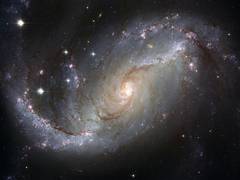
MaNGA release data including detailed maps of thousands of nearby galaxies
Washington D.C. [USA], Jan 30 (ANI): The latest data release from the Sloan Digital Sky Survey (SDSS) includes observations revealing internal structure and composition of nearly 5,000 nearby galaxies.
ANI
Jan 30, 2019 13:45 IST


Washington D.C. [USA], Jan 30 (ANI): The latest data release from the Sloan Digital Sky Survey (SDSS) includes observations revealing internal structure and composition of nearly 5,000 nearby galaxies.
The observations were made during the first three years of a programme called Mapping Nearby Galaxies at Apache Point Observatory (MaNGA).
According to experts, MaNGA uses a technique called resolved spectroscopy to study galaxies in much greater detail than previous surveys.
Spectroscopy is a powerful tool for astronomers, yielding a wealth of information by measuring how much light an object emits at different wavelengths. In the past, astronomers typically acquired just one spectrum for each galaxy, but resolved spectroscopy (also called integral field spectroscopy) obtains hundreds of separate spectra covering every location within the galaxy.
MaNGA principal investigator Kevin Bundy explained, "Resolved spectroscopy allows us to dissect a galaxy and study its internal composition and the motions of its stars and gas."
According to Bundy MaNGA's goal is to understand the "life history" of present-day galaxies, from their initial birth and assembly, through their ongoing growth via star formation and mergers, to their death from "quenching" of star formation at late times.
Bundy and his students at UC Santa Cruz, for example, have discovered evidence in the MaNGA data for outflows of hot ionized gas in "dead" galaxies, supporting the idea that powerful winds driven out from a galaxy's central black hole can shut down star formation.
Bundy's team is also finding clues to how galaxies were assembled over time by studying the motions of their stars and gas and by analyzing the chemical signatures of stars in different parts of galaxies.
MaNGA will eventually study a representative sample of some 10,000 nearby galaxies. Bundy said the survey is more than half way toward that goal and on track to reach it by 2020. Data from 4,621 galaxies are now publicly available as part of the 15th SDSS data release (the third data release for SDSS-IV).
"This data release is a major milestone for us," Bundy said. "MaNGA is already by far the largest survey of its kind, and this release includes both the data and the analytical tools the project has developed."
One important part of this data release is the MaNGA Stellar Library containing spectra of more than 3,000 stars in our Milky Way galaxy. When complete, it will include 5,000 to 6,000 stars. Researchers can use the spectra of these individual stars to try to reconstruct the spectrum of a galaxy and thereby figure out that galaxy's unique mix of different star types. (ANI)
Get the App