

ADD ANI AS A TRUSTED SOURCE
googleads
ANI Logo
Menu
Science

KU Leuven researchers shed new light on solar flares

Washington D.C. [USA], June 18 (ANI): Plasma astrophysicists at KU Leuven have created the first self-consistent simulation of the physical processes that occur during a solar flare. The researchers used Flemish supercomputers and a new combination of physical models.

ANI Jun 18, 2020 22:48 IST googleads

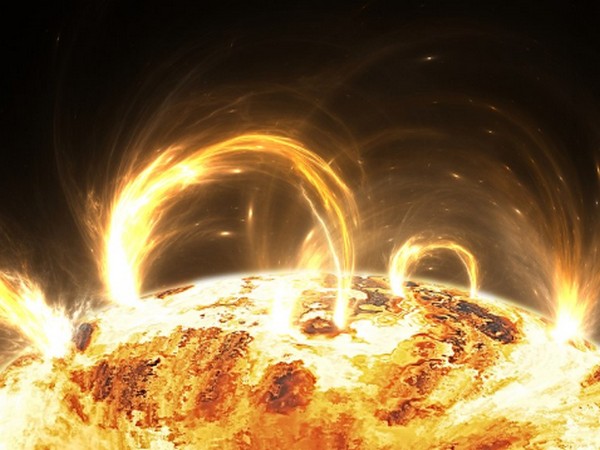
Solar flares are explosions on the surface of the Sun that release an enormous amount of energy (Image credit: Shutterstock, KU Leuven)

Washington D.C. [USA], June 18 (ANI): Plasma astrophysicists at KU Leuven have created the first self-consistent simulation of the physical processes that occur during a solar flare. The researchers used Flemish supercomputers and a new combination of physical models.
Solar flares are explosions on the surface of the Sun that release an enormous amount of energy, equivalent to a trillion 'Little Boy' atomic bombs exploding at the same time. In extreme cases, solar flares can disable radio connections and power stations on Earth, but they are also at the basis of stunning space weather phenomena.
The Northern Lights, for instance, are linked to a solar flare that disturbs the magnetic field of the Sun to such an extent that a bubble of solar plasma can escape from the atmosphere of the Sun.
Thanks to satellites and solar telescopes, we already understand quite a lot about the physical processes that take place during a solar flare. For one thing, we know that solar flares convert energy from magnetic fields into heat, light, and motion energy very efficiently.
In science textbooks, these processes are commonly visualised as the standard 2-D solar flare model. The details of this illustration, however, have never been confirmed. This is because creating a fully consistent simulation is a huge challenge, given that both macroscopic effects (we're talking several tens of thousands of kilometers here: larger than Earth) and microscopic particle physics have to be taken into account.
Researchers at KU Leuven have now been able to create such a simulation. As part of his doctoral research, Wenzhi Ruan worked on the simulation with his colleagues in the team of Professor Rony Keppens at the KU Leuven Department of Plasma Astrophysics.
The researchers used the computational power of Flemish supercomputers as well as a new combination of physical models in which the microscopic effects of accelerated charged particles were taken into account in a macroscopic model.
"Our work also makes it possible to calculate the energy conversion efficiency of a solar flare," Professor Rony Keppens explained.
"We can calculate this efficiency by combining the strength of the Sun's magnetic field at the feet of the flare with the speed at which those feet move. If we can complete our observations in time, that is, because everything happens within a time span of tens of seconds to a few minutes," Keppens added.
The professor further said: "We converted the results of the numerical simulation into virtual observations of a solar flare, whereby we imitated telescopes in all relevant wavelengths. This allowed us to upgrade the standard solar flare model from a textbook illustration to an actual model." (ANI)


Get the App

What to Read Next

Science

Amphibians bounce-back from Earth’s greatest mass extinction

Amphibians bounce-back from Earth’s greatest mass extinction

Researchers at the University of Bristol discovered that ancient frog ancestors survived the biggest mass extinction of species by eating on freshwater prey that evaded terrestrial predators.

Read More
Science

New insights into how cancer evades the immune system: Study

New insights into how cancer evades the immune system: Study

Immunotherapy research primarily focuses on better recognition of cancer cells by the body's own immune system. Researchers at Amsterdam UMC and Moffitt Cancer Center have taken a different approach.

Read More
Science

Scientists use AI to better understand nanoparticles: Study

Scientists use AI to better understand nanoparticles: Study

A group of scientists has created a way to illuminate the dynamic behavior of nanoparticles, which are essential components in the production of pharmaceuticals, electronics, and industrial and energy-conversion materials.

Read More
Science

Strand Life Sciences launches portal for rare disease diagnosis

Strand Life Sciences launches portal for rare disease diagnosis

Marking Rare Disease Day, Strand Life Sciences, a subsidiary of Reliance Industries and a leading genomics research company, has launched the StrandOmics Portal, an innovative digital platform designed to assist doctors in diagnosing rare diseases more efficiently.

Read More
Science

New technology enhances gravitational-wave detection: Study

New technology enhances gravitational-wave detection: Study

A team of physicists led by Jonathan Richardson of the University of California, Riverside, demonstrated how new optical technology can extend the detection range of gravitational-wave observatories such as the Laser Interferometer Gravitational-Wave Observatory, or LIGO, and pave the way for future observatories.

Read More
Science

Discovery of unexpected collagen structure to influence research

Discovery of unexpected collagen structure to influence research

Collagen, the body's most abundant protein, has long been considered a predictable structural component of tissues.

Read More
Science

Shubhanshu Shukla: IAF officer becomes first Indian astronaut for

Shubhanshu Shukla: IAF officer becomes first Indian astronaut for

Shubhanshu Shukla, Indian Air Force (IAF) officer and one of four astronauts for Indian Space Research Organisation's (ISRO) Gaganyaan mission, has been sele Shubhanshu Shukla, Indian Air Force (IAF) officer and one of four astronauts for Indian Space Research Organisation's (ISRO) Gaganyaan mission, has been selected as the pilot for Axiom Mission 4, scheduled for Spring 2025.cted as the pilot for Axiom Mission 4, scheduled for Spring 2025.

Read More
Science

Weather change linked to heightened risk of Salmonella outbreaks

Weather change linked to heightened risk of Salmonella outbreaks

According to new research from the University of Surrey, climate change has an impact on Salmonella spread. This study builds on prior work by the researchers, which discovered that weather change is contributing to the spread of deadly diarrhoeal illnesses.

Read More
Science

Astronomers find the smallest main-belt asteroids ever detected:

Astronomers find the smallest main-belt asteroids ever detected:

The majority of known asteroids orbit inside the main asteroid belt, which is positioned between Mars and Jupiter at an average distance of around 250 million km from Earth. Since the discovery of the first asteroid in 1801, about 750.000 asteroids have been identified, primarily in the last decade thanks to several optical surveys that examine the sky on clear nights.

Read More
Science

Study finds connection between quantum theory, information theory

Study finds connection between quantum theory, information theory

"Our results have no clear or direct application right now. It's basic research that lays the foundation for future technologies in quantum information and quantum computers. There's enormous potential for complete discoveries in many different research fields," said Guilherme B Xavier, a researcher in quantum communication at Linkoping University, Sweden.

Read More
Home About Us Our Products Advertise Contact Us Terms & Condition Privacy Policy

Copyright © aninews.in | All Rights Reserved.
