

ADD ANI AS A TRUSTED SOURCE
googleads
ANI Logo
Menu
Science

'Jumping genes' help fungus kill salamanders: Research

A fungus that infects salamanders contains multiple copies of the same "jumping genes", scientists have discovered. Jumping genes, called transposons, can "copy and paste" themselves and impact the organism.

ANI Jan 04, 2023 21:46 IST googleads

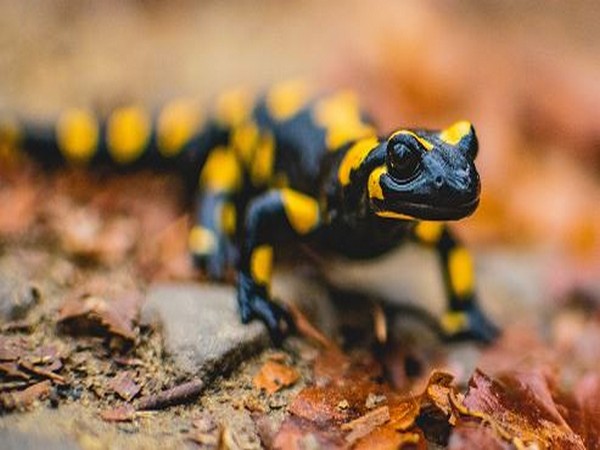
Representative Image

Exeter [UK], January 4 (ANI): Multiple copies of the same "jumping genes" have been found in a salamander-infecting fungus.
Transposons, or jumping genes, can "copy and paste" themselves and have an effect on the organism.
The majority of organisms have some repetitive DNA, some of which are jumping genes, but this can be detrimental and there are methods to stop or restrict this.
However, the new study - led by the MRC Centre for Medical Mycology at the University of Exeter - finds a possible evolutionary advantage of these jumping genes in a fungus called Batrachochytrium salamandrivorans (Bsal).
Not only did they find different versions of these jumping genes repeated multiple times in Bsal's genome - but the gene in question appears to have duplicated another group of genes that play a role in how severely it affects infected fire salamanders.
"Bsal and related fungal species infect amphibians worldwide, and have been responsible for more than 90 extinctions," said first author Theresa Wacker.
"Bsal infects the skin of salamanders and newts and causes severe wounds.
"It emerged in Asia, where many newts and salamanders have some tolerance, but it has spread to Europe and is causing European salamander populations to decline.
"Using new sequencing technologies, we found that Bsal has undergone a genome expansion compared to related species - that is to say, it now has a bigger genome with more genes and also more of these 'jumping gene' transposons."
The new study found the ability of jumping gene transposons to copy and paste themselves contributed significantly to this expansion.
"If you think of an organism's genome as a blueprint, transposons are like having many identical pages," Wacker explained.
"And sometimes, during the process of copying and pasting, other parts of the book are also copied."
It appears that this copying and pasting caused by repetitive jumping gene transposons has also amplified some skin-destroying genes.
Having more of these skin-destruction genes allows the fungus to destroy the skin of salamanders more quickly, making it more deadly."
Senior author Dr Rhys Farrer said repetitive DNA, including jumping genes, is sometimes referred to as "junk" DNA.
"Most organisms have a few jumping gene transposons," he said.
"In humans, they typically make up less than 1 per cent of the genome, and we have control mechanisms to prevent this from rising.
"In Bsal, repeated jumping genes make up about 19 per cent of the genome.
"Transposon jumping genes can interfere with regular gene function and cause problems for the organism - but for Bsal this seems to be outweighed by the advantages."
The team are now doing further research.
Dr Farrer said: "This kind of gene repetition is probably more widespread in nature than we currently realise.
"If, as appears to be the case, it confers an evolutionary advantage for the pathogen by making it more virulent, it's not clear why this isn't much more common."
The study's finding shed new light on the evolution of a major amphibian disease, and Dr Farrer called it a "paradigm shift" in terms of identifying repetitive genome content as a driving force behind its pathobiology. (ANI)


Get the App

What to Read Next

Science

New method guides magnetism without magnets

New method guides magnetism without magnets

Researchers at Paul Scherrer Institute PSI have demonstrated an innovative method to control magnetism in materials using an energy-efficient electric field.

Read More
Science

New insights into how cancer evades the immune system: Study

New insights into how cancer evades the immune system: Study

Immunotherapy research primarily focuses on better recognition of cancer cells by the body's own immune system. Researchers at Amsterdam UMC and Moffitt Cancer Center have taken a different approach.

Read More
Science

Scientists use AI to better understand nanoparticles: Study

Scientists use AI to better understand nanoparticles: Study

A group of scientists has created a way to illuminate the dynamic behavior of nanoparticles, which are essential components in the production of pharmaceuticals, electronics, and industrial and energy-conversion materials.

Read More
Science

New device could allow you to taste cake in virtual reality

New device could allow you to taste cake in virtual reality

The 'e-Taste' interface employs sensors and wireless chemical dispensers to enable remote taste perception, often known as gestation. Field testing done by researchers at The Ohio State University confirmed the device's ability to digitally simulate a range of taste intensities, while still offering variety and safety for the user.

Read More
Science

Strand Life Sciences launches portal for rare disease diagnosis

Strand Life Sciences launches portal for rare disease diagnosis

Marking Rare Disease Day, Strand Life Sciences, a subsidiary of Reliance Industries and a leading genomics research company, has launched the StrandOmics Portal, an innovative digital platform designed to assist doctors in diagnosing rare diseases more efficiently.

Read More
Science

Study reveals impact of animals as architects of Earth

Study reveals impact of animals as architects of Earth

A new study led by Professor Gemma Harvey from Queen Mary University of London has revealed how hundreds of species shape the landscapes we depend on, from termite mounds visible from space to beavers creating wetlands and hippos carving drainage systems.

Read More
Science

Opposing arrows of time emerge from certain quantum systems

Opposing arrows of time emerge from certain quantum systems

Researchers at the University of Surrey made a thought-provoking discovery. A new study reveals that opposing arrows of time can theoretically emerge from certain quantum systems.

Read More
Science

COVID-19 severity may be predicted by White Blood Cell Count

COVID-19 severity may be predicted by White Blood Cell Count

A COVID-19 diagnosis is no longer as frightening as it used to be, thanks to developments in treatment choices. However, a new study reveals that leukocyte (white blood cell) count may now be used to identify who is more likely to develop more significant disease symptoms.

Read More
Science

Seals can essentially act as 'smart sensors': Study

Seals can essentially act as 'smart sensors': Study

A new study by marine biologists reports that seals can essentially act as 'smart sensors' for monitoring fish populations in the ocean's eerily dim 'twilight zone.'

Read More
Science

'Creation of black holes without singularities through gravity'

'Creation of black holes without singularities through gravity'

Traditional black holes, as predicted by Albert Einstein's theory of General Relativity, contain what are known as singularities, i.e. points where the laws of physics break down. Identifying how singularities are resolved in the context of quantum gravity is one of the fundamental problems in theoretical physics. Now, a team of experts has described the creation of regular black holes from gravitational effects without the need for the existence of exotic matter required by some previous models.

Read More
Home About Us Our Products Advertise Contact Us Terms & Condition Privacy Policy

Copyright © aninews.in | All Rights Reserved.


