ADD ANI AS A TRUSTED SOURCE
googleads
Menu
Science

In a startling discovery, researchers find 18,000-year-old creature with nose, fur intact!

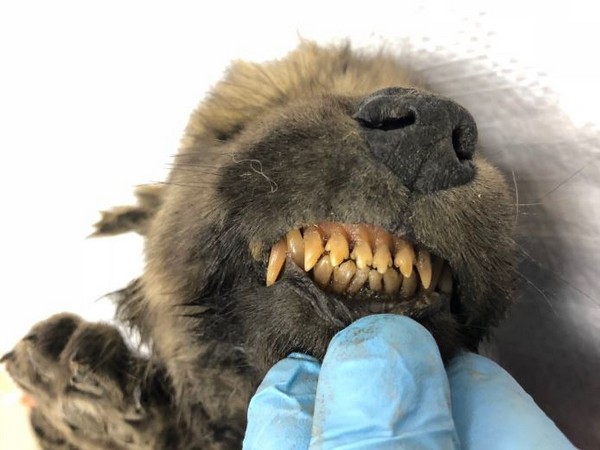
Washington D.C. [USA], Nov 30 (ANI): With his nose, fur and teeth totally intact, researchers in a baffling discovery have found a near-perfectly preserved puppy, which is 18,000 years old!

ANI Nov 30, 2019 21:31 IST googleads

The 18,000-year-old creature (Image courtesy: Twitter)

Washington D.C. [USA], Nov 30 (ANI): With his nose, fur and teeth totally intact, researchers in a baffling discovery have found a near-perfectly preserved puppy, which is 18,000 years old!
The canine's discovery was made by Russian scientists near Yakutsk, in eastern Siberia and not only was he protected by the permafrost but his nose, fur and teeth were found to be totally in place.
Experts from Sweden's Centre for Palaeogenetics used carbon dating on the specimen's rib bone and confirmed that it had been frozen for around 18,000 years.
But extensive DNA tests conducted so far have been unable to show whether the discovered creature was a dog or a wolf.
"It's normally relatively easy to tell the difference between the two," David Stanton, a researcher at the Centre for Palaeogenetics, told CNN.
"We have a lot of data from it already, and with that amount of data, you'd expect to tell if it was one or the other. The fact that we can't suggest that it's from a population that was ancestral to both -- to dogs and wolves," he explained.
The researcher added that the period from which the puppy has been found to belong that it is "a very interesting time in terms of wolf and dog evolution."
"We don't know exactly when dogs were domesticated, but it may have been from about that time. We are interested in whether it is, in fact, a dog or a wolf, or perhaps it's something halfway between the two," he explained.
While it is thought that modern-day dogs have been domesticated from wolves but the time of their emergence is still not clear.
In 2017, a study published in the journal Nature Communications found that modern dogs were domesticated from a single population of wolves 20,000 to 40,000 years ago.
However, in contrast, a 2016 study at the University of Oxford, published in the journal Science, suggested that dogs were independently domesticated twice from grey wolves during the Paleolithic era, once in Asia and once in Europe.
The scientist, who discovered the 18,000-year-old creature, said on Twitter that they will be calling it 'Dogor', which means 'friend' in Yakutian.
In order to uncover more about the origin of the creature, scientists are planning to run more genome data tests. (ANI)

Get the App

What to Read Next

Science

Researchers shed light on possible endosymbiosis

Researchers shed light on possible endosymbiosis

Endosymbiosis is a remarkable biological phenomenon in which one creature resides within another. Such an unconventional partnership is usually advantageous to both parties. Even in human bodies, we find evidence of such cohabitation: mitochondria, the cells' powerhouses, originated from an ancient endosymbiosis. Bacteria long ago invaded and colonized other cells. This coexistence created the groundwork for mitochondria, which are found in the cells of plants, animals, and fungi.

Read More
Science

Memory problems in old age may be linked to key enzyme: Study

Memory problems in old age may be linked to key enzyme: Study

Everyone experiences occasional episodes of forgetfulness, particularly as they age. It's not only that fresh material is hard for older folks to remember. Moreover, when new information becomes available, they find it more difficult to change those thoughts. Nevertheless, not much is understood about the processes that underlie memory updating and how they malfunction as we age.

Read More
Science

Study reveals novel therapeutic target for traumatic brain injury

Study reveals novel therapeutic target for traumatic brain injury

Health outcomes vary greatly among the approximately 1.5 million Americans who survive a traumatic brain injury each year. Not only can these injuries cause loss of coordination, depression, impulsivity, and difficulties concentrating, but they also increase the risk of getting dementia in the future.

Read More
Science

Study finds common complication of atrial fibrillation

Study finds common complication of atrial fibrillation

Atrial fibrillation is estimated to affect 18 million people in Europe by 2060 and 16 million people in the US by 2050. In the English NHS alone, more new cases of atrial fibrillation are diagnosed each year than the four most common causes of cancer combined, and direct expenditure on atrial fibrillation has reached Pound 2.5 billion.

Read More
Science

Hypertensive disorders of pregnancy increase cardiovascular risk

Hypertensive disorders of pregnancy increase cardiovascular risk

Researchers at Rutgers Health discovered that hypertensive problems during pregnancy are substantially related to deadly cardiovascular disease up to a year after birth.

Read More
Home About Us Our Products Advertise Contact Us Terms & Condition Privacy Policy

Copyright © aninews.in | All Rights Reserved.