

ADD ANI AS A TRUSTED SOURCE
googleads
Menu
Science

Hungriest of black holes among the most massive in the universe

Canberra [Australia], July 1 (ANI): We now know just how massive the fastest-growing black hole in the universe actually is, as well as how much it eats, thanks to new research led by the Australian National University (ANU).

ANI Jul 01, 2020 09:52 IST googleads

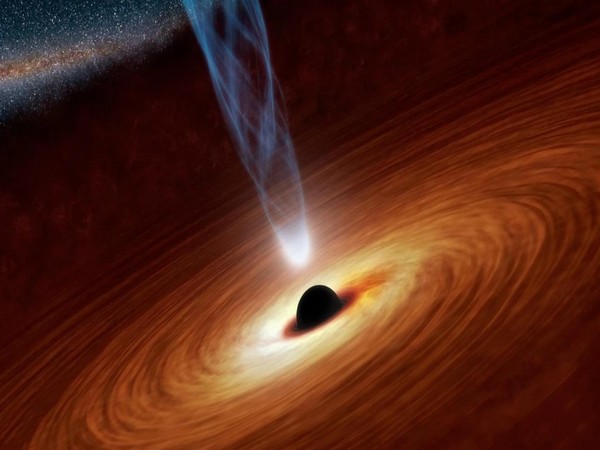
The black hole's mass is about 8,000 times bigger than the black hole in the centre of the Milky Way. (Image credits: NASA/JPL-Caltech)

Canberra [Australia], July 1 (ANI): We now know just how massive the fastest-growing black hole in the universe actually is, as well as how much it eats, thanks to new research led by the Australian National University (ANU).
It is 34 billion times the mass of our Sun and gorges on nearly the equivalent of one Sun every day, according to Dr. Christopher Onken and his colleagues.
"The black hole's mass is also about 8,000 times bigger than the black hole in the centre of the Milky Way. If the Milky Way's black hole wanted to grow that fat, it would have to swallow two thirds of all the stars in our galaxy," Dr. Onken said.
This giant black hole -- known as J2157 -- was discovered by the same research team in 2018.
"We're seeing it at a time when the universe was only 1.2 billion years old, less than 10 percent of its current age. It's the biggest black hole that's been weighed in this early period of the universe," Dr. Onken said.
Exactly how black holes grew so big so early in the life-span of the universe is still a mystery, but the team is now searching for more black holes in the hope they might provide some clues.
"We knew we were onto a very massive black hole when we realised its fast growth rate," said team member Dr. Fuyan Bian, a staff astronomer at the European Southern Observatory (ESO).
"How much black holes can swallow depends on how much mass they already have. So, for this one to be devouring matter at such a high rate, we thought it could become a new record holder. And now we know," Dr. Fuyan Bian added.
The team, including researchers from the University of Arizona, used ESO's Very Large Telescope in Chile to accurately measure the black hole's mass.
"With such an enormous black hole, we're also excited to see what we can learn about the galaxy in which it's growing," Dr. Onken said.
Dr. Onken said added, "is this galaxy one of the behemoths of the early universe, or did the black hole just swallow up an extraordinary amount of its surroundings? We'll have to keep digging to figure that out." (ANI)


Get the App

What to Read Next

Science

Scientists use AI to better understand nanoparticles: Study

Scientists use AI to better understand nanoparticles: Study

A group of scientists has created a way to illuminate the dynamic behavior of nanoparticles, which are essential components in the production of pharmaceuticals, electronics, and industrial and energy-conversion materials.

Read More
Science

'Creation of black holes without singularities through gravity'

'Creation of black holes without singularities through gravity'

Traditional black holes, as predicted by Albert Einstein's theory of General Relativity, contain what are known as singularities, i.e. points where the laws of physics break down. Identifying how singularities are resolved in the context of quantum gravity is one of the fundamental problems in theoretical physics. Now, a team of experts has described the creation of regular black holes from gravitational effects without the need for the existence of exotic matter required by some previous models.

Read More
Science

New technology enhances gravitational-wave detection: Study

New technology enhances gravitational-wave detection: Study

A team of physicists led by Jonathan Richardson of the University of California, Riverside, demonstrated how new optical technology can extend the detection range of gravitational-wave observatories such as the Laser Interferometer Gravitational-Wave Observatory, or LIGO, and pave the way for future observatories.

Read More
Science

Large, small galaxies may grow in ways more similar

 Large, small galaxies may grow in ways more similar

A team of astronomers led by University of Arizona researcher Catherine Fielder captured the most precise photographs of a small galaxy and its surroundings, revealing features typically found in much larger galaxies.

Read More
Science

Bacterial vaccine demonstrates potential as cancer treatment

Bacterial vaccine demonstrates potential as cancer treatment

Columbia researchers developed probiotic bacteria that train the immune system to eliminate cancer cells, paving the way for a new class of cancer vaccinations that take advantage of bacteria's innate tumour-targeting abilities. These microbial cancer vaccines can be tailored to each person's specific original tumour and metastases, perhaps preventing future recurrences.

Read More
Home About Us Our Products Advertise Contact Us Terms & Condition Privacy Policy

Copyright © aninews.in | All Rights Reserved.


