

ADD ANI AS A TRUSTED SOURCE
googleads
Menu
Science

Household favourite LEGO ® blocks just got 'cooler' than ever before

Lancaster [England], Jan 1 (ANI): As if they were not cool enough, to begin with, in an interesting experiment a group of scientists has cooled down LEGO ® blocks to the lowest temperatures modern technology is capable of achieving.

ANI Jan 01, 2020 23:09 IST googleads

The toy displayed some strange properties at super cryogenic temperatures that make it useful in developing better quantum computers.

Lancaster [England], Jan 1 (ANI): As if they were not cool enough, to begin with, in an interesting experiment a group of scientists has cooled down LEGO ® blocks to the lowest temperatures modern technology is capable of achieving.
The household favourite toy displayed some strange properties at super cryogenic temperatures that make it useful in developing better quantum computers.
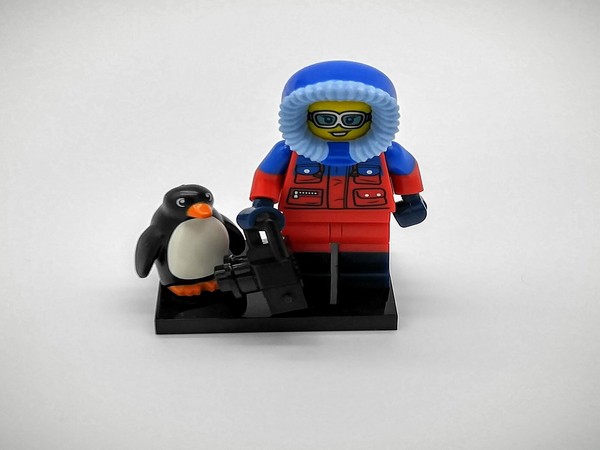
A world-leading team of ultra-low temperature physicists at Lancaster University decided to place a LEGO ® figure and four LEGO ® blocks inside their record-breaking dilution refrigerator.
This machine -- specially made at the university -- is the most effective refrigerator in the world, capable of reaching 1.6 millidegrees above absolute zero (minus 273.15 Centigrade), which is about 200,000 times colder than room temperature and 2,000 times colder than deep space.
The results -- published in the journal Scientific Reports -- were surprising.
Dr Dmitry Zmeev, who led the research team, said, "Our results are significant because we found that the clamping arrangement between the LEGO ® blocks causes the LEGO ® structures to behave as an extremely good thermal insulator at cryogenic temperatures.
"This is very desirable for construction materials used for the design of future scientific equipment like dilution refrigerators."
Invented 50 years ago, the dilution refrigerator is at the centre of a global multi-billion dollar industry and is crucial to the work of modern experimental physics and engineering, including the development of quantum computers.
The use of ABS plastic structures, such as LEGO ®, instead of the solid materials currently in use, means that any future thermal insulator could be produced at a significantly reduced cost.
Researchers say the next step is to design and 3D print a new thermal insulator for the next generation of dilution refrigerators. (ANI)

Get the App

What to Read Next

Science

Amphibians bounce-back from Earth’s greatest mass extinction

Amphibians bounce-back from Earth’s greatest mass extinction

Researchers at the University of Bristol discovered that ancient frog ancestors survived the biggest mass extinction of species by eating on freshwater prey that evaded terrestrial predators.

Read More
Science

Scientists use AI to better understand nanoparticles: Study

Scientists use AI to better understand nanoparticles: Study

A group of scientists has created a way to illuminate the dynamic behavior of nanoparticles, which are essential components in the production of pharmaceuticals, electronics, and industrial and energy-conversion materials.

Read More
Science

Opposing arrows of time emerge from certain quantum systems

Opposing arrows of time emerge from certain quantum systems

Researchers at the University of Surrey made a thought-provoking discovery. A new study reveals that opposing arrows of time can theoretically emerge from certain quantum systems.

Read More
Science

'Creation of black holes without singularities through gravity'

'Creation of black holes without singularities through gravity'

Traditional black holes, as predicted by Albert Einstein's theory of General Relativity, contain what are known as singularities, i.e. points where the laws of physics break down. Identifying how singularities are resolved in the context of quantum gravity is one of the fundamental problems in theoretical physics. Now, a team of experts has described the creation of regular black holes from gravitational effects without the need for the existence of exotic matter required by some previous models.

Read More
Science

New technology enhances gravitational-wave detection: Study

New technology enhances gravitational-wave detection: Study

A team of physicists led by Jonathan Richardson of the University of California, Riverside, demonstrated how new optical technology can extend the detection range of gravitational-wave observatories such as the Laser Interferometer Gravitational-Wave Observatory, or LIGO, and pave the way for future observatories.

Read More
Home About Us Our Products Advertise Contact Us Terms & Condition Privacy Policy

Copyright © aninews.in | All Rights Reserved.


