

ADD ANI AS A TRUSTED SOURCE
googleads
ANI Logo
Menu
Science

High entropy alloys provide discovery platform for new superconductors

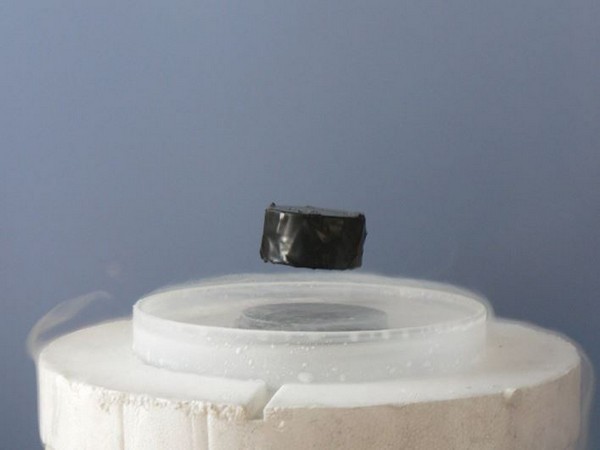
Tokyo [Japan], January 11 (ANI): A new research has mixed and designed a new, high entropy alloy (HEA) superconductor, using extensive data on simple superconducting substances with a specific crystal structure. HEAs are known to preserve superconducting characteristics up to extremely high pressures.

ANI Jan 11, 2021 00:09 IST googleads

Representative Image

Tokyo [Japan], January 11 (ANI): A new research has mixed and designed a new, high entropy alloy (HEA) superconductor, using extensive data on simple superconducting substances with a specific crystal structure. HEAs are known to preserve superconducting characteristics up to extremely high pressures.
According to the researchers from Tokyo Metropolitan University, the new superconductor, Co0.2Ni0.1Cu0.1Rh0.3Ir0.3Zr2, has a superconducting transition at 8K, a relatively high temperature for a HEA. The team's approach may be applied to discovering new superconducting materials with specific desirable properties.
It's been over a hundred years since the discovery of superconductivity, where certain materials were found to suddenly show minimal resistance to electrical currents below a transition temperature. As we explore ways to eliminate power waste, a way to dramatically reduce losses in power transmission is a fascinating prospect.
But the widespread use of superconductivity is held back by the demands of existing superconductors, particularly the low temperatures required. Scientists need a way to discover new superconducting materials without brute-force trial and error and tune key properties.
A team led by Associate Professor Yoshikazu Mizuguchi at Tokyo Metropolitan University have been pioneering a "discovery platform" that has already led to the design of many new superconducting substances. Their method is based on high entropy alloys (HEAs), where certain sites in simple crystal structures can be occupied by five or more elements.
After being applied to heat resistant materials and medical devices, certain HEAs were found to have superconducting properties with some exceptional characteristics, particularly retention of zero resistivity under extreme pressures. The team surveys material databases and cutting-edge research and finds a range of superconducting materials with a common crystal structure but different elements on specific sites.
They then mix and engineer a structure that contains many of those elements; throughout the crystal, those "HEA sites" are occupied by one of the elements mixed (see Figure 1). They have already succeeded in creating high entropy variants of layered bismuth-sulfide superconductors and telluride compounds with a sodium chloride crystal structure.
In their latest work, they focused on the copper aluminide (CuAl2) structure. Compounds combining a transition metal element (Tr) and zirconium (Zr) into TrZr2 with this structure are known to be superconducting, where Tr could be Sc, Fe, Co, Ni, Cu, Ga, Rh, Pd, Ta, or Ir.
The team combined a "cocktail" of these elements using arc melting to create a new HEA-type compound, Co0.2Ni0.1Cu0.1Rh0.3Ir0.3Zr2, which showed superconducting properties. They looked at both resistivity and electronic specific heat; the amount of energy used by the electrons in the material to raise the temperature, and identified a transition temperature of 8.0K. Not only is this relatively high for a HEA-type superconductor, but they also confirmed that the material had the hallmarks of "bulk" superconductivity.
The most exciting aspect of this is the vast range of other transition metals and ratios that can be tried and tuned to aim for higher transition temperatures and other desirable properties, all without changing the underlying crystal structure. The team hopes their success will lead to more discoveries of new HEA-type superconductors in the near future. (ANI)


Get the App

What to Read Next

Science

New method guides magnetism without magnets

New method guides magnetism without magnets

Researchers at Paul Scherrer Institute PSI have demonstrated an innovative method to control magnetism in materials using an energy-efficient electric field.

Read More
Science

Amphibians bounce-back from Earth’s greatest mass extinction

Amphibians bounce-back from Earth’s greatest mass extinction

Researchers at the University of Bristol discovered that ancient frog ancestors survived the biggest mass extinction of species by eating on freshwater prey that evaded terrestrial predators.

Read More
Science

Scientists use AI to better understand nanoparticles: Study

Scientists use AI to better understand nanoparticles: Study

A group of scientists has created a way to illuminate the dynamic behavior of nanoparticles, which are essential components in the production of pharmaceuticals, electronics, and industrial and energy-conversion materials.

Read More
Science

New technology enhances gravitational-wave detection: Study

New technology enhances gravitational-wave detection: Study

A team of physicists led by Jonathan Richardson of the University of California, Riverside, demonstrated how new optical technology can extend the detection range of gravitational-wave observatories such as the Laser Interferometer Gravitational-Wave Observatory, or LIGO, and pave the way for future observatories.

Read More
Science

Discovery of unexpected collagen structure to influence research

Discovery of unexpected collagen structure to influence research

Collagen, the body's most abundant protein, has long been considered a predictable structural component of tissues.

Read More
Science

Astronomers find the smallest main-belt asteroids ever detected:

Astronomers find the smallest main-belt asteroids ever detected:

The majority of known asteroids orbit inside the main asteroid belt, which is positioned between Mars and Jupiter at an average distance of around 250 million km from Earth. Since the discovery of the first asteroid in 1801, about 750.000 asteroids have been identified, primarily in the last decade thanks to several optical surveys that examine the sky on clear nights.

Read More
Science

Study finds connection between quantum theory, information theory

Study finds connection between quantum theory, information theory

"Our results have no clear or direct application right now. It's basic research that lays the foundation for future technologies in quantum information and quantum computers. There's enormous potential for complete discoveries in many different research fields," said Guilherme B Xavier, a researcher in quantum communication at Linkoping University, Sweden.

Read More
Science

When devices can read human emotions without a camera: Study

When devices can read human emotions without a camera: Study

Tokyo Metropolitan University researchers employed long-term skin conductance measurements to distinguish between emotions. Volunteers were given videos representing frightening scenarios, family bonding, and humour, while their skin conductance was measured.

Read More
Science

'Nuroscience study results can be better predicted by AI'

'Nuroscience study results can be better predicted by AI'

Large language models, a type of AI that analyses text, can anticipate the results of proposed neuroscience studies more correctly than human experts, according to a new study led by UCL (University College London) researchers.

Read More
Science

Thermal imaging may help fruits, veggies stay fresher longer: Study

Thermal imaging may help fruits, veggies stay fresher longer: Study

Before your favourite produce arrives at the grocery store, it must be carefully harvested and stored for extended periods of time. A recent University of Georgia assessment argues that new temperature sensing devices could make that procedure considerably easier, as agricultural issues are exacerbated by changing climates.

Read More
Home About Us Our Products Advertise Contact Us Terms & Condition Privacy Policy

Copyright © aninews.in | All Rights Reserved.
