 हिंदी खबर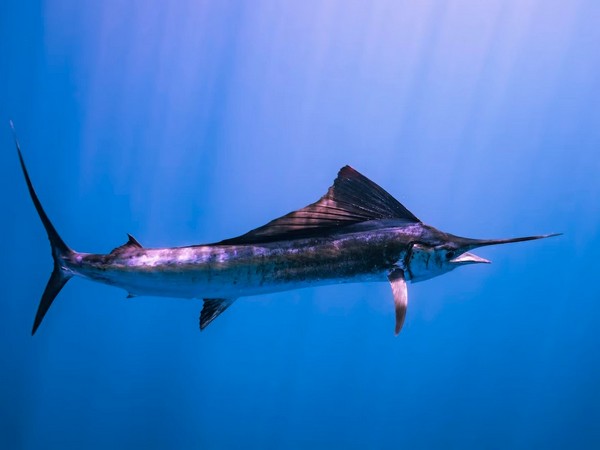

Florida [US], February 16 (ANI): To say that studying sailfish is difficult is an understatement. These fish, frequently referred to as the "fastest fish in the world," exhibit some surprising characteristics as they navigate the oceans in quest of their next meal.
Yet until now, nothing was known about how they did what they did when hunting alone.
Thanks to researchers at NSU's Guy Harvey Research Institute (GHRI) who designed a novel electronic tag package incorporating high-tech sensors and a video camera, we now have for the first time, a detailed view of exactly how these fish behave and hunt once they are on their own and out of view of the surface. This research was carried out offshore of one of the premier fishing locations in the world, Tropic Star Lodge, in southwest Panama.
"Most of the day they dive back and forth between the surface and the thermocline layer, where the water gets cold," said Ryan Logan, the lead author of the study and a doctoral candidate and research associate at NSU's GHRI. "The thermocline can concentrate prey that doesn't want to enter the cold water, so it looks like the sailfish might be using this to its advantage."
The new research study just published in Scientific Reports originally set out to determine how long it took the sailfish to recover after being released by a recreational fisher, the answer to which you can find in another study conducted by the authors. But after the fish had recovered, the video cameras continued to roll, picking up some never-before-seen footage of hunting behaviour.
Sailfish are known for their distinctive large dorsal fins and elongated front-end bill, which gives them a built-in sword-like weapon for hunting. These open ocean wanderers can travel both by themselves or in groups. Sailfish have been observed to hunt in groups on schooling fishes, using their bill in a slash, stun, and eat the baitfish sequence of actions.
This type of hunting by sailfish has been observed several times by wildlife photographers because it often occurs at the surface of the ocean, where it is easily accessible to human eyes.
However, when sailfish are not engaged in these cooperative group hunting events, they are thought to live a mostly solitary lifestyle. Sailfish have some other pretty unique features that separate them from many other groups of fish. For example, they can keep their eyes and brain warmer than the surrounding water, which gives them an advantage over their prey when hunting in colder or dimly lit water. But because of this, it's assumed that they burn a lot of calories throughout the day, so one could assume that they must also need to eat in between those group hunting events, although this had never been documented.
While this new video footage provides a unique perspective on the daily lives of sailfish, researcher caution that most of them aren't that exciting -- not exactly the kind of footage that makes it to Instagram or TikTok.
"Most of what you see in the videos is just a lot of blue water," said Logan, describing the open ocean habitat of these fish. "But when I saw the sailfish start to swim really fast toward the surface, I knew something was up."
The video shows a 100-pound sailfish ascending fast to the surface from nearly 200 feet deep, and vigorously chasing a small tuna once it reaches the surface. The sailfish makes several attempts to catch the little tuna, twisting and turning, speeding up and slowing down, often breaking the surface of the water during each attack. In the end, it looks like the sailfish got what it was after, returning to normal, calm swimming behaviour.
Logan said that these findings change what we know about the daily lives of sailfish.
"Because you can't keep a sailfish in captivity, we know surprisingly little about their basic biology," he said. "For instance, how much food do they need on a daily basis to survive?"
These are questions that this research is helping to answer. The team of researchers used the video footage, along with other swimming information collected by the high-resolution tag, to estimate how much energy the sailfish burned throughout the day, and how much energy it gained back by consuming the tuna, an energy-rich prey item.
"Based on our estimations, this sailfish needs roughly half of a tuna like this per day to meet energetic demands," said Logan.
While this research took place in Panama, sport fishing is a huge business around the world, especially in the state NSU's GHRI calls home -- Florida. Recent numbers show that fishing is an USD 11.5 billion dollar industry in Florida, supporting approximately 100,000 jobs.
"This research improves our understanding of the hidden lives of these majestic, ecologically and economically very important fishes," said Mahmood Shivji, PhD, a co-author of the study and Director of NSU's GHRI. "Such knowledge is essential to help us better protect the health of these fish and their prey to have a sustainable sportfish industry for many years to come." (ANI)




