

ADD ANI AS A TRUSTED SOURCE
googleads
ANI Logo
Menu
Science

From lab to space: Discovery of new organic molecule in interstellar molecular cloud

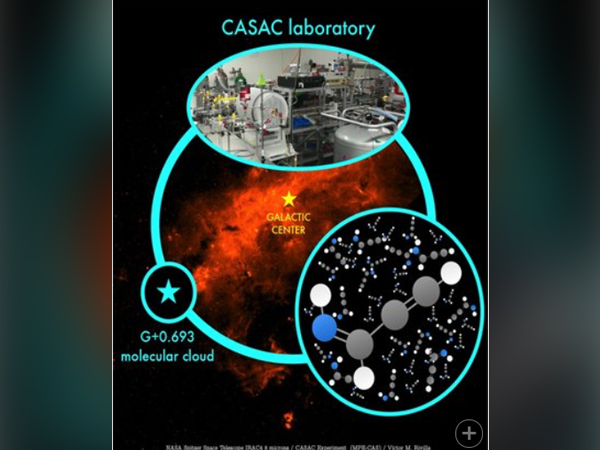
Washington D.C. [USA], June 17 (ANI): Laboratory experiments performed at the Centre for Astrochemical Studies (CAS) of the Max Planck Institute for Extraterrestrial Physics (MPE) in Munich, together with astronomical observations conducted by the Italian National Institute of Astrophysics (INAF), lead to the identification of a new molecule in the molecular cloud known as G+0.693-0.027, close to the Galactic centre.

ANI Jun 17, 2020 21:42 IST googleads

Experts discover new organic molecule in interstellar molecular cloud(Image credits:  Nasa Spitzer Space Telescope, IRAC4 camera (8 microns), MPE-CASAC experiment, Victor M. Rivilla (INAF-Arcetri)

Washington D.C. [USA], June 17 (ANI): Laboratory experiments performed at the Centre for Astrochemical Studies (CAS) of the Max Planck Institute for Extraterrestrial Physics (MPE) in Munich, together with astronomical observations conducted by the Italian National Institute of Astrophysics (INAF), lead to the identification of a new molecule in the molecular cloud known as G+0.693-0.027, close to the Galactic centre.
The newly discovered molecule is called propargylimine: according to the experts, this chemical species may play a fundamental role in the formation of amino acids, among the key ingredients for life as we know it.
The propargylimine has the chemical formula HCCCHNH and is an unstable compound. It is very difficult to isolate it in the ordinary conditions of the Earth's atmosphere, but it thrives at low densities and temperatures typical of the interstellar medium.
Luca Bizzocchi, the study's lead author who studied the molecule spectroscopy at MPE, explained: "The peculiarity of this chemical species lays in its carbon-nitrogen double bond, which gives it a high reactivity. With this double bond, it becomes a fundamental constituent of the chemical chains that lead from the simplest and most abundant molecules in space containing carbon and nitrogen -- for example formaldehyde (H2CO) and ammonia (NH3), respectively - to the more complex amino acids, the fundamental building blocks of terrestrial biology."
Every molecule absorbs and emits radiation at certain wavelengths, creating a pattern that uniquely describes it, like human fingerprints. With the aim of unveiling the presence of propargylimine in space, spectroscopic analysis has been performed at the Max Planck laboratories to rebuild the molecule's "identikit".
"As a molecule rotates in the interstellar medium it emits photons at very precise frequencies. This information, when combined with data from radio telescopes, allows us to know whether a molecule is present in the molecular clouds, the sites of star and planet formation," continued Bizzocchi.
In this case, the laboratory data have been compared with the results of observations taken at the 30m radio telescope in Sierra Nevada, Spain.
"Our molecule was already there. It was laying in our data of the G+0.693-0.027 molecular cloud, but we couldn't identify it without knowing its precise spectroscopy, which is the full description of its emission frequency pattern. As soon as we got it, thanks to the measurements in the laboratory, we realized that the propargylimine was undoubtedly there, waiting for someone to recognize it," said Victor M. Rivilla M, a Marie Sklodowska-Curie research fellow at INAF Florence, who led the INAF observational effort that resulted in the confirmation of propargylimine in the G+0.693-0.027 environment.
As a matter of fact, molecules with such a carbon-nitrogen double bond take part in the so called Strecker synthesis, a chemical process widely used to synthesize amino acids in laboratory.
Under favourable conditions, similar reactions are thought to occur also in a number of extraterrestrial environments such as the frozen mantles of interstellar dust or asteroid surfaces, as demonstrated by the recent discovery of glycine, the simplest amino acid, in the tail of comet 67P Churyumov-Gerasimenko.
"High precision molecular spectroscopy is one of our group's goals," concluded Paola Caselli, the director of the Center for Astrochemical Studies at MPE and co-author of the paper.
"Only with high precision measurements of the frequencies of interstellar molecules we can use such molecules as powerful diagnostic tools of the physical and chemical evolution of interstellar clouds, where stellar systems like our own form," Caselli added.
The paper "Propargylimine in the Laboratory and in Space: Millimetre-wave Spectroscopy and First Detection in the ISM," by L. Bizzocchi, D. Prudenzano, V.M. rivilla et al. has been accepted for publication in Astronomy & Astrophysics. (ANI)


Get the App

What to Read Next

Science

Amphibians bounce-back from Earth’s greatest mass extinction

Amphibians bounce-back from Earth’s greatest mass extinction

Researchers at the University of Bristol discovered that ancient frog ancestors survived the biggest mass extinction of species by eating on freshwater prey that evaded terrestrial predators.

Read More
Science

New insights into how cancer evades the immune system: Study

New insights into how cancer evades the immune system: Study

Immunotherapy research primarily focuses on better recognition of cancer cells by the body's own immune system. Researchers at Amsterdam UMC and Moffitt Cancer Center have taken a different approach.

Read More
Science

Scientists use AI to better understand nanoparticles: Study

Scientists use AI to better understand nanoparticles: Study

A group of scientists has created a way to illuminate the dynamic behavior of nanoparticles, which are essential components in the production of pharmaceuticals, electronics, and industrial and energy-conversion materials.

Read More
Science

New device could allow you to taste cake in virtual reality

New device could allow you to taste cake in virtual reality

The 'e-Taste' interface employs sensors and wireless chemical dispensers to enable remote taste perception, often known as gestation. Field testing done by researchers at The Ohio State University confirmed the device's ability to digitally simulate a range of taste intensities, while still offering variety and safety for the user.

Read More
Science

Strand Life Sciences launches portal for rare disease diagnosis

Strand Life Sciences launches portal for rare disease diagnosis

Marking Rare Disease Day, Strand Life Sciences, a subsidiary of Reliance Industries and a leading genomics research company, has launched the StrandOmics Portal, an innovative digital platform designed to assist doctors in diagnosing rare diseases more efficiently.

Read More
Science

Study reveals impact of animals as architects of Earth

Study reveals impact of animals as architects of Earth

A new study led by Professor Gemma Harvey from Queen Mary University of London has revealed how hundreds of species shape the landscapes we depend on, from termite mounds visible from space to beavers creating wetlands and hippos carving drainage systems.

Read More
Science

Opposing arrows of time emerge from certain quantum systems

Opposing arrows of time emerge from certain quantum systems

Researchers at the University of Surrey made a thought-provoking discovery. A new study reveals that opposing arrows of time can theoretically emerge from certain quantum systems.

Read More
Science

'Creation of black holes without singularities through gravity'

'Creation of black holes without singularities through gravity'

Traditional black holes, as predicted by Albert Einstein's theory of General Relativity, contain what are known as singularities, i.e. points where the laws of physics break down. Identifying how singularities are resolved in the context of quantum gravity is one of the fundamental problems in theoretical physics. Now, a team of experts has described the creation of regular black holes from gravitational effects without the need for the existence of exotic matter required by some previous models.

Read More
Science

New technology enhances gravitational-wave detection: Study

New technology enhances gravitational-wave detection: Study

A team of physicists led by Jonathan Richardson of the University of California, Riverside, demonstrated how new optical technology can extend the detection range of gravitational-wave observatories such as the Laser Interferometer Gravitational-Wave Observatory, or LIGO, and pave the way for future observatories.

Read More
Science

Discovering the genetics of climate adaptation 

Discovering the genetics of climate adaptation 

As climate change accelerates, plants are under increasing pressure to adapt to changing habitats and environmental conditions.

Read More
Home About Us Our Products Advertise Contact Us Terms & Condition Privacy Policy

Copyright © aninews.in | All Rights Reserved.


