

ADD ANI AS A TRUSTED SOURCE
googleads
ANI Logo
Menu
Science

Female butterflies breed despite male shortage: Research

According to research, female monarch butterflies have no trouble finding a mate, even when a parasite kills the majority of the males.

ANI Apr 18, 2023 07:15 IST googleads

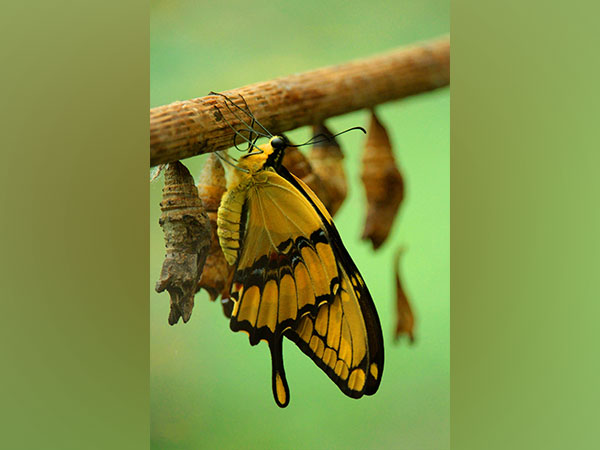
Representative image

Washington [US], April 18 (ANI): According to research, female monarch butterflies have no trouble finding a mate, even when a parasite kills the majority of the males.
Some females carry a parasite called Spiroplasma that kills all their male offspring, meaning highly infected populations have very few males.
But the new study - by the universities of Exeter, Rwanda and Edinburgh, and the Dian Fossey Gorilla Fund - found females mated about 1.5 times on average, regardless of how many males were around.
The male proportion dropped below 10% in some cases, but it appears the remaining hard-working males managed to breed with most of the available females.
10-20% of females remained unmated, only slightly higher than the expected average in a population with plenty of males (5-10%).
"It was an inspiring and powerful experience working along with an international team of experts and advancing our knowledge of monarchs, which will shape my future career path towards research-based conservation," said first author Vincent Rutagarama, a student at the University of Rwanda.
Professor Richard ffrench-Constant, from the Centre for Ecology and Conservation on Exeter's Penryn Campus in Cornwall, said: "It seems that monarch butterflies are very good at finding each other and mating.
"The proportion of males in butterfly populations fluctuates through the year, but we found consistent evidence of female breeding success all year round."
Dr Ian Gordon, of the University of Rwanda, said this breeding success might explain how the male-killing parasite can be successfully transmitted in a population where males are rare.
"The irony is that if the entire population was infected, monarch butterflies - also known as African queens - would produce no more princes, and the parasite would die out along with the butterflies," Dr Gordon said.
"Further research is now needed, to find out why some monarch butterflies remain uninfected, and therefore able to produce healthy male offspring.
"Future research could also explain why the male-killing parasite is currently confined to a sub-section of the East African 'contact zone' (where prevailing winds converge, bringing flying insects together)."
Professor ffrench-Constant said other butterfly species have evolved resistance to parasites like Spiroplasma, so monarchs - which are very numerous and widespread - are unlikely to be at risk.
However, several years of severe drought in East Africa have caused a food crisis for humans and damaged biodiversity and ecosystems.
"We hope the monarch butterfly could become a symbol of conservation across Africa," Professor ffrench-Constant said.
"Monarchs live in savanna habitats. When there is rain, they thrive. When there is no rain, there are no butterflies, no cattle and no food for humans.
"The future of the monarch butterfly is tied to that of the continent, and humanity must tackle the climate and environment crisis to secure that future."
In butterflies and moths, successful breeding involves the transfer of a "spermatophore" from the male to the female. Spermatophores remain detectable after breeding.
In this study, carried out at one site in Rwanda and another in Kenya, male-female ratios were regularly counted and 10 randomly selected females were dissected each month to count spermatophores. (ANI)


Get the App

What to Read Next

Science

New method guides magnetism without magnets

New method guides magnetism without magnets

Researchers at Paul Scherrer Institute PSI have demonstrated an innovative method to control magnetism in materials using an energy-efficient electric field.

Read More
Science

Amphibians bounce-back from Earth’s greatest mass extinction

Amphibians bounce-back from Earth’s greatest mass extinction

Researchers at the University of Bristol discovered that ancient frog ancestors survived the biggest mass extinction of species by eating on freshwater prey that evaded terrestrial predators.

Read More
Science

New insights into how cancer evades the immune system: Study

New insights into how cancer evades the immune system: Study

Immunotherapy research primarily focuses on better recognition of cancer cells by the body's own immune system. Researchers at Amsterdam UMC and Moffitt Cancer Center have taken a different approach.

Read More
Science

Scientists use AI to better understand nanoparticles: Study

Scientists use AI to better understand nanoparticles: Study

A group of scientists has created a way to illuminate the dynamic behavior of nanoparticles, which are essential components in the production of pharmaceuticals, electronics, and industrial and energy-conversion materials.

Read More
Science

New device could allow you to taste cake in virtual reality

New device could allow you to taste cake in virtual reality

The 'e-Taste' interface employs sensors and wireless chemical dispensers to enable remote taste perception, often known as gestation. Field testing done by researchers at The Ohio State University confirmed the device's ability to digitally simulate a range of taste intensities, while still offering variety and safety for the user.

Read More
Science

Strand Life Sciences launches portal for rare disease diagnosis

Strand Life Sciences launches portal for rare disease diagnosis

Marking Rare Disease Day, Strand Life Sciences, a subsidiary of Reliance Industries and a leading genomics research company, has launched the StrandOmics Portal, an innovative digital platform designed to assist doctors in diagnosing rare diseases more efficiently.

Read More
Science

Study reveals impact of animals as architects of Earth

Study reveals impact of animals as architects of Earth

A new study led by Professor Gemma Harvey from Queen Mary University of London has revealed how hundreds of species shape the landscapes we depend on, from termite mounds visible from space to beavers creating wetlands and hippos carving drainage systems.

Read More
Science

Opposing arrows of time emerge from certain quantum systems

Opposing arrows of time emerge from certain quantum systems

Researchers at the University of Surrey made a thought-provoking discovery. A new study reveals that opposing arrows of time can theoretically emerge from certain quantum systems.

Read More
Science

COVID-19 severity may be predicted by White Blood Cell Count

COVID-19 severity may be predicted by White Blood Cell Count

A COVID-19 diagnosis is no longer as frightening as it used to be, thanks to developments in treatment choices. However, a new study reveals that leukocyte (white blood cell) count may now be used to identify who is more likely to develop more significant disease symptoms.

Read More
Science

Seals can essentially act as 'smart sensors': Study

Seals can essentially act as 'smart sensors': Study

A new study by marine biologists reports that seals can essentially act as 'smart sensors' for monitoring fish populations in the ocean's eerily dim 'twilight zone.'

Read More
Home About Us Our Products Advertise Contact Us Terms & Condition Privacy Policy

Copyright © aninews.in | All Rights Reserved.
