

ADD ANI AS A TRUSTED SOURCE
googleads
ANI Logo
Menu
Science

Elephant extinction may raise carbon dioxide levels in atmosphere: Study

Washington D.C. [USA], Aug 3 (ANI): Forest elephants engineer the ecosystem of the entire central African forest, but their catastrophic decline toward extinction has catastrophic implications for carbon policy.

ANI Aug 03, 2019 14:06 IST googleads

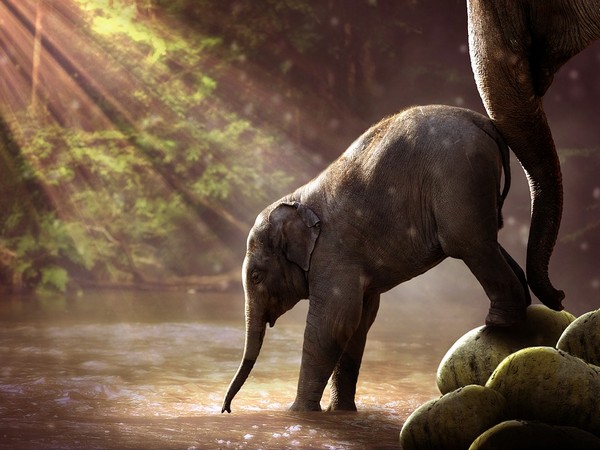
Representative image

Washington D.C. [USA], Aug 3 (ANI): Forest elephants engineer the ecosystem of the entire central African forest, but their catastrophic decline toward extinction has catastrophic implications for carbon policy.
One of the last remaining megaherbivores, forest elephants shape their environment by serving as seed dispersers and forest bulldozers as they eat over a hundred species of fruit, trample bushes, knock over trees and create trails and clearings. Their ecological impact also affects tree populations and carbon levels in the forest, researchers report, with significant implications for climate and conservation policies.
In a paper published in the journal of 'Nature Geoscience,' researchers found that elephant populations in central African forests encourage the growth of slow-growing trees with the high wood density that sequesters more carbon from the atmosphere than fast-growing species which are the preferred foods of elephants.
As forest elephants preferentially browse on the fast-growing species, they cause high levels of damage and mortality to these species compared to the slow-growing, high wood density species. The collapse of forest elephant populations will likely, therefore, causes an increase in the abundance of fast-growing tree species at the expense of slow-growing species, and reduce the ability of the forest to capture carbon.
Stephen Blake, one of the researchers of the study, spent 17 years in central Africa doing, among other things, applied for research and conservation work with elephants. While there, he collected a data set on forest structure and species composition in the Nouabale-Ndoki Forest of northern Congo.
In the current study, Blake's collaborators developed a mathematical computer model to answer the question 'What would happen to the composition of the forest over time with and without elephant browsing?'
To find out, they simulated elephant damage through browsing in the forest and assumed they browse certain plant species at different rates. Elephants prefer fast-growing species in more open spaces. As they feed and browse, they cause damage, knocking off a limb or breaking a shrub. The model calculated feeding and breakage rates along with elephant mortality rates to see their effect on certain woody plants.
"Lo and behold, as we look at numbers of elephants in a forest and we look at the composition of forest over time, we find that the proportion of trees with high-density wood is higher in forests with elephants," Blake said.
"The simulation found that the slow-growing plant species survive better when elephants are present. These species aren't eaten by elephants and, over time, the forest becomes dominated by these slow-growing species. Wood (lignin) has a carbon backbone, meaning it has a large number of carbon molecules in it. Slow growing high wood density species contain more carbon molecules per unit volume than fast-growing low wood density species. As the elephants "thin" the forest, they increase the number of slow-growing trees and the forest is capable of storing more carbon."
These findings suggested far-ranging ecological consequences of past and present extinction. The loss of elephants will seriously reduce the ability of the remaining forest to sequester carbon. Trees and plants use carbon dioxide during photosynthesis, removing it from the atmosphere. For this reason, plants are helpful in combating global warming and serve to store carbon emissions.
Without the forest elephants, less carbon dioxide will be taken out of the atmosphere. In monetary terms, forest elephants represent a carbon storage service of $43 billion.
"The sad reality is that humanity is doing its best to rid the planet of elephants as quickly as it can. Forest elephants are rapidly declining and facing extinction. From a climate perspective, all of their positive effect on carbon and their myriad other ecological roles as forest gardeners and engineers will be lost," Blake concluded. (ANI)

Get the App

What to Read Next

Science

Amphibians bounce-back from Earth’s greatest mass extinction

Amphibians bounce-back from Earth’s greatest mass extinction

Researchers at the University of Bristol discovered that ancient frog ancestors survived the biggest mass extinction of species by eating on freshwater prey that evaded terrestrial predators.

Read More
Science

Microbes help detoxify our atmosphere, says study 

Microbes help detoxify our atmosphere, says study 

Melbourne researchers have uncovered important new information on how microbes absorb huge amounts of carbon monoxide (CO) and assist in reducing levels of this deadly gas.

Read More
Science

Chemists design novel method for generating sustainable fuel

Chemists design novel method for generating sustainable fuel

Tuning this environment by controlling how the CoPc catalyst was distributed on the carbon nanotube surface allowed carbon dioxide to be as much as eight times more likely to produce methanol, a discovery that could increase the efficiency of other catalytic processes and have a widespread impact on other fields, said Robert Baker, co-author of the study and a professor in chemistry and biochemistry at The Ohio State University.

Read More
Science

Climate policies and children's health

Climate policies and  children's health

A recent study suggests that efforts to limit carbon dioxide (CO2) emissions from motor vehicles, along with investments in electric vehicles and public transit, would reduce air pollution and have a significant impact on children's health. They'd also save money.

Read More
Science

Study reveals air pollution hides increases in rainfall

Study reveals air pollution hides increases in rainfall

We know that greenhouse gas emissions, such as carbon dioxide, should increase rainfall. The emissions warm the atmosphere, resulting in a one-two punch: warmer oceans make it easier for water to evaporate, and warmer air can store more water vapour, allowing more moisture to fall as rain. However, for long of the twentieth century, the data did not clearly reveal a rise in precipitation.

Read More
Science

Rising sea levels may lead to more methane emitted from wetlands

Rising sea levels may lead to more methane emitted from wetlands

Global warming is causing sea levels to rise, which is altering ecosystems. Scientists assumed that the tidal wetlands present in estuaries could create less methane, a strong greenhouse gas because the increased influx of seawater renders these habitats less hospitable to methane-producing microorganisms.

Read More
Science

Ice age may help predict oceans’ response to global warming

Ice age may help predict oceans’ response to global warming

A team of scientists led by a Tulane University oceanographer discovered that deposits deep beneath the ocean floor provide a means to estimate ocean oxygen levels and their relationship to carbon dioxide in the Earth's atmosphere during the last ice age, which ended more than 11,000 years ago.

Read More
Science

Climate change threatens global forest carbon sequestration

Climate change threatens global forest carbon sequestration

A new analysis of U.S. Forest Service data shows that climate change is changing forests differently across the country. With increasing temperatures, intensifying droughts, wildfires, and disease outbreaks wreaking havoc on trees, researchers warn that forests in the American West are facing the brunt of the repercussions.

Read More
Science

Study explores origins of life using ancient hot springs

Study explores origins of life using ancient hot springs

Researchers use historic hot springs to investigate the beginnings of life on Earth.

Read More
Science

Lowering inequality is essential in dealing with climate crisis

Lowering inequality is essential in dealing with climate crisis

Researchers argue in a new analysis published in the journal Nature Climate Change that reducing inequality is critical in getting the world towards Net-Zero because inequality limits who can afford to adopt low-carbon habits.

Read More
Home About Us Our Products Advertise Contact Us Terms & Condition Privacy Policy

Copyright © aninews.in | All Rights Reserved.




