

ADD ANI AS A TRUSTED SOURCE
googleads
ANI Logo
Menu
Science

Cosmic ring of fire: Astronomers see super-rare type of galaxy

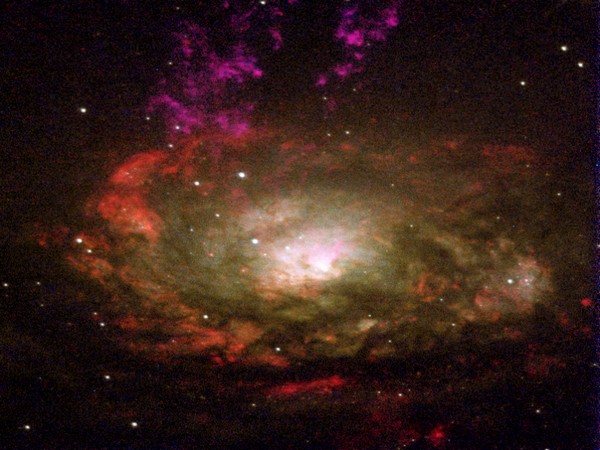
Washington D.C. [USA], May 26 (ANI): A team of astronomers has captured an image of a rare type of galaxy, which is described as a "cosmic ring of fire" - as it existed 11 billion years ago.

ANI May 26, 2020 17:33 IST googleads

Representative Image

Washington D.C. [USA], May 26 (ANI): A team of astronomers has captured an image of a rare type of galaxy, which is described as a "cosmic ring of fire" - as it existed 11 billion years ago.
The galaxy, which has roughly the mass of the Milky Way, is circular with a hole in the middle, rather like a titanic doughnut.
The research was published in the journal Nature Astronomy and is set to shake up theories about the earliest formation of galactic structures and how they evolve.
"It is a very curious object that we've never seen before. It looks strange and familiar at the same time," said lead researcher Dr Tiantian Yuan from Australia's ARC Centre of Excellence for All Sky Astrophysics in 3 Dimensions (ASTRO 3D).
The galaxy, named R5519, is 11 billion light-years from the Solar System. The hole at its centre is truly massive, with a diameter two billion times longer than the distance between the Earth and the Sun.
To put it another way, it is three million times bigger than the diameter of the supermassive black hole in the galaxy Messier 87, which in 2019 became the first ever to be directly imaged.
"It is making stars at a rate 50 times greater than the Milky Way," said Dr Yuan, who is an ASTRO 3D Fellow based at the Centre for Astrophysics and Supercomputing at Swinburne University of Technology, in the state of Victoria.
"Most of that activity is taking place on its ring - so it truly is a ring of fire," Dr Yuan added.
Working with colleagues from around Australia, US, Canada, Belgium, and Denmark, Dr Yuan used spectroscopic data gathered by the WM Keck Observatory in Hawaii and images recorded by NASA's Hubble Space Telescope to identify the unusual structure.
The evidence suggests it is a type known as a "collisional ring galaxy," making it the first one ever located in the early Universe.
There are two kinds of ring galaxies. The more common type forms because of internal processes. Collisional ones form - as the name suggests - as a result of immense and violent encounters with other galaxies.
In the nearby "local" Universe they are 1000 times rarer than the internally created type. Images of the much more distant R5519 stem from about 10.8 billion years ago, just three billion years after the Big Bang. They indicate that collisional ring galaxies have always been extremely uncommon.
ASTRO 3D co-author, Dr Ahmed Elagali, based at the International Centre for Radio Astronomy Research in Western Australia, said studying R5519 would help determine when spiral galaxies began to develop.
"Further, constraining the number density of ring galaxies through cosmic time can also be used to put constraints on the assembly and evolution of local-like galaxy groups," he added.
Another co-author, Professor Kenneth Freeman from the Australian National University, said the discovery had implications for understanding how galaxies like the Milky Way formed.
"The collisional formation of ring galaxies requires a thin disk to be present in the 'victim' galaxy before the collision occurs," he explained.
"The thin disk is the defining component of spiral galaxies: before it assembled, the galaxies were in a disorderly state, not yet recognisable as spiral galaxies. In the case of this ring galaxy, we are looking back into the early universe by 11 billion years, into a time when thin disks were only just assembling," Freeman noted.
He added: "For comparison, the thin disk of our Milky Way began to come together only about nine billion years ago. This discovery is an indication that disk assembly in spiral galaxies occurred over a more extended period than previously thought."
Drs Yuan and Elagali, and Professor Freeman, worked with colleagues from the University of New South Wales, Macquarie University, and the University of Queensland, all in Australia, together with others at the Cosmic Dawn Centre (DAWN) in Denmark, Texas A&M University in the US, York University in Canada, and Ghent University in Belgium. (ANI)


Get the App

What to Read Next

Science

Amphibians bounce-back from Earth’s greatest mass extinction

Amphibians bounce-back from Earth’s greatest mass extinction

Researchers at the University of Bristol discovered that ancient frog ancestors survived the biggest mass extinction of species by eating on freshwater prey that evaded terrestrial predators.

Read More
Science

New insights into how cancer evades the immune system: Study

New insights into how cancer evades the immune system: Study

Immunotherapy research primarily focuses on better recognition of cancer cells by the body's own immune system. Researchers at Amsterdam UMC and Moffitt Cancer Center have taken a different approach.

Read More
Science

Scientists use AI to better understand nanoparticles: Study

Scientists use AI to better understand nanoparticles: Study

A group of scientists has created a way to illuminate the dynamic behavior of nanoparticles, which are essential components in the production of pharmaceuticals, electronics, and industrial and energy-conversion materials.

Read More
Science

New device could allow you to taste cake in virtual reality

New device could allow you to taste cake in virtual reality

The 'e-Taste' interface employs sensors and wireless chemical dispensers to enable remote taste perception, often known as gestation. Field testing done by researchers at The Ohio State University confirmed the device's ability to digitally simulate a range of taste intensities, while still offering variety and safety for the user.

Read More
Science

Strand Life Sciences launches portal for rare disease diagnosis

Strand Life Sciences launches portal for rare disease diagnosis

Marking Rare Disease Day, Strand Life Sciences, a subsidiary of Reliance Industries and a leading genomics research company, has launched the StrandOmics Portal, an innovative digital platform designed to assist doctors in diagnosing rare diseases more efficiently.

Read More
Science

Study reveals impact of animals as architects of Earth

Study reveals impact of animals as architects of Earth

A new study led by Professor Gemma Harvey from Queen Mary University of London has revealed how hundreds of species shape the landscapes we depend on, from termite mounds visible from space to beavers creating wetlands and hippos carving drainage systems.

Read More
Science

Opposing arrows of time emerge from certain quantum systems

Opposing arrows of time emerge from certain quantum systems

Researchers at the University of Surrey made a thought-provoking discovery. A new study reveals that opposing arrows of time can theoretically emerge from certain quantum systems.

Read More
Science

'Creation of black holes without singularities through gravity'

'Creation of black holes without singularities through gravity'

Traditional black holes, as predicted by Albert Einstein's theory of General Relativity, contain what are known as singularities, i.e. points where the laws of physics break down. Identifying how singularities are resolved in the context of quantum gravity is one of the fundamental problems in theoretical physics. Now, a team of experts has described the creation of regular black holes from gravitational effects without the need for the existence of exotic matter required by some previous models.

Read More
Science

New technology enhances gravitational-wave detection: Study

New technology enhances gravitational-wave detection: Study

A team of physicists led by Jonathan Richardson of the University of California, Riverside, demonstrated how new optical technology can extend the detection range of gravitational-wave observatories such as the Laser Interferometer Gravitational-Wave Observatory, or LIGO, and pave the way for future observatories.

Read More
Science

Discovering the genetics of climate adaptation 

Discovering the genetics of climate adaptation 

As climate change accelerates, plants are under increasing pressure to adapt to changing habitats and environmental conditions.

Read More
Home About Us Our Products Advertise Contact Us Terms & Condition Privacy Policy

Copyright © aninews.in | All Rights Reserved.
