

ADD ANI AS A TRUSTED SOURCE
googleads
ANI Logo
Menu
Science

Butterflies might lose spots as climate warms: Research

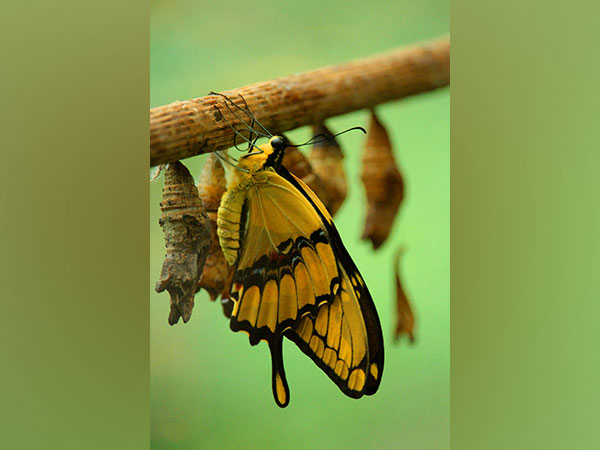
According to new research, female Meadow Brown butterflies have less spots when they grow up in warmer conditions, thus climate change may reduce their spottiness.

ANI Jan 18, 2024 16:18 IST googleads

Representative Image

Washington DC [US], January 18 (ANI): According to new research, female Meadow Brown butterflies have less spots when they grow up in warmer conditions, thus climate change may reduce their spottiness.
University of Exeter scientists found females that developed at 11°C had six spots on average, while those developing 15°C had just three.
The findings challenge long-held scientific views about why these butterflies have varying numbers of spots.
"Meadow Browns always have large 'eyespots' on their forewings, probably for startling predators," said Professor Richard ffrench-Constant, from the Centre for Ecology and Conservation on Exeter's Penryn Campus in Cornwall.
"They also have smaller spots on their hindwings, probably useful for camouflage when the butterfly is at rest.
"Our findings show that fewer of these hindwing spots appear when females experience higher temperatures during their pupal stage (in a chrysalis before emerging as a butterfly).
"This suggests the butterflies adapt their camouflage based on the conditions. For example, with fewer spots they may be harder to spot on dry, brown grass that would be more common in hot weather.
"We did not observe such a strong effect in males, possibly because their spots are important for sexual selection (attracting females)."
Since the classic work of biologist EB Ford, eyespot variation in the Meadow Brown butterfly has been used as an example of "genetic polymorphism" (the co-existence of multiple genetic forms in a single population).
However, the new study shows the eyespot variation is caused by thermal plasticity (the ability to react to changing temperatures).
"This is a family story for me, as my father collected butterflies for EB Ford here in Cornwall," Professor ffrench-Constant said.
"In the new study, we looked at current Cornish populations - collecting males and females from the same field every day throughout the flight season - and historical collections from Eton and Buckingham."
The researchers predict that spotting will decrease year on year as our climate warms.
Professor ffrench-Constant added: "This is an unexpected consequence of climate change. We tend to think about species moving north, rather than changing appearance."
Meadow Browns spend about 28 days in the pupal stage, usually emerging in late spring in the UK.
The paper, published in the journal Ecology and Evolution, is entitled: "Eyespot variation and field temperature in the Meadow Brown butterfly." (ANI)


Get the App

What to Read Next

Science

Discovering the genetics of climate adaptation 

Discovering the genetics of climate adaptation 

As climate change accelerates, plants are under increasing pressure to adapt to changing habitats and environmental conditions.

Read More
Science

Weather change linked to heightened risk of Salmonella outbreaks

Weather change linked to heightened risk of Salmonella outbreaks

According to new research from the University of Surrey, climate change has an impact on Salmonella spread. This study builds on prior work by the researchers, which discovered that weather change is contributing to the spread of deadly diarrhoeal illnesses.

Read More
Science

Researchers discover molecular mechanism for bacterial infection

Researchers discover molecular mechanism for bacterial infection

Researchers at Virginia Tech have discovered how bacteria change molecules in order to infect their host.

Read More
Science

Contrail avoidance is less likely to damage climate by mistake

Contrail avoidance is less likely to damage climate by mistake

A new study allays concerns that rerouting planes to avoid producing climate-warming contrails may accidentally exacerbate climate change.

Read More
Science

Memory problems in old age may be linked to key enzyme: Study

Memory problems in old age may be linked to key enzyme: Study

Everyone experiences occasional episodes of forgetfulness, particularly as they age. It's not only that fresh material is hard for older folks to remember. Moreover, when new information becomes available, they find it more difficult to change those thoughts. Nevertheless, not much is understood about the processes that underlie memory updating and how they malfunction as we age.

Read More
Science

Study finds how genetic diagnostics of ultra-rare diseases

Study finds how genetic diagnostics of ultra-rare diseases

Most rare diseases are caused by genetics. A molecular genetic diagnosis can be made more quickly and readily by identifying the underlying genetic change, for instance by exome sequencing (ES). The analysis of every region of our DNA that codes for a protein is known as ES.

Read More
Science

Study finds biodiversity is key to better mental health

Study finds biodiversity is key to better mental health

A study by King's College London found that spaces with a variety of natural features are associated with better mental health than spaces with less natural diversity.

Read More
Science

Researchers discover new approach against follicular lymphoma

Researchers discover new approach against follicular lymphoma

Important factors that cause follicular lymphoma, a type of blood cancer, to change from its slow-growing form to the aggressive form it takes in some people have been found by a team of researchers at Weill Cornell Medicine.

Read More
Science

Climate change disrupts vital ecosystems in Alps: Study

Climate change disrupts vital ecosystems in Alps: Study

Reduced snow cover and altering vegetation patterns in the Alps, both caused by climate change, are having significant combined effects on biodiversity and ecosystem functioning in the high mountains, according to a new study.

Read More
Science

Climate policies and children's health

Climate policies and  children's health

A recent study suggests that efforts to limit carbon dioxide (CO2) emissions from motor vehicles, along with investments in electric vehicles and public transit, would reduce air pollution and have a significant impact on children's health. They'd also save money.

Read More
Home About Us Our Products Advertise Contact Us Terms & Condition Privacy Policy

Copyright © aninews.in | All Rights Reserved.


