 हिंदी खबर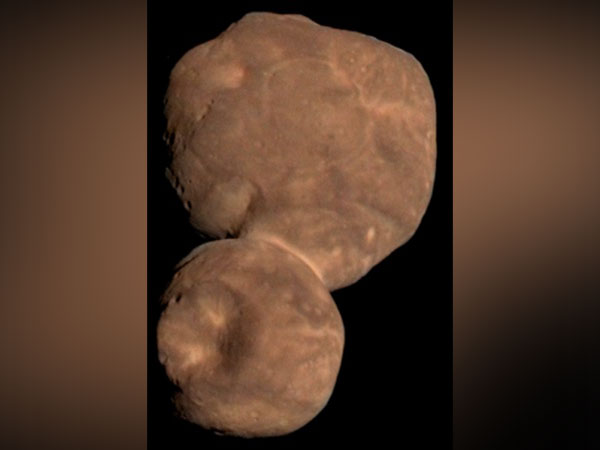

Haifa [Israel], April 23 (ANI): New research by a team of astronomers shed new light on the formation of Kuiper Belt objects, asteroid-like objects at the edge of the solar system, and for understanding the early stages of the solar system's formation.
A model developed at the Faculty of Physics at the Technion, Institute of Technology, in collaboration with German scientists at Tubingen, explains the unique properties of Arrokoth -- the most distant object ever imaged in the solar system.
The researchers' findings published in the journal- Nature - explain the unique characteristics of 'the Snowman,' known formally as Arrokoth. It is the farthest imaged object in the system, and pictures of it were first taken last year by the New Horizons space mission.
The story begins in 2006 when the New Horizons robotic spacecraft was sent to take, for the first time, a close look at the last planet in the solar system, Pluto, which had not yet been seen up close, and to study its features and terrain.
After launch, New Horizons fixed its trajectory toward Pluto, starting a long journey that would last about 9 years. In order not to waste fuel and resources, most of its systems were put to 'sleep' until it was close to its target, Pluto.
Meanwhile, back on Earth, the international astronomical union decided in to demote Pluto from its status as a planet to a dwarf planet. In short, the New Horizons robotic spacecraft was sent to investigate a planet, fell asleep, and awoke to discover that Pluto was no longer considered a planet.
But this does not detract from the importance of the mission. New Horizons provided spectacular images of Pluto and its moon Charon, and provided invaluable scientific information that is now still being investigated, and will likely be studied for years.
These studies will provide important input for understanding the formation of the solar system, and in particular the Kuiper Belt.
But there is still more to the New Horizons adventure. While Pluto is the largest object at the far ends of the solar system, it is not the only one.
Beyond Neptune, in a region called the Kuiper Belt, there are numerous asteroid-like objects ranging in size from a few feet to thousands-of-miles-big objects.
The conditions in this area are different (and in particular much colder), than its 'sister' asteroid belt in the inner regions of the solar system, and Kuiper Belt objects typically consist of much more icy materials.
Even before its arrival at Pluto, it was planned that the New Horizon spacecraft would still have enough resources left so that it could closely watch another Kuiper Belt object if such an object could be found that was not too far from the spacecraft's original trajectory.
On June 26, 2014, after an extensive survey in search of such objects, one was identified by the Hubble Space Telescope. Following that identification, the New Horizons research team designed the spacecraft's trajectory so that it would pass next to the newly found object after completing its mission in mapping Pluto.
Five years later (and four after its encounter with Pluto in 2015), New Horizons passed by the object. On January 1, 2019, humanity won its first close-up shot of a small Kuiper Belt object, thanks to the New Horizons spacecraft passing just 3,500 miles away.
Immediately after the arrival of its first images, the Kuiper Belt object (hitherto known as 2014 MU69) was nicknamed 'the Snowman,' because of its unique appearance (see photo).
New Horizons researchers initially called it Ultima Thule ('The Edge of the World' in Latin), because of its remote location at the edge of the solar system). But the object eventually earned its professional name: 486958 Arrokoth, for 'sky' or 'cloud' in the (now extinct) Powhatan native-American language.
New Horizons photos and gathered information provided the scientific community with a wealth of information about the Snowman: it is a 30-kilometer contact binary that consists of two different sized lobes interconnected with a thin neck (see photo), which appears to be the product of two smaller Kuiper Belt objects that collided to form Arrokoth.
Although various models have been proposed to explain the formation of Arrokoth and its peculiar properties, these encountered major challenges and could not well explain important features of the Snowman, in particular its slow rotation speed around itself and its large inclination angle.
In their Nature article, the Technion researchers present novel analytic calculations and detailed simulations explaining Arrokoth's formation and features.
The research was led by Ph.D. student Evgeni Grishin, postdoc Dr. Uri Malamud, and their supervisor Professor Hagai Perets, in collaboration with the German research group in Tubingen.
"Simple high-speed collision between two random objects in the Kuiper Belt would shatter them, as they are likely to predominantly be made of soft ice. If the two bodies orbited each other on a circular orbit (similar to the Moon orbiting the Earth), and then slowly in-spiraled to more gently approach each other and make contact, Arrokoth's rotation speed would have been extremely high, while the measured speed was actually quite low in respect to such expectations," said Grishin.
"Arrokoth's full rotation, 'a day,' takes 15.92 hours. In addition, its angle of inclination (relative to the plane of its orbit around the Sun) is very large -- 98 degrees -- so it almost lies on the side relative to its orbit, a peculiar feature in itself." Grishin added.
"According to our model, these two bodies revolve around each other, but because they revolve together around the Sun, they basically constitute a triple system," he continued.
"The dynamics of such triple systems are complex and notoriously known as the three-body problem. The dynamics of gravitating triple systems is known to be very chaotic. In our study, we showed that the system did not move in a simple and orderly manner, but also did not behave in a totally chaotic way," he said.
"It evolved from having a wide, relatively circular orbit, into a highly eccentric, elliptic orbit through a slow (secular) evolution, much slower compared to the orbital period of Arrokoth around the Sun." said Prof. Perets.
"We could show that such trajectories eventually lead to a collision, which on the one hand will be slow, and not smash the objects, but on the other hand, produce a slowly rotating, highly inclined object, consistent with Arrokoth properties," Perets added.
"Our detailed simulations confirmed this picture, and produced models closely resembling Arrokoth's snowman appearance, rotation and inclination," said Dr. Malamud.
The researchers also studied how robust and probable such processes are, and found them to potentially be quite common with as many as 20% of all Kuiper Belt wide binaries, and potentially evolving in similar ways.
Until now, said the researchers, it was not possible to explain the unique features of Arrokoth. It is a counterintuitive result, but the likelihood of collision in such configurations actually increases as the initial binary is more widely separated (but still bound) and the initial tilt angle is closer to 90 degrees.
"Our model explains both the high likelihood of collision as well as the unique data of the unified system today, and in fact predict that many more objects in the Kuiper Belt," said Mr. Grishin.
"In fact, even Pluto's and Charon's system might have formed through a similar process, and they appear to play an important role in the evolution of binary and moon systems in the solar system," Grishin added. (ANI)




