

ADD ANI AS A TRUSTED SOURCE
googleads
ANI Logo
Menu
Science

Biodiversity of bee population critical for ecosystems: Research

Rutgers has conducted the first study showing how many more species of bees are needed to maintain crop yields when a longer-term time frame is considered.

ANI Jan 02, 2023 19:51 IST googleads

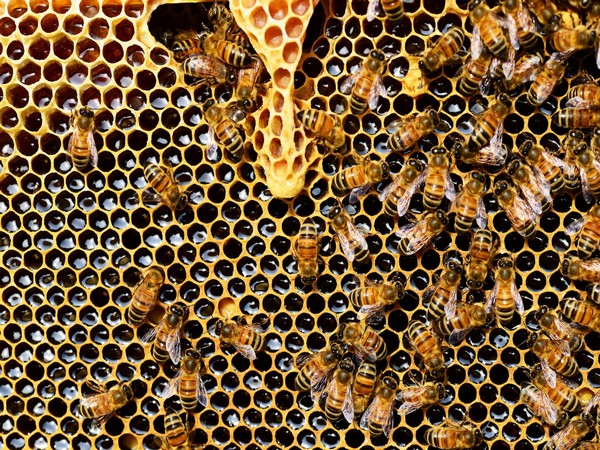
Representative Image

New York [US], January 2 (ANI): In the first study of its kind, Rutgers determined how many more species of bees are required over the long term to maintain crop production.
Scientists said in a report just published in the journal Nature Ecology & Evolution that the biodiversity of the bee population is essential to preserving the ecosystem function of crop pollination, which is crucial to the availability of food for humans.
"We found that biodiversity plays a key role in the stability of ecosystems over time," said Natalie Lemanski, lead author on the study and a postdoctoral researcher in the Department of Ecology, Evolution and Natural Resources at the Rutgers School of Environmental and Biological Sciences (SEBS). "You do actually need more bee species in order to get stable pollination services over a growing season and over years."
The team on the study focused on various populations of bees at dozens of farms in New Jersey, Pennsylvania and California and found that many more bee species were not only needed for pollination than expected over an entire flowering season but even more were needed over multiple years.
The researchers said they discovered different bee species pollinated the same types of plants at different times of the year. They also found that different bee species were the dominant pollinators on the same kind of plants in different years. Because of natural fluctuations in bee populations, researchers said, all bee species present were needed to maintain a minimum threshold of pollination during lean years.
"This research shows that abundance [of a species] matters, but bee diversity matters even more," said Michelle Elekonich, the deputy division director of the National Science Foundation's Directorate for Biological Sciences, which funded the study. "It's not the same bees that are abundant at a given point in time, and variety is necessary to provide balance during a growing season - and from year to year."
Lemanski said the study offers substantiation to long-standing concept ecologists refer to as the "insurance hypothesis." The idea is that ecosystems probably benefit when nature "diversifies the portfolio," supporting multiple species of a category of a plant or animal, rather than relying on one dominant species.
"We found that two to three times as many bee species were needed to meet a target level of crop pollination over the course of a growing season compared to a single date," Lemanski said. "Similarly, twice as many species were needed to provide pollination over the course of six years compared to a single year."
The researchers based their analysis on their own extensive observations of bee visits to flowers and measurements of the number of pollen grains deposited on individual flowers over weeks and months within a given calendar year and then over multiple years. They collected the data, with permission of farmers, at 16 blueberry farms in South Jersey, at 25 watermelon farms in Central Jersey and eastern Pennsylvania and at 36 watermelon farms in the Northern Central Valley of California.
"The magnitude of increase in species needed over multiple years was remarkably consistent among crop systems when considered over the same interval of time," Lemanski said. "In addition, the fact that the relationship between timescale and the number of species needed did not level off suggests that even longer time series, spanning multiple seasons, may further bolster the need for biodiversity to ensure reliable ecosystem service." (ANI)


Get the App

What to Read Next

Science

New method guides magnetism without magnets

New method guides magnetism without magnets

Researchers at Paul Scherrer Institute PSI have demonstrated an innovative method to control magnetism in materials using an energy-efficient electric field.

Read More
Science

Amphibians bounce-back from Earth’s greatest mass extinction

Amphibians bounce-back from Earth’s greatest mass extinction

Researchers at the University of Bristol discovered that ancient frog ancestors survived the biggest mass extinction of species by eating on freshwater prey that evaded terrestrial predators.

Read More
Science

New insights into how cancer evades the immune system: Study

New insights into how cancer evades the immune system: Study

Immunotherapy research primarily focuses on better recognition of cancer cells by the body's own immune system. Researchers at Amsterdam UMC and Moffitt Cancer Center have taken a different approach.

Read More
Science

Scientists use AI to better understand nanoparticles: Study

Scientists use AI to better understand nanoparticles: Study

A group of scientists has created a way to illuminate the dynamic behavior of nanoparticles, which are essential components in the production of pharmaceuticals, electronics, and industrial and energy-conversion materials.

Read More
Science

New device could allow you to taste cake in virtual reality

New device could allow you to taste cake in virtual reality

The 'e-Taste' interface employs sensors and wireless chemical dispensers to enable remote taste perception, often known as gestation. Field testing done by researchers at The Ohio State University confirmed the device's ability to digitally simulate a range of taste intensities, while still offering variety and safety for the user.

Read More
Science

Strand Life Sciences launches portal for rare disease diagnosis

Strand Life Sciences launches portal for rare disease diagnosis

Marking Rare Disease Day, Strand Life Sciences, a subsidiary of Reliance Industries and a leading genomics research company, has launched the StrandOmics Portal, an innovative digital platform designed to assist doctors in diagnosing rare diseases more efficiently.

Read More
Science

Study reveals impact of animals as architects of Earth

Study reveals impact of animals as architects of Earth

A new study led by Professor Gemma Harvey from Queen Mary University of London has revealed how hundreds of species shape the landscapes we depend on, from termite mounds visible from space to beavers creating wetlands and hippos carving drainage systems.

Read More
Science

Opposing arrows of time emerge from certain quantum systems

Opposing arrows of time emerge from certain quantum systems

Researchers at the University of Surrey made a thought-provoking discovery. A new study reveals that opposing arrows of time can theoretically emerge from certain quantum systems.

Read More
Science

COVID-19 severity may be predicted by White Blood Cell Count

COVID-19 severity may be predicted by White Blood Cell Count

A COVID-19 diagnosis is no longer as frightening as it used to be, thanks to developments in treatment choices. However, a new study reveals that leukocyte (white blood cell) count may now be used to identify who is more likely to develop more significant disease symptoms.

Read More
Science

Seals can essentially act as 'smart sensors': Study

Seals can essentially act as 'smart sensors': Study

A new study by marine biologists reports that seals can essentially act as 'smart sensors' for monitoring fish populations in the ocean's eerily dim 'twilight zone.'

Read More
Home About Us Our Products Advertise Contact Us Terms & Condition Privacy Policy

Copyright © aninews.in | All Rights Reserved.


