Astronomers spot far-away planet that could possibly support life
Cambridge [England], Feb 27 (ANI): Astronomers have found an exoplanet more than twice the size of Earth which could be potentially habitable. This discovery might take us a step closer to search for life on planets significantly larger than Earth but smaller than Neptune.
ANI
Feb 27, 2020 12:25 IST

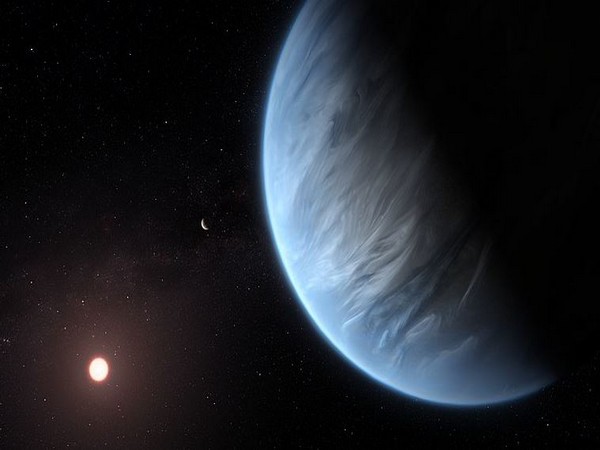
Cambridge [England], Feb 27 (ANI): Astronomers have found an exoplanet more than twice the size of Earth which could be potentially habitable. This discovery might take us a step closer to search for life on planets significantly larger than Earth but smaller than Neptune.
A team from the University of Cambridge used the mass, radius, and atmospheric data of the exoplanet K2-18b and determined that the planet can host liquid water at habitable conditions beneath its hydrogen-rich atmosphere. The results were reported in The Astrophysical Journal Letters.
The exoplanet K2-18b, which is 124 light-years away, is 2.6 times the radius and 8.6 times the mass of Earth and orbits its star within the habitable zone, where temperatures could allow liquid water to exist.
The planet was the subject of significant media coverage in the autumn of 2019, as two different teams reported the detection of water vapour in its hydrogen-rich atmosphere. However, the extent of the atmosphere and the conditions of the interior underneath remained unknown.
"Water vapour has been detected in the atmospheres of a number of exoplanets but, even if the planet is in the habitable zone, that doesn't necessarily mean there are habitable conditions on the surface," said Dr Nikku Madhusudhan from Cambridge's Institute of Astronomy, who led the new research.
"To establish the prospects for habitability, it is important to obtain a unified understanding of the interior and atmospheric conditions on the planet - in particular, whether liquid water can exist beneath the atmosphere," Madhusudhan added.
Given the large size of K2-18b, it has been suggested that it would be more like a smaller version of Neptune than a larger version of Earth. A 'mini-Neptune' is expected to have a significant hydrogen 'envelope' surrounding a layer of high-pressure water, with an inner core of rock and iron.
If the hydrogen envelope is too thick, the temperature and pressure at the surface of the water layer beneath would be far too great to support life.
Now, Madhusudhan and his team have shown that despite the size of K2-18b, its hydrogen envelope is not necessarily too thick and the water layer could have the right conditions to support life.
They used the existing observations of the atmosphere, as well as the mass and radius, to determine the composition and structure of both the atmosphere and interior by utilising detailed numerical models and statistical methods.
The researchers confirmed the atmosphere to be hydrogen-rich with a significant amount of water vapour. They also found that levels of other chemicals such as methane and ammonia were lower than expected for such an atmosphere. Whether these levels can be attributed to biological processes remains unknown.
The team then used the atmospheric properties as boundary conditions for models of the planetary interior. They explored a wide range of models that could explain the atmospheric properties as well as the mass and radius of the planet. This allowed them to obtain the range of possible conditions in the interior, including the extent of the hydrogen envelope and the temperatures and pressures in the water layer.
"We wanted to know the thickness of the hydrogen envelope - how deep the hydrogen goes," said co-author Matthew Nixon, a PhD student at the Institute of Astronomy.
The researchers found that the maximum extent of the hydrogen envelope allowed by the data is around 6% of the planet's mass, though most of the solutions require much less. The minimum amount of hydrogen is about one-millionth by mass, similar to the mass fraction of the Earth's atmosphere. In particular, a number of scenarios allow for an ocean world, with liquid water below the atmosphere at pressures and temperatures similar to those found in Earth's oceans. (ANI)
Get the App