 हिंदी खबर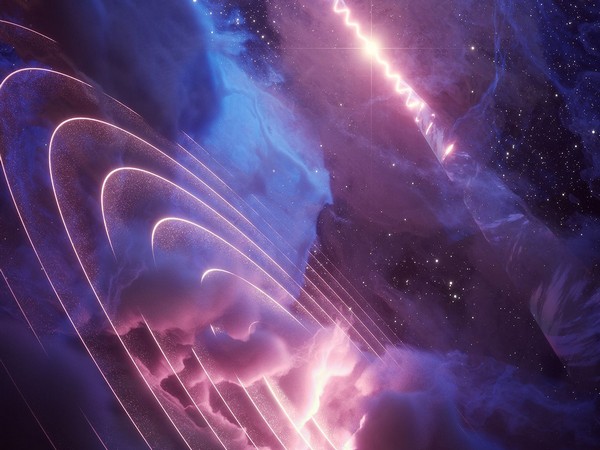

Florida [USA], August 17 (ANI): An international team of researchers using data from Arecibo Observatory and the Fermi Space Telescope have discovered what they call a "gamma-ray heartbeat" coming from a cosmic gas cloud.
The cloud is in the constellation Aquilla and "beats" in rhythm with a black hole 100 light-years away in a microquasar system known as SS 433. The results were published today in the journal Nature Astronomy.
"This result challenges obvious interpretations and is unexpected from previously published theoretical models," said Jian Li, a Humboldt Fellow with the Deutsches Elektronen-Synchrotron in Zeuthen, Germany, and study co-author.
"It provides us with a chance to unveil the particle transport from SS 433 and to probe the structure of the magnetic field in its vicinity," added Li.
In the SS 433 system, a black hole orbits a giant star, 30 times the mass of Earth's sun. The black hole sucks matter from the giant star while orbiting it, forming a swirling accretion disc that drains into the black hole, like water into a bathtub drain.
Some of the matter doesn't fall into the hole though but rather jets out in high-speed spirals from the disc's center in both directions, top, and bottom, like pegs on a wheel.
The researchers made the discovery by analyzing more than a decade of data from NASA's Fermi Large Area Space Telescope and from Galactic ALFA HI survey data collected with the Arecibo Observatory's 1,000-foot-wide radio telescope.
The observatory was recently damaged and is currently offline, but scientists continue to have access to data previously collected. Engineers are assessing what caused a cable to break and plans for repairs.
The researchers found that the precession, or wobble, of the black hole's jets, matched with a gamma-ray signal emitted from a gas cloud. The researchers have labeled the position in the gas cloud Fermi J1913+0515. The position was revealed using Arecibo Observatory's telescope, and Fermi provided data about the SS 433 system.
"The consistent periods indicate the gas cloud's emission is powered by the microquasar," Li said.
Scientists still do not fully know how the jets overcome the black hole's pull and are emitted from the disc, and the current study presents a new question -- How does the black hole power the gas cloud's heartbeat?
The study's researchers say further observations and theoretical work are needed, but one suggestion is that the cloud's gamma-ray emissions are caused by the injection of the nuclei of hydrogen atoms, known as fast protons, that are produced at the end of the jets, or near the black hole.
"SS 433 continues to amaze observers at all frequencies and theoreticians alike. And it is certain to provide a testbed for our ideas on cosmic-ray production and propagation near microquasars for years to come," Li said. (ANI)


