

ADD ANI AS A TRUSTED SOURCE
googleads
ANI Logo
Menu
Science

Animals fake death for long periods to escape predators: Study

Bristol [England], March 3 (ANI): A recent study by researchers from the University of Bristol has found that many animals fake death to try to escape their predators. with some individuals in prey species remaining motionless, if in danger, for extended lengths of time.

ANI Mar 03, 2021 10:34 IST googleads

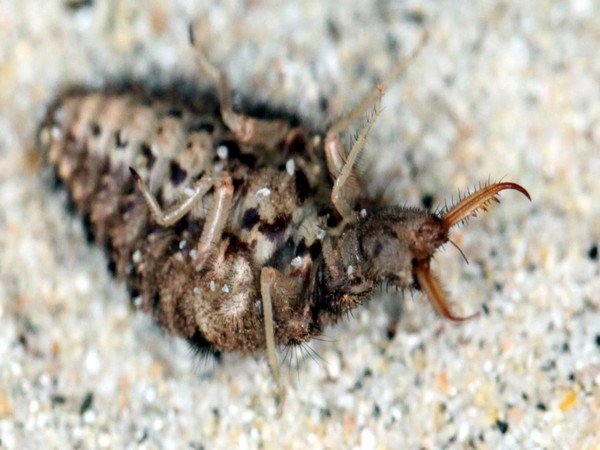
European antlion (Euroleon nostras) on its dorsal side playing dead (Image courtesy: Nigel R. Franks)

Bristol [England], March 3 (ANI): A recent study by researchers from the University of Bristol has found that many animals fake death to try to escape their predators. with some individuals in prey species remaining motionless, if in danger, for extended lengths of time.
The study was published today in the science journal Biology Letters.
Charles Darwin recorded a beetle that remained stationary for 23 minutes - however, the University of Bristol has documented individual antlion larvae pretending to be dead for an astonishing 61 minutes.
Of equal importance, the amount of time that an individual remains motionless is not only long but unpredictable. This means that a predator will be unable to predict when a potential prey item will move again, attract attention, and become a meal.
Predators are hungry and cannot wait indefinitely. Similarly, prey may be losing opportunities to get on with their lives if they remain motionless for too long. Thus, death-feigning might best be thought of as part of a deadly game of hiding and seek in which prey might gain most by feigning death if alternative victims are readily available.
The study involved evaluating the benefits of death-feigning in terms of a predator visiting small populations of conspicuous prey. Researchers used computer simulations that utilise the marginal value theorem, a classical model in optimization.
The lead author of the paper Professor Nigel R. Franks from the University of Bristol's School of Biological Sciences said: "Imagine you are in a garden full of identical soft fruit bushes. You go to the first bush. Initially collecting and consuming fruit is fast and easy, but as you strip the bush finding more fruit gets harder and harder and more time-consuming.
"At some stage, you should decide to go to another bush and begin again. You are greedy and you want to eat as many fruits as quickly as possible. The marginal value theorem would tell you how long to spend at each bush given that time will also be lost moving to the next bush.
"We use this approach to consider a small bird visiting patches of conspicuous antlion pits and show that antlion larvae that waste some of the predator's time, by 'playing dead' if they are dropped, change the game significantly. In a sense, they encourage the predator to search elsewhere."
The modelling suggests that antlion larvae would not gain significantly if they remained motionless for even longer than they actually do. This suggests that in this arms race between predators and prey, death-feigning has been prolonged to such an extent that it can hardly be bettered.
Professor Franks added: "Thus, playing dead is rather like a conjuring trick. Magicians distract an audience from seeing their sleights of hand by encouraging them to look elsewhere. Just so with the antlion larvae playing dead - the predator looks elsewhere. Playing dead seems to be a very good way to stay alive." (ANI)


Get the App

What to Read Next

Science

New method guides magnetism without magnets

New method guides magnetism without magnets

Researchers at Paul Scherrer Institute PSI have demonstrated an innovative method to control magnetism in materials using an energy-efficient electric field.

Read More
Science

Amphibians bounce-back from Earth’s greatest mass extinction

Amphibians bounce-back from Earth’s greatest mass extinction

Researchers at the University of Bristol discovered that ancient frog ancestors survived the biggest mass extinction of species by eating on freshwater prey that evaded terrestrial predators.

Read More
Science

New insights into how cancer evades the immune system: Study

New insights into how cancer evades the immune system: Study

Immunotherapy research primarily focuses on better recognition of cancer cells by the body's own immune system. Researchers at Amsterdam UMC and Moffitt Cancer Center have taken a different approach.

Read More
Science

Scientists use AI to better understand nanoparticles: Study

Scientists use AI to better understand nanoparticles: Study

A group of scientists has created a way to illuminate the dynamic behavior of nanoparticles, which are essential components in the production of pharmaceuticals, electronics, and industrial and energy-conversion materials.

Read More
Science

New device could allow you to taste cake in virtual reality

New device could allow you to taste cake in virtual reality

The 'e-Taste' interface employs sensors and wireless chemical dispensers to enable remote taste perception, often known as gestation. Field testing done by researchers at The Ohio State University confirmed the device's ability to digitally simulate a range of taste intensities, while still offering variety and safety for the user.

Read More
Science

Study reveals impact of animals as architects of Earth

Study reveals impact of animals as architects of Earth

A new study led by Professor Gemma Harvey from Queen Mary University of London has revealed how hundreds of species shape the landscapes we depend on, from termite mounds visible from space to beavers creating wetlands and hippos carving drainage systems.

Read More
Science

Opposing arrows of time emerge from certain quantum systems

Opposing arrows of time emerge from certain quantum systems

Researchers at the University of Surrey made a thought-provoking discovery. A new study reveals that opposing arrows of time can theoretically emerge from certain quantum systems.

Read More
Science

COVID-19 severity may be predicted by White Blood Cell Count

COVID-19 severity may be predicted by White Blood Cell Count

A COVID-19 diagnosis is no longer as frightening as it used to be, thanks to developments in treatment choices. However, a new study reveals that leukocyte (white blood cell) count may now be used to identify who is more likely to develop more significant disease symptoms.

Read More
Science

Seals can essentially act as 'smart sensors': Study

Seals can essentially act as 'smart sensors': Study

A new study by marine biologists reports that seals can essentially act as 'smart sensors' for monitoring fish populations in the ocean's eerily dim 'twilight zone.'

Read More
Science

New technology enhances gravitational-wave detection: Study

New technology enhances gravitational-wave detection: Study

A team of physicists led by Jonathan Richardson of the University of California, Riverside, demonstrated how new optical technology can extend the detection range of gravitational-wave observatories such as the Laser Interferometer Gravitational-Wave Observatory, or LIGO, and pave the way for future observatories.

Read More
Home About Us Our Products Advertise Contact Us Terms & Condition Privacy Policy

Copyright © aninews.in | All Rights Reserved.


