 हिंदी खबर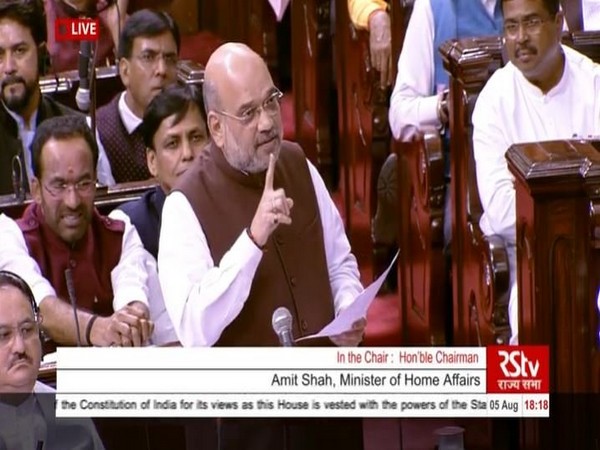

New Delhi [India], Aug 8 (ANI): The abrogation of Article 370, removing the special status of Jammu and Kashmir, has triggered a flurry of reactions with most backing the Centre's move.
Before proceeding to the crux of why this 'special status' has been deleterious for the country, it must be pointed out that radicalisation of Kashmiris is a disparate issue, best dealt with the Vajpayee doctrine of "Insaniyat" (or humanity) combined with no countenance of separatists.
However, the provision empowering the state with 'special' status has always been the elephant in the room.
Jammu & Kashmir has, along with its sensitive topography, appeared like a foreign policy issue, instead of a domestic one due to its status in our Constitution.
There existed an unnecessary chasm between citizens of Kashmir and the rest of India.
It borders on being trite, but nonetheless, sadly, must be reiterated - Article 370 and Article 35-A had to go. Article 370 detailed the relationship Kashmir will share with the rest of the country; Article 35-A granted permanent residents of Kashmir some special rights.
From the get-go, the Constitutional relationship of India with Jammu and Kashmir has been adversely lopsided. India has already ensured the states with the Mizos and the Naga population with constitutional safeguards (special provisions) such as protecting their social practices. India has an assortment of examples where it has performed positive discrimination for groups (Articles 15 and 16) and as mentioned, states.
The problem, to put it succinctly, is that with Kashmir the positive discrimination has tended to be insidious.
Instead of taking a legislative route, Article 35-A was passed through a Presidential order. It subverted the law-making powers of the legislature, granted by the Constitution.
They cannot amend the Constitution. Even an ordinance, which this was most decidedly not, has to be passed by Parliament.
The order, passed in 1954 by the President, was due to fulfilling Article 370 (1) (d). Article 370 itself was supposed to be temporary; the first word of the Article is temporary.
It sat under Part XXI which is titled "Temporary, Transitional and Special Provisions".
The state of J&K itself has done phenomenally well on its indicators as an Indian state should. It has grown by almost 7 per cent last year, ensured a greater number of schools per household and even health and connectivity outcomes have outperformed expectations.
A big reason is that it is also heavily subsidised by the Centre. A study showed that it has received, from 2000-2016, 10 per cent of all Central funds despite having 1 per cent of the population.
It is an economic powerhouse waiting to be unleashed.
"Article 370, very obviously, however, is still an impediment in restricting private or global investment into the state. If Indians (non-Kashmiris) cannot invest in land or property, how can manufacturing firms or multinational corporations? These might have provided jobs to the young people of Kashmir", said the Union Home Minister, Amit Shah, in the Parliament.
It also stopped public institutes such as medical colleges from adequately fulfilling vacancies. Professors could not be hired from outside the state except in extremely low quotas. These and many more issues ensured that unemployment increases, which made the advent of radicalisation, more viable.
Hence, Article 370, the pernicious basis of Article 35-A had to go.
Article 370 itself was gender-neutral, but the way permanent residents were defined in the state constitution based on the notifications issued in April 1927 and June 1932 during the Maharaja's rule -- seemed biased against women.
The 1927 notification included an explanatory note which said: "The wife or a widow of the state subject ... shall acquire the status of her husband as state subject of the same class as her husband, so long as she resides in the state and does not leave the state for permanent residence outside the state." This was widely interpreted as also suggesting that a woman from the state who marries outside the state would lose her status as a state subject. (ANI)
Here's why Articles 370 and 35A were scrapped
ANI | Updated: Aug 08, 2019 15:46 IST


